
Almost every researcher eventually faces the same challenge. A conference submission deadline approaches quickly, yet the manuscript remains unfinished. Sometimes the paper still needs editing. Other times the journal selection process has not even started. Many researchers begin searching for journals that promise publication within a few weeks.
Unfortunately, academic publishing rarely moves that fast.
Many journals require several months to complete peer review, revisions, editorial decisions, and final publication. Even efficient journals cannot guarantee acceptance within a specific timeframe. That does not mean meeting your conference deadline is impossible.
Fast Publications frequently works with researchers who need publication strategies instead of false promises. While no reputable publisher can guarantee immediate publication, several practical steps can significantly reduce unnecessary delays.
This guide explains:
- What can researchers achieve before a conference deadline?
- How long does each publication stage usually take?
- Common mistakes that waste valuable time
- How to maximise your chances of publishing successfully?
Can You Publish Before a Conference Deadline?
The answer depends on one important factor. How much time do you have?
Researchers often underestimate how many stages exist between completing a manuscript and seeing it published.
A journal submission normally includes:
- Final manuscript preparation
- Language editing
- Journal selection
- Technical formatting
- Initial editorial screening
- Peer review
- Author revisions
- Final editorial decision
- Production
- Online publication
Each stage requires time. Skipping one step usually creates bigger delays later. For example, submitting a poorly formatted manuscript may result in an immediate desk rejection. Likewise, language problems often generate revision requests instead of acceptance.
Planning always saves more time than rushing.
A Realistic Publication Timeline
Researchers should build expectations around actual publishing workflows instead of unrealistic advertisements.
The table below illustrates a typical timeline for a well-prepared manuscript.
| Stage | Estimated Time |
| Final manuscript writing | 3 to 7 days |
| Professional editing | 2 to 5 days |
| Journal selection | 1 to 3 days |
| Formatting | 1 to 2 days |
| Initial editorial screening | 1 to 3 weeks |
| Peer review | 4 to 12 weeks |
| Author revisions | 1 to 3 weeks |
| Final decision | 1 to 2 weeks |
| Online publication | 1 to 4 weeks |
Some journals move faster.
Others require considerably longer.
Researchers should investigate average review times before submission.
Start Earlier
The biggest mistake involves waiting until conference registration opens. Researchers often begin writing only after the conference announcement appears. That leaves little room for revisions. Instead, prepare your manuscript several months before the conference deadline.
Early preparation offers several advantages. You have time to improve the manuscript. You can receive feedback from co-authors and select a suitable journal carefully.
Most importantly, unexpected delays become manageable.
Choose the Right Journal First

Many authors write an excellent manuscript but submit it to the wrong journal.
The paper receives an immediate rejection.
Weeks disappear before the author submits elsewhere.
Choosing the correct journal from the beginning saves valuable time.
Researchers should evaluate:
- Journal scope
- Acceptance rate
- Average review time
- Indexing
- Publication model
- Publication frequency
- Author guidelines
A journal selection service can also reduce unnecessary submissions to unsuitable journals, especially when deadlines are tight.
Fast Publications sees one of the most common issues we see involves manuscripts submitted to journals that simply do not match the research topic.
Prepare Your Manuscript Before Submission
A complete manuscript has a much better chance of moving smoothly through editorial screening.
Many researchers focus only on the research findings. However, editors evaluate much more than the results.
Your manuscript should include:
- A clear and informative title
- A structured abstract
- Relevant keywords
- A strong introduction
- A well-defined methodology
- Clear results
- A balanced discussion
- An evidence-based conclusion
- Proper references
- Required declarations
Missing sections often delay the editorial process.
Editors may return the manuscript before sending it for peer review.
Careful preparation saves valuable time.
Do Not Skip Professional Editing
Language quality influences first impressions. Editors review hundreds of manuscripts every year. Poor grammar, unclear sentences, and inconsistent terminology create unnecessary obstacles.
Professional editing cannot guarantee acceptance. However, it helps reviewers focus on your research instead of language problems. Researchers working in English as a second language benefit even more from editorial support.

A professional manuscript editing service improves clarity, consistency, and readability before submission. Similarly, a scientific editing service ensures technical language remains accurate throughout the paper.
At Fast Publications, we encourage authors to complete editing before journal submission rather than after receiving reviewer comments. Early improvements often shorten the revision process.
Select Keywords Carefully
Many researchers treat keywords as an afterthought. That approach reduces discoverability.
Keywords help journals assign suitable reviewers. They also improve indexing after publication. Choose keywords that accurately describe your research. Avoid terms that are too broad.
For example, “medicine” covers thousands of subjects.
Instead, choose more specific phrases such as:
- Diabetes management
- Breast cancer screening
- Qualitative health research
- Artificial intelligence in radiology
Specific keywords improve both visibility and reviewer matching.
Follow the Author Guidelines
Every journal provides detailed submission instructions.
Ignoring those instructions creates unnecessary delays.
Before submission, review:
- Word count
- Reference style
- Figure requirements
- Table formatting
- File naming
- Supplementary documents
- Ethical declarations
- Conflict of interest statements
Editors often return manuscripts that fail basic formatting requirements.
A formatting service can help authors meet journal specifications before submission.
That small investment often saves several weeks.
Check for Plagiarism Before Submission
Similarity reports should never become a surprise.
Researchers should review originality before uploading their manuscript.
Plagiarism screening identifies:
- Unintentional duplication
- Missing citations
- Excessive quotation
- Self-plagiarism
- Reference problems
Addressing these issues before submission reduces editorial concerns.
A professional plagiarism-checking service helps authors identify potential problems early.
Original writing strengthens both credibility and publication success.
Understand the Editorial Screening Stage

Editorial screening occurs before peer review.
This stage often determines whether your manuscript moves forward.
Editors usually evaluate:
- Journal scope
- Research quality
- Ethical compliance
- Language quality
- Formatting
- Novelty
- Completeness
Many manuscripts receive desk rejections during this stage.
Common reasons include:
- Poor journal fit
- Weak research question
- Low language quality
- Missing ethical approval
- Incomplete submission files
Researchers often lose several weeks because they overlook these simple issues.
Respond Quickly to Editorial Requests
Editors sometimes request additional information before sending a manuscript for review.
Examples include:
- Missing author forms
- Ethics approval documents
- Data availability statements
- Figure corrections
- Reference updates
Researchers should respond promptly.
Every unnecessary delay extends the publication timeline.
Keep all required documents organized before submission.
Preparation makes future communication much easier.
What Happens During Peer Review?
Once editorial screening finishes, the manuscript enters peer review.
Independent experts evaluate the research.
Reviewers usually examine:
- Research originality
- Study design
- Statistical methods
- Literature review
- Interpretation of findings
- Ethical standards
- Overall contribution
Most manuscripts receive revision requests.
This outcome is completely normal.
Revision does not mean failure.
Instead, it shows the editor believes the manuscript has publication potential.
Researchers should treat reviewer comments as opportunities to strengthen their work.
Respond to Reviewer Comments Professionally
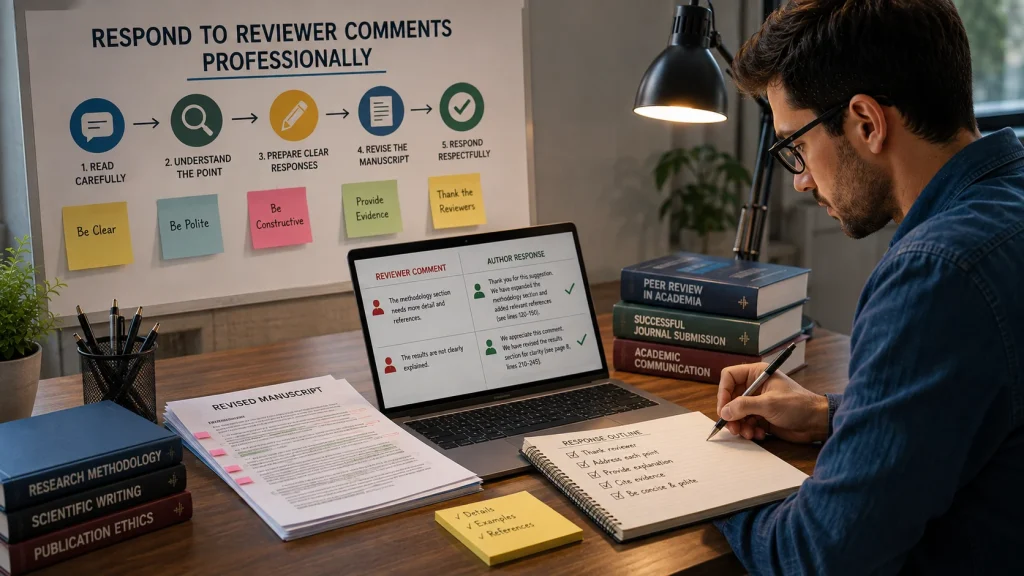
A thoughtful response often influences the final editorial decision.
Researchers should answer every reviewer comment individually.
Avoid emotional language.
Instead:
- Thank the reviewers.
- Explain every revision.
- Provide page numbers.
- Justify disagreements respectfully.
- Revise the manuscript carefully.
Clear responses simplify the editor’s work.
Editors appreciate organised revision documents.
At Fast Publications, we often advise authors to prepare a detailed response letter alongside the revised manuscript. Clear communication helps reviewers evaluate revisions more efficiently.
Can Expedited Peer Review Help?
Some journals offer expedited review options.
Others provide fast-track processing for selected manuscript types.
However, researchers should remain cautious.
Fast review does not mean guaranteed acceptance.
It also does not eliminate scientific evaluation.
Before selecting expedited review, verify:
- Journal reputation
- Indexing status
- Editorial policies
- Review process
- Publication ethics
Avoid publishers making unrealistic promises.
Claims such as “publication in three days” or “guaranteed acceptance” should raise immediate concerns.
Reputable journals protect research quality through proper peer review.
Mistakes Delaying Publication
Many publication delays result from avoidable mistakes.
Researchers can reduce these risks through careful planning.
Submitting Before the Manuscript Is Ready
Incomplete manuscripts rarely save time.
Instead, they create additional revision cycles.
Choosing the Wrong Journal
Poor journal selection remains one of the most common reasons for rejection.
Researchers should study the journal’s aims and scope carefully.
Ignoring Author Guidelines
Formatting problems delay editorial screening.
Always follow submission instructions.
Weak Cover Letters
Editors appreciate concise, professional cover letters.
Explain why your manuscript fits the journal.
Highlight its originality.
Delayed Revisions
Authors sometimes spend months responding to reviewer comments.
Quick, thoughtful revisions keep the publication process moving.
How Fast Publications Support Researchers?

Meeting a conference deadline requires more than speed. It requires preparation.
At Fast Publications, we help researchers improve manuscript quality before submission rather than chasing unrealistic publication promises.
Depending on your needs, you may benefit from:
- Journal Selection Service to identify journals with realistic review timelines.
- Manuscript editing service to improve language and clarity.
- Scientific editing service for technical accuracy.
- Formatting service to meet journal requirements.
- Pre-Submission Review to identify weaknesses before submission.
- Plagiarism Checking Service to verify originality.
Using these services before submission often prevents delays that occur later in the publication process.
Conclusion
Publishing before a conference deadline requires realistic expectations and careful planning. Most delays occur long before peer review begins. Weak journal selection, incomplete manuscripts, formatting errors, and language issues often slow the process more than the review itself.
Researchers who prepare early, choose the right journal, and submit a polished manuscript place themselves in a much stronger position. While no reputable publisher can promise guaranteed acceptance or immediate publication, thoughtful preparation can significantly improve both efficiency and success.
At Fast Publications, we believe researchers deserve honest guidance instead of unrealistic promises. By focusing on manuscript quality, journal compatibility, and strong editorial preparation, authors can navigate the publication process with greater confidence and maximise their chances of meeting important conference deadlines.
Frequently Asked Questions
Can I publish before a conference deadline?
Yes, but success depends on your available time, manuscript quality, journal selection, and review timeline.
How long does journal publication usually take?
Many journals require three to six months from submission to publication. Some journals move faster, while others take considerably longer.
Can professional editing improve publication speed?
Professional editing improves manuscript quality and reduces avoidable revision requests. Although it cannot guarantee faster publication, it often shortens the editorial process.
Should I submit to the fastest journal available?
Not necessarily. Researchers should balance review speed with journal quality, scope, reputation, and indexing.
Is expedited peer review worth it?
It depends on the journal. Legitimate expedited review still follows proper editorial and peer review standards.