
Choosing a journal can feel harder than writing the research paper itself.
Researchers face thousands of journals across different disciplines. Each journal has different requirements, audiences, review processes, and publication timelines.
A strong manuscript can still face rejection if it reaches the wrong journal.
That is why journal selection deserves careful attention.
The right journal should match your research topic, audience, methodology, and publication goals. It should also have a credible editorial process and transparent policies.
Unfortunately, many researchers select journals based on impact factor alone. Others choose a journal because a colleague published there. Some simply select the first journal that appears in a database search.
These approaches can waste months.
At Fast Publications, we help researchers approach journal selection as a strategic decision. The goal is not simply to find a journal that accepts manuscripts. The goal is to identify a suitable publication venue for your specific research.
This guide explains how to choose the right academic journal step by step. It covers journal scope, readership, indexing, peer review, publication timelines, fees, rejection risks, and other factors researchers should consider before submission.
Do Journal Selections Impact Research?
Journal selection affects the entire publication process.
A suitable journal improves your chances of reaching the right readers. It also increases the likelihood that editors will consider your manuscript relevant.
An unsuitable journal can create immediate problems.
The editor may reject the manuscript before peer review. This outcome is called a desk rejection.
The rejection may have nothing to do with research quality.
The manuscript simply does not fit the journal.
For example, imagine a researcher publishes a study about artificial intelligence in medical diagnosis. Submitting it to a general computer science journal may seem reasonable.
However, a medical informatics journal may provide a much better fit.
The second journal may have readers who actively follow this research area.
It may also have editors and reviewers with relevant expertise.
Therefore, the right journal can influence visibility, readership, citations, and future collaborations.
Step 1: Understand Your Research Before Choosing a Journal

Start with the manuscript.
Do not begin by searching journal rankings.
First, identify what your research actually contributes.
Ask yourself several questions:
- What problem does the study address?
- Which academic field does it serve?
- What methodology does it use?
- Who will benefit from the findings?
- What makes the research relevant?
- Which researchers would cite this work?
Your answers create the foundation for journal selection.
For example, consider a qualitative study examining patient experiences with telemedicine.
The research could fit several areas.
It might interest healthcare researchers. It could also interest public health researchers, digital health specialists, or medical sociologists.
The strongest journal depends on the study’s central contribution.
Step 2: Define Your Target Audience
Every journal serves a particular readership.
Before submitting, determine who should read your research.
Ask yourself whether your main audience includes:
- Clinicians
- Researchers
- Engineers
- Social scientists
- Policy researchers
- Business scholars
- Educators
- Industry professionals
Audience alignment matters because publication creates little value if the right readers never discover your work.
A specialized journal may provide stronger visibility within your field.
A broader journal may offer wider exposure.
Neither option is automatically better.
The choice depends on your research objectives.
Step 3: Study the Journal’s Aims and Scope
The journal’s aims and scope should become your first serious screening tool.
Read the complete scope instead of relying on the journal title.
A journal may appear relevant but still reject your manuscript because of its specific editorial focus.
Look for information about:
- Research topics
- Accepted methodologies
- Subject areas
- Article types
- Target audience
- Geographic focus
- Theoretical approaches
Compare these details with your manuscript.
A strong match should become obvious.
If you struggle to explain why the journal needs your research, reconsider the submission.
Step 4: Read Recently Published Articles

Journal websites reveal more than formal scope statements.
Recent articles show what editors actually publish.
Read at least five to ten recent papers from your target journal.
Look for similarities in:
- Research topics
- Methodology
- Article length
- Research questions
- Writing style
- Theoretical framework
- Data analysis
- Geographic focus
This exercise can reveal whether your manuscript genuinely belongs there.
For example, a journal may mention qualitative research in its scope. However, its recent publications may focus almost entirely on quantitative studies.
That difference matters.
Recent articles often provide a more realistic picture of editorial preferences.
Step 5: Check the Journal’s Indexing
Indexing affects discoverability and academic visibility.
Researchers should verify where the journal appears before submission.
Depending on the discipline, relevant databases may include:
- Scopus
- Web of Science
- PubMed
- DOAJ
- IEEE Xplore
- ERIC
- PsycINFO
Not every database applies to every discipline.
Therefore, choose databases that matter within your field.
Researchers should also verify indexing directly through the database whenever possible.
Do not rely only on claims displayed on a journal website.
Step 6: Evaluate Journal Reputation
A journal’s reputation involves several factors.
Impact metrics can provide useful information. However, they should never become the only selection criterion.
Consider the journal’s:
- Editorial board
- Publishing organization
- Peer review process
- Publication history
- Indexing
- Research community
- Citation performance
- Transparency
A journal with a modest impact metric may still provide an excellent fit.
Likewise, a highly ranked journal may not suit your manuscript.
The strongest choice balances relevance, credibility, audience, and realistic acceptance prospects.
Step 7: Check the Peer Review Process
Peer review remains central to scholarly publishing.
Before submission, understand how the journal handles manuscripts.
Look for information about:
- Single-blind review
- Double-blind review
- Open peer review
- Reviewer selection
- Editorial screening
- Revision procedures
- Appeals
A transparent journal should explain its review process clearly.
Be cautious when a journal provides little information about peer review.
Also check whether the journal publishes realistic information about review timelines.
Extremely short review promises deserve careful scrutiny.
Step 8: Compare Publication Timelines
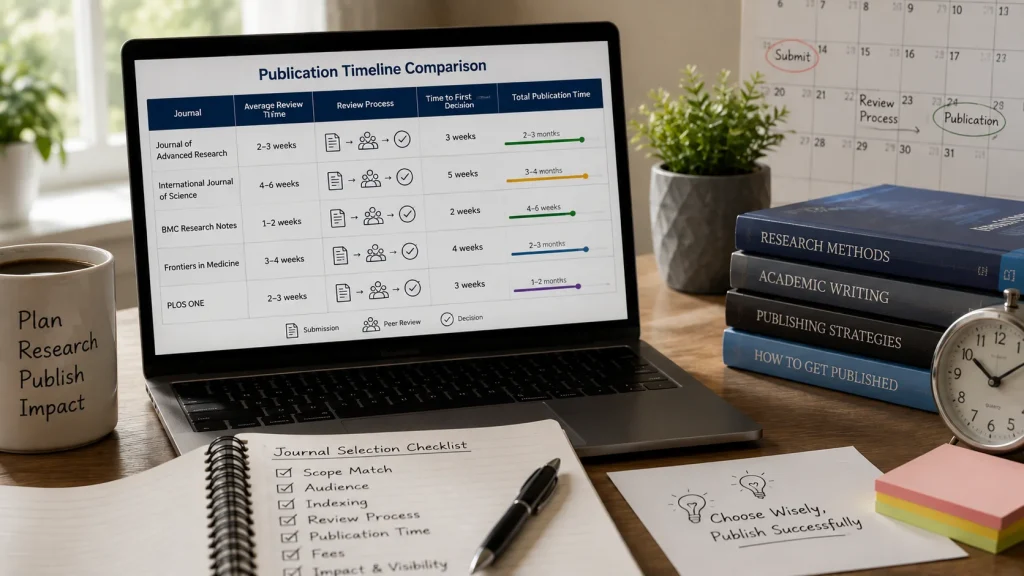
Publication speed matters for many researchers.
You may have a graduation deadline, promotion requirement, grant deadline, or conference schedule.
However, speed should never outweigh journal quality.
Review the journal’s:
- Submission-to-first-decision time
- Review period
- Acceptance-to-publication period
- Publication frequency
Remember that advertised timelines can vary.
Peer review depends on reviewer availability.
Complex manuscripts may require several review rounds.
Therefore, treat publication timelines as estimates rather than guarantees.
Researchers who face strict deadlines can benefit from Journal Selection Support when comparing suitable journals with realistic publication timelines.
Step 9: Check Article Types
Not every journal accepts every type of research paper.
A journal may accept:
- Original research
- Review articles
- Systematic reviews
- Meta-analyses
- Case reports
- Short communications
- Technical notes
- Editorials
- Methodological papers
Make sure your manuscript matches an accepted article type.
Submitting the wrong format can lead to unnecessary delays.
For example, a journal may publish systematic reviews but reject narrative reviews.
Always verify the requirements before preparing the final submission.
Step 10: Review Author Guidelines
Once a journal looks suitable, study its author guidelines carefully.
Pay attention to:
- Word limits
- Abstract structure
- Reference style
- Figure requirements
- Table formatting
- Supplementary files
- Ethical declarations
- Data availability
- Conflict of interest statements
Formatting differences can become significant.
A manuscript prepared for one journal may require substantial changes for another.
This is another reason to select the journal before final formatting.
Step 11: Compare Journal Metrics Carefully
Journal metrics can help researchers compare publication venues. However, metrics require careful interpretation.
The Journal Impact Factor remains one of the most recognized metrics. Yet it does not measure the quality of every individual article.
Other metrics can provide additional context.
These may include:
- CiteScore
- SCImago Journal Rank
- Source Normalized Impact per Paper
- Five-Year Impact Factor
- Article Influence Score
Researchers should use metrics as one part of the decision.
A high metric does not automatically mean better suitability.
A lower-ranked journal may reach your exact research audience.
Therefore, relevance should remain a primary consideration.
Step 12: Verify Indexing Claims

Researchers should never rely solely on information provided by a journal.
Some questionable publishers display misleading indexing claims.
Always verify the journal directly through the relevant database.
For example, if a journal claims Scopus coverage, search the official Scopus source list.
The same principle applies to Web of Science and other databases.
Check the exact journal title.
Also check the ISSN.
These details help prevent confusion with similarly named journals.
If you discover conflicting information, investigate before submitting.
Step 13: Understand Open Access Options
Many journals now offer open access publishing.
Open access allows readers to access research without traditional subscription barriers.
However, some open access journals charge an Article Processing Charge.
Researchers should check the exact fee before submission.
Look for information about:
- Article Processing Charges
- Waiver policies
- Institutional agreements
- Funding support
- Copyright ownership
- Licensing terms
Not every open access journal charges authors.
Some journals operate without author fees.
Therefore, never assume that open access automatically means expensive publication.
Step 14: Check the Journal’s Copyright Policy
Copyright policies differ between journals.
Some publishers require authors to transfer copyright.
Others allow authors to retain copyright under specific licenses.
Researchers should understand these terms before submission.
Pay attention to:
- Copyright ownership
- Reuse rights
- Creative Commons licenses
- Repository rights
- Preprint policies
These details become important when researchers want to share their work later.
Step 15: Look for Predatory Journal Warning Signs
Journal selection requires caution.
Not every journal that appears professional follows legitimate publishing practices.
Predatory journals often use aggressive emails and unrealistic publication promises.
Watch for warning signs such as:
- Guaranteed acceptance
- Extremely fast peer review
- Fake editorial board members
- Misleading indexing claims
- Unclear fees
- Poorly maintained websites
- Excessive solicitation emails
- Unverifiable contact information
One warning sign does not always prove misconduct.
However, several warning signs should trigger deeper investigation.
Researchers should verify journals through recognized scholarly databases and publishing organizations.
Step 16: Evaluate the Editorial Board

The editorial board can provide useful information about a journal’s credibility.
Review the listed editors and their affiliations.
Check whether they actively publish within the journal’s subject area.
You can also verify their institutional profiles.
A credible editorial board should include identifiable researchers with relevant expertise.
Be cautious when:
- Names cannot be verified.
- Affiliations appear incorrect.
- Researchers deny involvement.
- The board lacks subject expertise.
Editorial transparency supports journal credibility.
Step 17: Assess Your Career Goals
Journal selection should support your broader academic objectives.
Different researchers have different priorities.
A PhD student may need a journal recognized by their university.
A researcher applying for promotion may prioritize indexing.
Another researcher may prioritize rapid publication.
Someone seeking international collaboration may prefer a widely read journal.
Therefore, create a short list based on your specific goals.
Ask:
What does this publication need to achieve for my career?
The answer should influence your final decision.
Step 18: Create a Journal Shortlist
Do not submit immediately after finding one suitable journal.
Create a shortlist of three to five options.
Rank each journal according to important criteria.
A simple comparison matrix can help.
| Factor | Journal A | Journal B | Journal C |
| Scope Match | 5 | 4 | 3 |
| Indexing | 5 | 5 | 4 |
| Audience | 5 | 4 | 3 |
| Review Timeline | 3 | 5 | 4 |
| Publication Cost | 4 | 3 | 5 |
| Reputation | 5 | 4 | 4 |
| Overall Fit | 27 | 25 | 23 |
Use a five-point scale for each category.
This approach makes the decision more objective.
It also reduces emotional decisions based on journal prestige alone.
Step 19: Estimate Your Acceptance Prospects
No researcher can accurately predict acceptance.
However, you can assess whether your manuscript fits the journal.
Consider:
- Does the topic match recent papers?
- Does the methodology fit?
- Does the manuscript address the journal audience?
- Does the research provide a clear contribution?
- Does the article type match?
- Does the manuscript meet formatting requirements?
Strong alignment improves the likelihood of surviving editorial screening.
Poor alignment increases desk rejection risk.
Step 20: Use Professional Journal Selection Support

Researchers sometimes struggle to evaluate multiple journals.
This problem becomes especially difficult when journals have similar scopes.
Professional Journal Selection Support can help researchers compare potential journals based on research topic, methodology, indexing, audience, and publication requirements.
The objective should not be to find the easiest journal.
Instead, the goal should be finding the most appropriate journal for the manuscript.
At Fast Publications, journal selection should remain evidence-based and transparent. Researchers should understand why a particular journal suits their research before submitting.
When Should You Use Journal Selection Support?
Professional support can become useful in several situations.
Your Research Fits Multiple Fields
Interdisciplinary research often creates several possible journal targets.
A structured comparison can identify the strongest option.
You Have Experienced Repeated Rejections
Repeated desk rejections may indicate a journal selection problem.
Reviewing previous submissions can reveal patterns.
You Have a Strict Deadline
Researchers facing graduation, funding, promotion, or conference deadlines may need to compare publication timelines carefully.
You Are New to Academic Publishing
Early career researchers often struggle to distinguish journal quality from marketing claims.
Professional guidance can simplify the process.
Journal Selection Is Not the Same as Finding the Fastest Journal

This distinction matters.
Researchers sometimes search for journals promising the shortest review time.
That approach can create serious problems.
Speed does not guarantee quality.
A fast decision from an unsuitable journal still wastes time.
Similarly, a fast acceptance from a questionable journal may damage your academic record.
The better strategy involves balancing several factors.
Think about:
Fit + Credibility + Audience + Indexing + Timeline + Cost
A journal that performs well across these categories deserves serious consideration.
Prepare Your Manuscript for the Selected Journal
Once you choose your journal, adapt your manuscript to its requirements.
- Do not submit the same document everywhere.
- Review the journal’s recent articles.
- Study its formatting style.
- Adjust the abstract.
- Check keywords.
- Review references.
- Confirm figure requirements.
- Make sure your manuscript follows the journal’s structure.
A Manuscript Editing Service can also help improve clarity before submission.
Similarly, technical researchers may benefit from Technical Editing Services when terminology, formatting, and technical presentation require careful review.
At Fast Publications, we recommend completing these checks before submission. A polished manuscript creates a stronger first impression during editorial screening.
Conclusion
Selecting an academic journal should never become an afterthought.
The right journal can improve visibility, readership, citation potential, and publication outcomes. The wrong choice can create months of unnecessary delays.
Start with your research.
Understand its contribution, audience, methodology, and subject area.
Then compare journals systematically.
Read their recent articles. Check their scope. Verify their indexing. Examine their editorial board. Review their peer review process. Compare publication timelines and costs.
Most importantly, avoid choosing a journal simply because it appears prestigious or promises rapid publication.
At Fast Publications, we believe effective journal selection combines research fit with practical publishing goals. Our Journal Selection Support helps researchers evaluate suitable publication options before they commit to a submission.
A careful selection process can save more than time. It can prevent avoidable rejections and help your research reach the readers who need it.
When researchers choose strategically, journal submission becomes less of a guessing game. It becomes a planned part of the research publication process.
Frequently Asked Questions
How do I choose the right academic journal?
Start with your research topic and target audience. Then compare journal scope, indexing, reputation, peer review, publication timelines, costs, and article requirements.
Should I choose a journal based on Impact Factor?
No. Impact Factor can provide useful context, but journal relevance and audience should remain major considerations.
How many journals should I shortlist?
Three to five journals usually provide enough options for a structured comparison.
Can journal selection reduce rejection?
Yes. A strong journal match can reduce the risk of desk rejection caused by scope or audience mismatch.
What is Journal Selection Support?
Journal Selection Support helps researchers evaluate potential journals based on factors such as scope, indexing, audience, publication model, and suitability.
Should I choose the journal before writing my paper?
Ideally, yes. Choosing early allows you to follow the journal’s structure and formatting requirements from the beginning.
Can Fast Publications guarantee journal acceptance?
No reputable service can guarantee acceptance. Editorial decisions remain with the journal and its reviewers.
:::