In the rat race of publishing, the destiny of a manuscript is, in most cases, determined before it is given to peer review. It is not necessarily your discovery or in-depth analysis, but the power and authority of the publications you refer to. Reviewers, Auditors of your reference list. Old, obscure, or bad sources instantly subvert your argument, undercutting your scholarly rigour and open to the charge of being rejected or subject to extensive revision. On the other hand, the literature review based on credible, current research is respectful and expedites the editorial procedure.
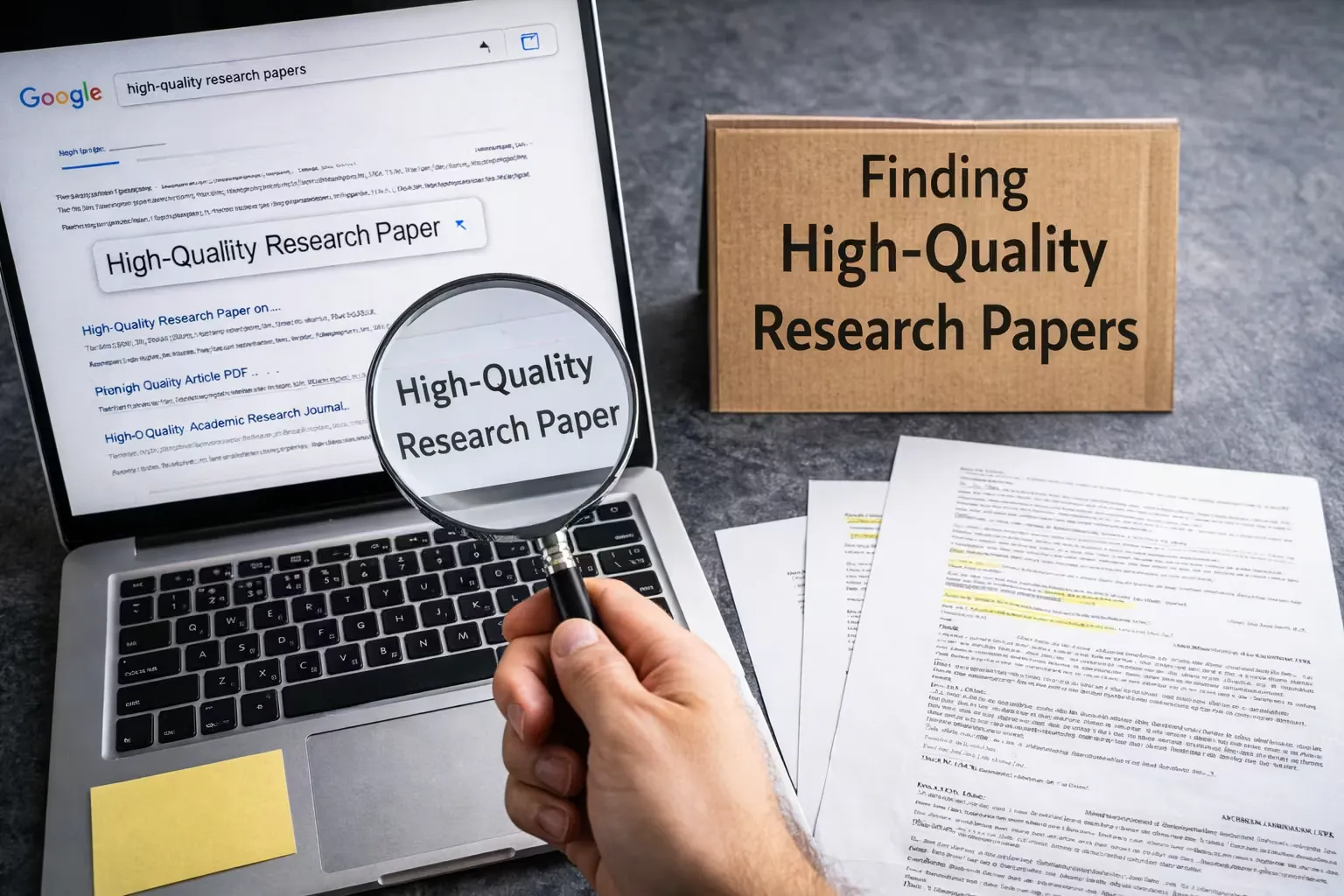
Learning how to locate and assimilate high-quality sources is thus an essential skill in professional Research Article Writing. It is a tactical art that, once done well, which is often aided by specific research, can be a direct engine for quickly getting publications.
What Makes a Research Paper of High Quality?
All PDFs labelled “research” are not worth including in your paper. Some of the most important pointers that identify high-quality papers are:
- Peer-reviewed: Published in a journal that has a clear and stringent peer review.
- Authoritative Source: Documented in major databases such as Scopus or Web of Science that have decided inclusion.
- Methodological Soundness: The research design is proper, the sample size is adequate, and the study analysis is powerful.
- Citation Impact: Although not the only indicator, the presence of a paper that receives other viable researchers is often an indicator of the power and acceptance in the field.
- Relevance and Recency: Answers your research question directly and, in most areas, is published within 3-5 years (seminal works are an exception).
This is the way to start your argument on your path toward writing credible, publishable research articles.
Choosing the Right Hunting Grounds: Databases over Browsers
Your success depends on the starting point. Do not use the shotgun method of generic web search. Rather, select specialised academic databases:
- Scopus and Web of Science: The king of cross-disciplinary research. Their indexing itself is a quality filter.
- PubMed: The indispensable life sciences and clinical medicine resource.
- IEEE Xplore / ACM Digital Library: Essential to engineering and computer science.
- Google Scholar (Used Strategically): GS is great at discovering and tracking citations, but needs to be combined with careful assessment because it also finds non-peer-reviewed works.

Learning to search smartly
Efficiency is key. Apply these methods to be a strategist, not just a searcher:
- Keyword Precision: Start broad and then narrow your search with the specific terms that key papers you locate have.
- Boolean Operators: AND to combine ideas (or OR to synonyms or not), (catalyst AND efficiency) NOT biological to eliminate unrelated fields.
- Phrase Searching: Help with exact phrases: put them in quotation marks: machine learning.
- Filters: Use leverage filters on publication date (last 5 years), document type (article, review), and subject area.
- Citation Chaining: Find older, seminal literature with a reference list of a key paper (backward chaining) and find newer literature which has built on it with tools called Cited by (forward chaining).
Having a Critical Eye Screen: The Quality Check
The identification of a paper is just the first step. You must evaluate it:
- Journal Check: Does it lie in the index of Scopus/WoS? What is its ranking or CiteScore?
- Abstract scan: Does it effectively fill your research gap?
- Methods Scrutiny: Does it have a sound methodology, and is it described appropriately? Do we have evident constraints (e.g., small sample size, no control group)?
- Results & Conclusion: Do the results present a clear finding, and does the conclusion log out of the findings?
The Predatory Journal Trap: A Credibility Killer
One of the gravest risks is accidentally referencing the work of a shoddy journal, one that focuses more on profit rather than the review. Red flags include:
- Invitations to participate in editorial boards or to contribute to editorial boards, without request.
- Unrealistically rapid pace of acceptance (e.g., acceptance in 72 hrs).
- Ineffective or absent peer review procedures.
- Names of journals resembling already existing titles.
Managing to be Effective and Disciplined
Chaotic PDF folders result in a chaotic literature review. Install a system on any given day:
- Reference Manager: Zotero, Mendeley, or EndNote are essential. They save PDF files, cite and build bibliographies in real time.
- Annotate and Tag: As you read, make notes right in your manager. Label pages according to theme, procedures or use in particular chapters.
- Compare Studies: In a basic table, compare the studies based on the key dimensions: author, year, methodology, sample, key finding, and limitation. This is the visual aid, which will be the raw material for your literature review synthesis.
Combining the Literature: Summary to Syntheses
The last test is the use of the literature. A dismal review only provides: “Smith (2020) found X. Jones (2021) found Y. A good review is synthesising and constructing a case:
- Compare and Contrast: When Smith (2020) found X to be the key factor, Jones (2021) recommended Y; this interaction is more intricate.
- Find Patterns and Gaps: “Put together, these findings illustrate a tendency towards A, but no one has researched its effects on the scenario of B.
- Justify Your Work: This is a methodological inconsistency in previous work, leading to the necessity of the unified method in this research.
The Role of Research Assistance in Faster Process
Research support in Fast Publications can simplify all of this work by offering:
- Search Support: Aiding in the refinement of complex search strategies to bring up the most impactful literature in the least amount of time.
- Source Checking: Checking your reference list due to credibility, recency and relevance.
- Synthesis and Organisation: To help organise the literature review into a strong narrative gap.
- Citation Perfecting: Making sure that the formatting and adherence to journal rules are flawless.
Conclusion
There is no way of having better research than the research you base on. With literature search being seen not as a pre-research job, but as a strategic phase in writing a research article, all is different. Through the right place search, critical-evaluation eye, organisation towards insight and purposeful integration, you build a manuscript that credible reviewers can believe in, can co-exist clearly and compellingly. This rigorous approach, with purposeful research support, is the surest way to make the concept-to-publication route shorter. Put money into what you source and put money into what you achieve.