
The h-index is probably the most widely used metric for evaluating the impact of an individual researcher’s body of work. It appears in grant applications, promotion dossiers, hiring shortlists, and researcher profiles on Google Scholar, Scopus, and Web of Science. If you have ever looked up a researcher’s profile online, you have almost certainly seen an h-index displayed prominently.
Its appeal is obvious: it is a single number that attempts to capture both productivity (you need many published papers) and impact (those papers need to be cited). It was proposed by physicist Jorge Hirsch in 2005 as a simple, robust indicator of a researcher’s cumulative scientific output, and it was adopted with remarkable speed.
The problem is that the h-index has well-documented limitations that have been known for almost as long as the metric itself has existed. It cannot be compared across disciplines. It disadvantages early-career researchers and women. H-index rewards breadth over depth, making it possible to game by publishing many low-stakes papers. It ignores the position of an author in a paper’s author list. And it can be inflated through self-citation. Despite all of this, it remains the dominant metric in many academic evaluation contexts – which means every researcher needs to understand both what it measures and where it breaks down.
| Core Definition The h-index is the largest number h such that a researcher has published at least h papers, each of which has received at least h citations. A researcher with an h-index of 12 has published at least 12 papers, each cited at least 12 times. The (h+1)th most-cited paper has fewer than (h+1) citations. |
How to Calculate h-index?
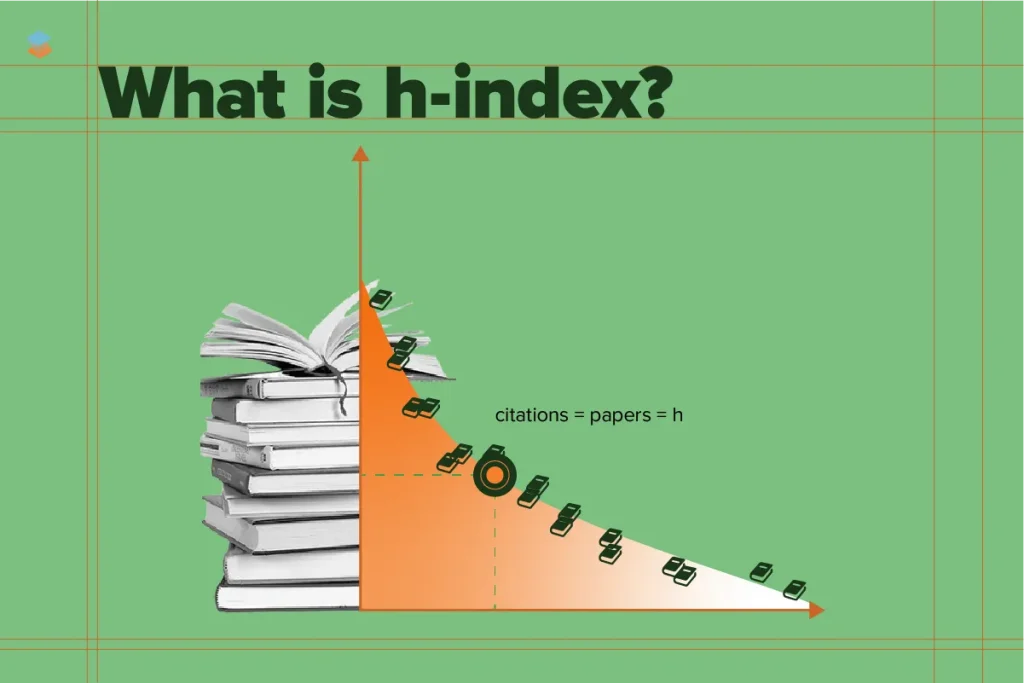
Calculating your h-index is straightforward:
- List all your publications in descending order of citation count.
- Find the point where the paper’s rank equals or is exceeded by its citation count.
- Your h-index is that rank number.
Example: A researcher’s papers, ranked by citations, receive: 45, 38, 22, 17, 14, 11, 9, 8, 5, 3 citations respectively. Paper 6 (rank 6) has 11 citations – more than 6. The Paper 7 (rank 7) has 9 citations – more than 7. Paper 8 (rank 8) has 8 citations – equal to 8. Paper 9 (rank 9) has 5 citations – fewer than 9. Therefore, the h-index is 8.
Your h-index will differ depending on where you look it up:
- Google Scholar: Typically the highest, because it indexes the most sources including preprints, book chapters, and theses
- Scopus: Typically lower than Google Scholar but higher than Web of Science; covers more journals than WoS but fewer grey literature sources
- Web of Science: Typically the lowest of the three, because it indexes fewer journals overall
Always specify which database you used when reporting your h-index – the numbers are not interchangeable.
H-index Benchmarks by Career Stage and Field
What constitutes a good h-index depends enormously on your career stage and discipline. The following benchmarks are rough guidelines based on published research and academic norms – not absolute standards.
| Career Stage / Context | Google Scholar | Web of Science | Notes |
| Early career (3–5 yrs post-PhD) | 3–6 | 2–4 | High variability; fields differ substantially |
| Mid-career (6–12 yrs post-PhD) | 8–15 | 5–10 | Assistant to associate professor range in many STEM fields |
| Senior researcher (15+ yrs) | 15–30+ | 10–20+ | Full professor range in competitive fields |
| Nobel Prize laureates (science) | Typically 40–60+ | Typically 30–50+ | Top 0.1% of researchers globally |
| Humanities / Social sciences | Lower by ~50% vs STEM | Even lower (fewer journals indexed) | Field norms differ dramatically – never compare across fields |
| Computer Science | Higher for active conference publishers | Lower (conference papers less indexed in WoS) | Field-specific norms apply strongly |
| Critical Warning Never compare h-index values across disciplines. An h-index of 15 in molecular biology is modest; an h-index of 15 in mathematics or philosophy represents an extremely high-impact career. Institutional committees that use h-index cutoffs without field normalisation are making methodologically invalid comparisons – a fact that is worth knowing when your work is being evaluated. |
The Six Key Limitations of the H-index

1. Cannot Be Compared Across Fields
Citation cultures differ dramatically between disciplines. In molecular biology, papers routinely accumulate hundreds or thousands of citations. In mathematics or philosophy, a highly influential paper may receive a few dozen. The h-index does not account for these differences, making cross-field comparisons invalid. Yet academic hiring committees, grant panels, and promotion boards routinely use h-index cutoffs that apply the same standard to researchers in very different fields.
2. Biased Against Early-Career Researchers
The h-index grows monotonically with career length – it can never decrease, only increase or stay the same. This means a prolific early-career researcher with an h-index of 6 after four years post-PhD may be producing a faster rate of high-impact research than a senior researcher with an h-index of 20 after 25 years – but the raw numbers are not comparable. The m-index (h divided by years since first publication) addresses this limitation.
3. Biased Against Women and Researchers Taking Career Breaks
Because h-index accumulates with career time, any interruption – for parental leave, caregiving, illness, or career changes – permanently affects a researcher’s h-index relative to peers who published continuously. This disproportionately affects women in academic evaluation contexts that use h-index without temporal normalisation.
4. Rewards Breadth Over Depth
A researcher who publishes 30 papers each cited 30 times has the same h-index as a researcher who publishes 30 papers each cited 30 times – but the latter researcher might have one paper cited 3,000 times that transformed their field, while the h-index sees both researchers as equivalent. The g-index and total citation count address this by giving more weight to highly cited papers.
5. Susceptible to Self-Citation Manipulation
Self-citations – citing your own previous papers – contribute to your h-index. A researcher who systematically self-cites to push their own papers over the h-threshold is gaming the metric. Some databases allow you to filter self-citations from h-index calculations, but this is rarely done in standard profile displays.
6. Author Position Is Ignored
Whether you are the first author, last author, or third of twelve authors on a paper, your h-index receives the same credit. This is a significant limitation in fields with large collaborative author lists, where contributions vary enormously in scale. A researcher who made minor contributions to 30 highly cited papers has the same h-index boost as one who drove those projects entirely.
Better Alternatives and Complements to the h-index
| Metric | What It Measures | Best Used For |
| g-index | Largest number g where top g papers have received at least g² citations combined | Researchers with a few very high-impact papers; rewards blockbuster contributions |
| m-index (h/career years) | h-index divided by years since first publication | Comparing researchers at different career stages; normalises for seniority |
| i10-index | Number of papers with at least 10 citations | Simple productivity filter; widely used by Google Scholar; easy to interpret |
| FWCI (Field-Weighted Citation Impact) | Ratio of actual citations to expected citations based on world average in same field, year, and document type | Cross-field comparison; available in Scopus Author Search; normalises for discipline and recency |
| Total citations | Simple count of all citations received across all publications | Identifying researchers with transformative single contributions; supplements h-index |
| Highly Cited Researcher (Clarivate) | Designation for researchers in top 1% of citations in their field over 10 years | Top-tier recognition metric; independent of h-index manipulation |
| Altmetrics | Online attention: social media, news coverage, policy citations, downloads | Non-academic impact; societal reach; useful for public health and policy-relevant research |
How to Use These Metrics Strategically?
For Grant Applications
Many major grant applications now ask for evidence of research impact beyond a single number. Consider presenting: your h-index (with database specified), your total citation count, your FWCI if available through Scopus, your most-cited paper with its citation count, and any external recognition (e.g., Highly Cited Researcher designation, invited reviews, editorial board memberships). This multi-metric profile presents a more credible and complete picture than a single h-index.
For Promotion and Tenure Dossiers
If your institution uses h-index benchmarks in promotion decisions, request that the committee use field-normalised benchmarks – or provide context yourself. A one-page research impact statement that contextualises your h-index within field norms (citing published benchmarks) and supplements it with FWCI or other normalised metrics is increasingly expected in dossiers submitted to internationally-aware committees.
For Comparing Potential Journals
H-index thinking applies at the journal level too: the h5-index (the h-index of papers published in the last 5 years) is used by Google Scholar Metrics to rank journals. While less commonly used than Impact Factor or CiteScore, it can be a useful complement for assessing a journal’s recent citation performance.
For Evaluating Your Own Progress
Track your metrics across multiple platforms. Set up automatic citation alerts through Google Scholar, Scopus, and Web of Science. Review your citation profile annually. Focus on publishing in journals indexed in both Scopus and Web of Science to maximise your papers’ discoverability and citation potential.
Where to Find Your h-index?
- Google Scholar Profile: Create a verified Google Scholar profile at scholar.google.com to have your h-index calculated automatically from all sources Google indexes. This is the most inclusive and typically highest figure.
- Scopus Author Search: Search for your name at scopus.com/authors. Scopus provides h-index, citation count, FWCI, and subject-area percentile rankings – one of the most comprehensive researcher profiles available.
- Web of Science Researcher Profile: Available through your institutional WoS subscription. Provides h-index, citation count, and highly cited paper designations.
- ResearchGate and ORCID: Both provide citation tracking and h-index estimates, though with less rigour than the primary databases. Useful for a quick check but should not be cited in formal applications.
Conclusion
The h-index is not going away. Despite its limitations – and they are significant – it remains embedded in academic evaluation systems worldwide. Every researcher needs to understand how it is calculated, what its benchmarks are in their field, and how to contextualise it appropriately in applications and evaluations.
But no one should rely on h-index alone to represent their research impact. A thoughtfully selected combination of h-index, FWCI, total citation count, and evidence of specific high-impact contributions gives a far more accurate and defensible account of your scholarly influence. In an increasingly metrics-aware academic landscape, researchers who understand their own numbers – and can explain them – have a genuine advantage.
Building your citation profile starts with publishing in the right journals – those indexed in Scopus and Web of Science where your work will be discoverable and citable. Fast Publications helps researchers at every career stage navigate this process.
| Build Your Citation Profile With the Fast Publications. Fast Publications helps researchers publish in Scopus and Web of Science indexed journals – the publications that build citation profiles, h-indexes, and academic credibility. Explore Scopus Journal Support |