
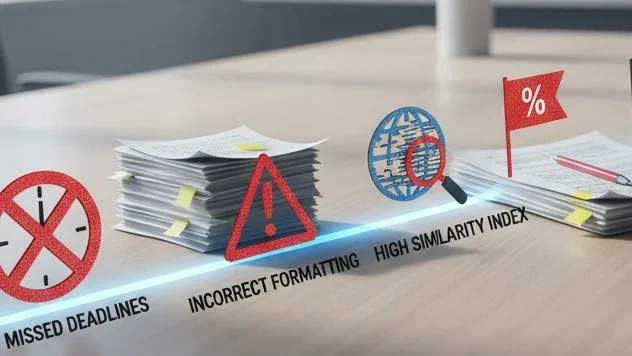
It is painful to wait till a journal decides on your manuscript. What do you think, could we considerably reduce that wait? The reality is that most delays during acceptance are a result of several typical errors that are easy to avoid. These traps can be avoided, and by knowing them, you can have an easy time publishing. This blog decodes the top five pitfalls that delay publication. So that you can eliminate them to make your work achieve the acknowledgement it deserves. We will also talk about how Manuscript Editing Services help researchers in increasing their chances of publication.
Mistake 1: Ignoring Journal Guidelines
Most writers are in a hurry to submit and consider journal guidelines a formality. This is a grave mistake. Even the smallest variations in formatting or structure can cause an automatic desk rejection or cause the editor to send your manuscript back. So you can undergo painful revisions before it even goes to peer review.
The Significance of Journal Guidelines
Each of the academic journals has its own identity, and its guidelines are a road map for what its editors expect. Following them is not only a form of compliance but is an indicator of professionalism. It presents respect for the publication process. Moreover, it shows that you have done due diligence, and therefore, you are likely to go through with your manuscript without any hassles.
Common Journal Guideline Mistakes
We often see the writers fall into the same traps of issues. They consist of the open disregard of word counts or other section requirements, like highlights or ethical statements. Another quite typical error is to choose the incorrect referencing style, subjecting the editorial staff to unwarranted efforts. Lastly, the exclusion of mandatory components, like inserting figures and tables into the text instead of on the side, brings instant tension.
Publications Tip
Technicalities should not derail your hard work. In Our Manuscript Editing Services, we carefully compare your paper with the requirements of your preferred journal.
Mistake 2: Weak Abstract and Title
The title and abstract are significant for your manuscript. Submissions overwhelm editors and reviewers; a positive first impression might lead them to ignore your outstanding research and quickly reject it.
The Significance of a Good Abstract
Look at the abstract as a miniature that has to give the reader assurance that the full paper will be worth the time. A strong abstract clearly spells out your research problem, methods, important findings, as well as conclusion. It allows an editor to understand the relevance and rigour of your work in a speedy manner, which is likely to enhance the chances of a positive review.
Title Mistakes That Delay Acceptance
An excessively complicated or full of jargon title will not get the right attention. It also loses an essential search engine optimisation (SEO). Unless your title contains the keywords that peers used, your manuscript will be difficult to find even after publication.
Best Practices
Always write a well-organised, brief abstract that tells a very strong narrative. To your title, consider being clear and impactful, and strategically put prime keywords so that it becomes more discoverable in academic databases.
Mistake 3: Methodological Errors
The body of your research article would be the methodology. When this is shaky, the reviewers will instantly cast doubt on the merits of your entire work, leading to massive revisions or even rejection.
Typical Methodological Fallacies
Many of those manuscripts do not succeed because their procedures are not repeatable. This is often a result of an inadequately described procedure or equipment. A lack of clarity when collecting data or selecting participants is also often found. Lastly, inappropriate or poorly justifiable statistical analysis undermines your work and kills the trust of those reviewing it.
Causes of Method Errors
Weaknesses in your research procedure are one of the most difficult to correct after you have submitted. They will require massive revisions, and unless their underlying issues with the study design are properly addressed, the manuscript will be turned in, and months of waiting will go to waste.
Mistake 4: Poor language and grammar
You may have groundbreaking data, but in case the reviewers are having problems reading what you wrote, they will cast doubt on the quality of the science itself. Eliminate barriers in the form of poor language and grammar, which create frustration in reviewers and slow down the acceptance of a manuscript.
The Importance of Language Quality
In writing on academic subjects, clarity is of utmost importance. Sophisticated, ill-written sentences full of grammatical mistakes make the reviewer strive to figure out what you are saying rather than concentrate on your scientific input. This is a particularly frequent yet solvable challenge for non-native speakers of English.
Frequent Language Mistakes
Be alert to repetitive grammar and spelling mistakes, lack of uniformity in the use of technical terms, and inflexible and winding sentences, which make you lose track of your core messages. These problems are indications of an unpolished and unprofessional manuscript.
The positive thing is that when you receive a revise and resubmit decision, it means that you are on the right track. However, it is up to you to respond to the comments of the reviewers. Defensive or superficial response ensures further lengthening of the process or rejection at the subsequent round.
The Significance of the Feedback Reply
Even critical reviewer feedback is significant. The professional interaction with it proves you are devoted to scientific speech and the enhancement of your work. A point-by-point reply demonstrates to the editor that you are both cooperative and serious about publication, and therefore increases speedy acceptance.
Mistake 5: Common Feedback Mistakes
The biggest mistake is to shut out or disregard remarks that you do not agree with. The other mistake is doing a non-serious revision, which is not based on the concern of reviewer. Even a little issue like fixing citation formats must be handled with exceptional care in order to showcase attention to detail.
Fast Publications Assistance
It may be difficult to make a strong response letter and update your paper. Our resubmission support service helps you revise your manuscript efficiently and write a polished, thorough response letter that responds to all the reviewer comments, and thus, greatly enhances your likelihood of getting a speedy, final acceptance.
Conclusion
Obstacles on the road to manuscript acceptance need not be scattered along the way. Delays in journal publication may be avoided by following journal rules carefully, writing an effective abstract and title, making your methods rigorous, refining your language, and responding courteously to reviewer comments. Should you want to stream this process even more, Fast Publications will be happy to assist. Whether it is writing and editing a research article by an expert or providing end-to-end journal submission support, our services will help you make your way to success quickly.