
The choice of journal to publish your AI or Machine Learning (ML) research paper in can be the difference between your article receiving the attention, authority, and references it warrants or being buried in a cycle of rejection. The process is now confusing even to experienced researchers, with thousands of journals publishing in artificial intelligence, data science, and computer science. This is a complete guide that breaks down the key steps and considerations for selecting the best-fit journal for your work, supported by professional Journal Selection Advice from Fast Publications in Computer Science.
The Importance of Journal Selection in AI and Machine Learning
AI and ML are fast-evolving disciplines, with technology changing monthly rather than yearly. A journal that’s too broad may dilute your paper’s impact, while one too specialized might limit visibility. Submitting to the wrong journal wastes time and can hurt your academic profile, especially if your topic doesn’t align with the journal’s aims and scope.
A strategic choice ensures:
- Faster peer review and acceptance
- Higher citation potential
- Increased visibility in global databases (Scopus, Web of Science, IEEE Xplore)
- Better networking and collaboration opportunities
That’s why many researchers today seek Journal Selection Advice to match their paper with the most suitable platform before submission.
Step 1: Identify Your Research Focus
Understand the actual contribution of your research before you go through journals.
Ask yourself:
- Does it propose a new algorithm or model (e.g., deep learning, reinforcement learning)?
- Does it apply AI to a particular area such as medicine, finance, or education?
- Is it theoretical innovation or experimental application?
Being aware of the core of your paper, whether theoretical, applied, or hybrid. It will help you narrow your journal list and avoid scope mismatch, one of the leading reasons for rejection.
Step 2: Journal’s Scope and Audience
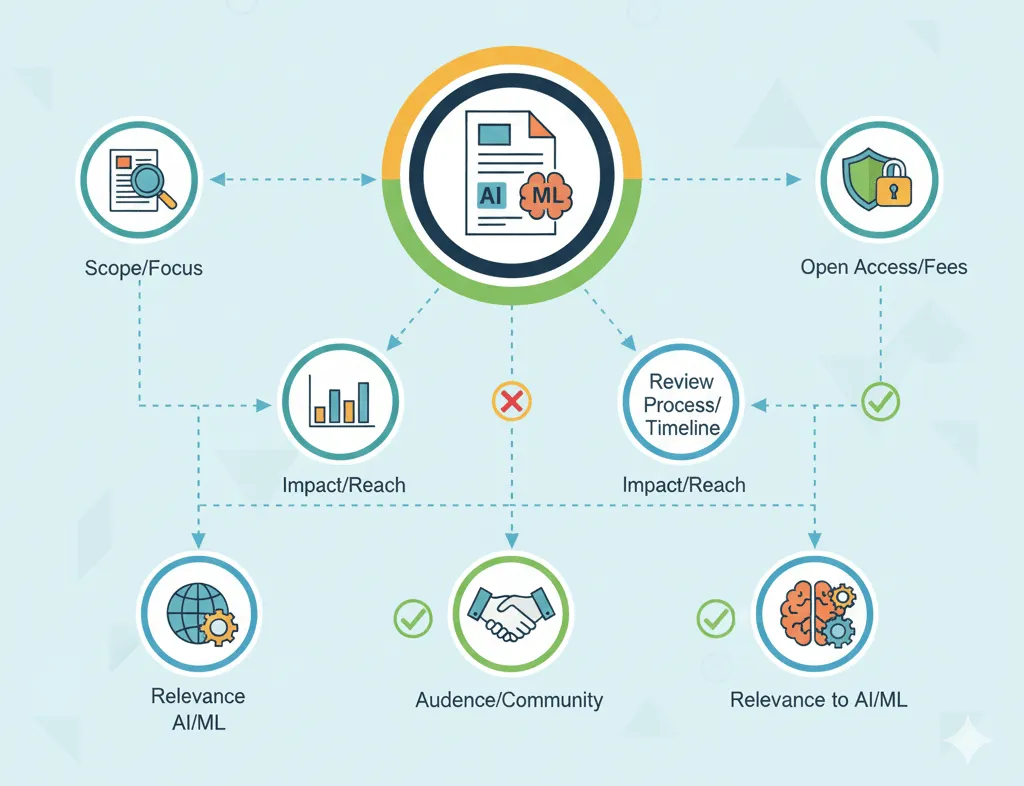
All journals clearly state their scope and objectives on their websites. Read these parts thoroughly and compare them with the focus of your manuscript.
For instance:
In case you are working with neural networks to recognize images, you can consider such journals as Pattern Recognition Letters or Computer Vision and Image Understanding.
If your study combines AI research with healthcare or diagnostics, consider journals such as Artificial Intelligence in Medicine or the IEEE Journal of Biomedical and Health Informatics.
Do not submit a strictly technical AI research paper to a journal that focuses on social impact or ethics – reviewers will dismiss it immediately as being out of scope.
Step 3: Indexing and Ranking of the Journal
It is essential to publish in a good, indexed journal to be recognized academically. The Scopus, Web of Science, and IEEE Xplore are reputed databases that will guarantee your research is accessed by a verified and global audience.
The most important metrics to consider are:
- Scopus Quartile Ranking (Q1-Q4) -Q1 journals are the most impactful and visible.
- Impact Factor (Web of Science journals).
- CiteScore and h-index also influence metrics.
When you want to your AI research paper to be seen in the long term academically, you should always target Q1 or Q2 Scopus-indexed journals. For early-career researchers, Q3 or Q4 journals have shorter publication timelines and remain credible.
To be adequately evaluated, professional Journal Selection Advice services provide up-to-date lists of indexed journals in AI and ML.
Step 4: Evaluate Review Speed and Acceptance Rate
AI research evolves quickly. Sending your work to journals that take a long time to review may make your work obsolete before it is published. Always check:
- Mean time to first decision (usually posted on journal websites)
- Acceptance rate (journals that have less than 10% acceptance are very competitive)
- Publication frequency (monthly, quarterly, continuous online)
Fast-track journals, such as IEEE Access or Applied Intelligence, can be the best choice for fast-moving AI research papers on topics such as generative models, large language models (LLMs), and federated learning.
Step 5: Open Access vs Subscription
Open-access publications are often advantageous for AI research papers and ML research papers, as they offer increased visibility, higher citation counts, and greater industry adoption. Nevertheless, open access may involve Article Processing Charges (APCs), which can be substantial.
Compare both options:
- Open Access Journals: Instant visibility, increased coverage, quicker citation, at a cost.
- Subscription Journals: No charges, slower delivery, less access.
In case your institution pays APCs, you can use open-access journals such as Frontiers in Artificial Intelligence or Scientific Reports. Otherwise, respectable subscription journals with IEEE or Elsevier are also excellent choices.
Step 6: Read the Editorial Board and Ethics Policy
Top journals have editorial boards made up of well-known researchers from reputable institutions. Avoid journals with unclear or suspicious editor affiliations.
It is also crucial to verify the section on publication ethics. Research in AI frequently involves sensitive information, algorithmic bias, and privacy issues, and journals are now highly vigilant about ethical standards.
Ensure your paper follows:
- AI transparency and bias reporting standards.
- Guidelines on data sharing and reproducibility.
- Disclosure of conflict of interest and funding.
Step 7: Do not use Predatory or Fake Journals
Predatory publishers are very aggressive in soliciting submissions, offer unrealistic timelines, and impose hidden charges without appropriate peer review. Warning signs include:
- Missing indexing details
- Poorly written websites
- Absence of ISSN or DOI registration
- Unclear editorial policies
Check authentic journal lists, such as Scopus or DOAJ. You can also use trusted Journal Selection Advice services to identify predatory journals.
Step 8: Consider Relevance and Audience Reach
In addition to impact measures, consider your target audience’s location. When targeting AI practitioners, engineers, and data scientists, select journals that focus on applied methods or industry-oriented innovation.
For academic readers, it is better to focus on journals that emphasize theoretical frameworks and new contributions to algorithms.
Step 9: Review Formatting and Submission Requirements
The journals have their own technical submission guidelines for formatting, figures, tables, and reference styles. Noncompliance may result in desk rejection – before peer review.
Check for:
- Style of reference (APA, IEEE, Vancouver, etc.) preferred
- Limitations of words and abstract structure
- Additional resources (e.g., code or datasets)
- Figure file formats (TIFF, EPS, or PNG)
Journal Submission Support or Advanced Formatting Services can save you hours by formatting your manuscript to the requirements of a journal.
Step 10: Expert Journal Selection Advice
Professional Journal Selection services by Fast Publications are recommended to authors who are not sure where to start, and are based on sophisticated databases and citation analytics to suggest journals that fit your paper topic, impact objectives, and acceptance likelihood. You’ll receive:
- A list of target journals (indexed, relevant, and verified)
- Impact factor, APC, and average review time data
- Guidance on cover letter drafting and submission strategy
This data-driven approach eliminates guesswork and helps you position your AI research paper for maximum reach and acceptance.
Choosing the right journal for your AI or Machine Learning paper isn’t about guessing. It’s about strategic alignment. Your paper’s relevance, scope, and visibility depend on how well you match its focus to the journal’s audience, review standards, and indexing.
Conclusion
In a fast-paced field like AI, timely and targeted publication determines who reads, cites, and builds on your work. By following these steps or partnering with Fast Publications’ Journal Selection Support, you can ensure your research finds the right home, achieves a more substantial impact, and accelerates your academic career.