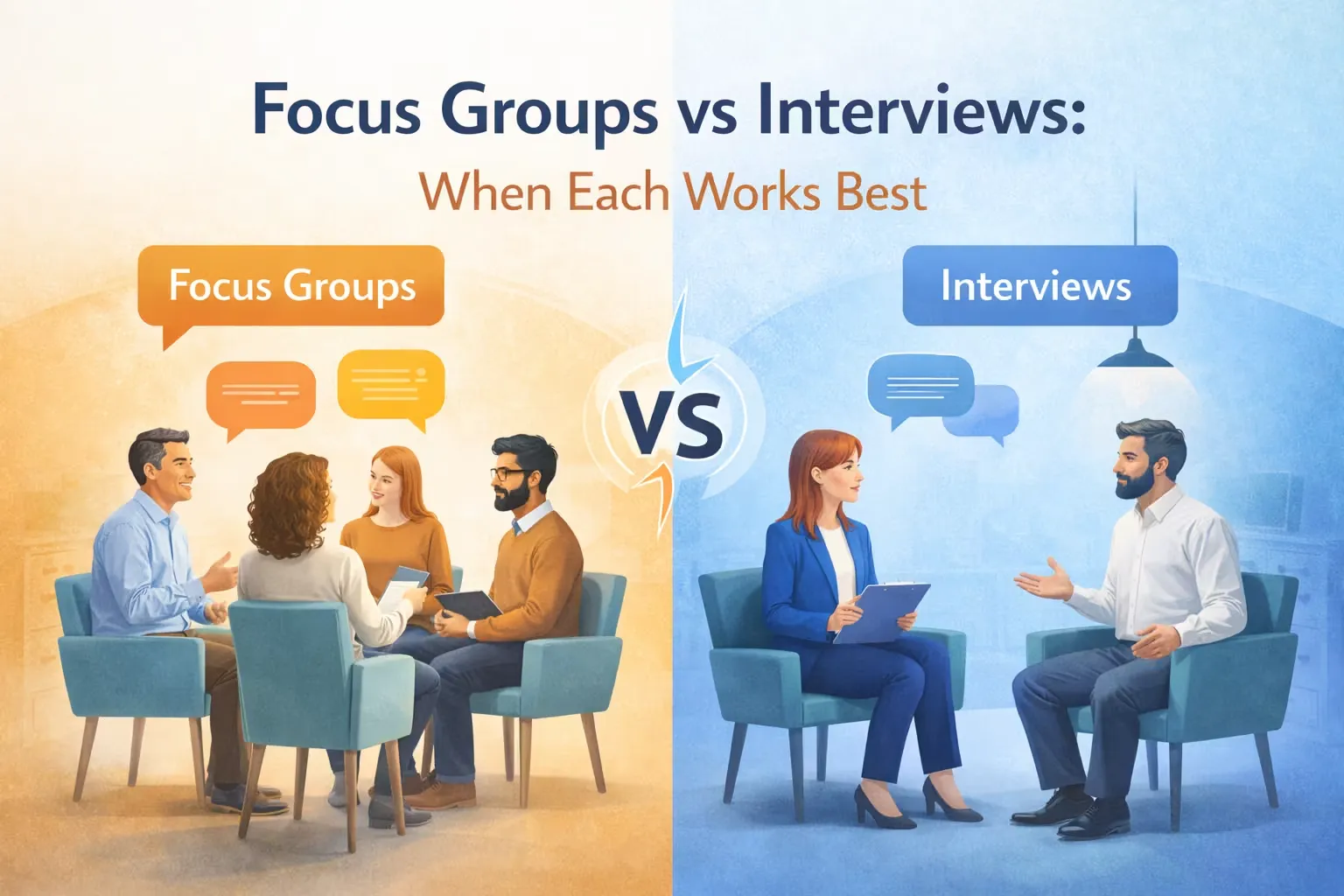
Qualitative research has great means of knowing, mainly behaviour, yet in one condition, matching the method to the question. The focus groups and interviews are used for different purposes, but researchers tend to revert to the known rather than what the study needs them to be.
The main tradeoff is the interaction versus depth. Focus groups initiate discussion, bringing out common beliefs and social relationships. Interviews provide an intimate setting where elaborate accounts can be given. Making the right decision affects the recruitment, analysis and evaluation of the reviewers. In Fast Publications, we frequently read qualitative papers that suffer due to an inappropriate method match of strong results. These differences are also important when addressing Elsevier journals, where one can always expect methodological coherence.
When Focus Groups Work Best
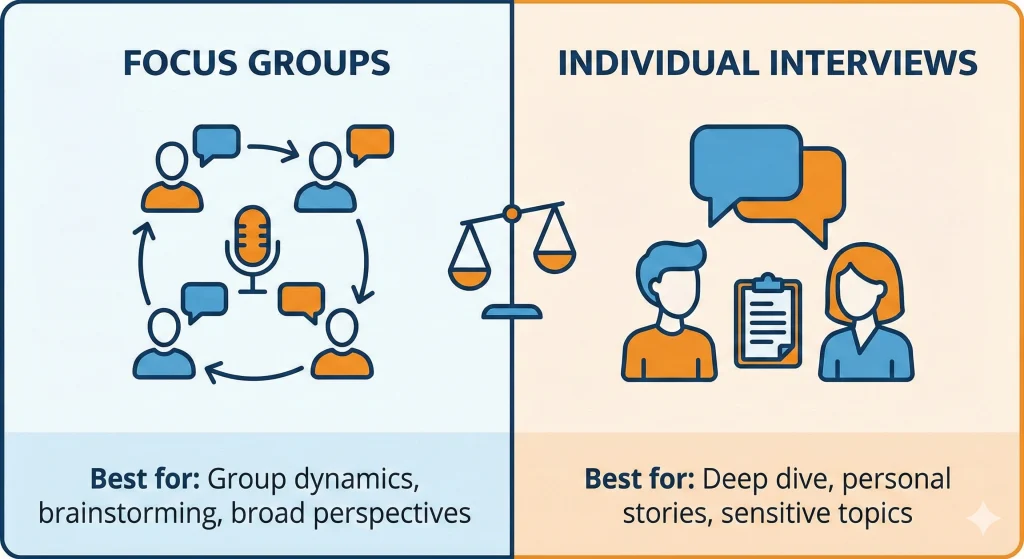
- You Want to Scout Perceptions and Why People Think That Way: The focus groups are most effective in exploration at the initial stages. They allow you to listen to the conversation people have on a subject, their vocabulary, and the arguments they provide. They are perfect when it comes to testing of messages, learning the vocabulary of the community and generating hypotheses.
- You Want Co-Creation or Feature Prioritisation: The participants develop each other’s ideas in a manner that is not seen in the one-to-one interviews. A single comment can lead to another idea, and new dimensions are created due to discussion. This dynamism renders focus groups useful in product development and service design.
- You Wish to See the Social Norms and Group Dynamics: Where peer influence is important, the focus groups allow you to see it at work. Group interaction occurs through workplace culture, consumer choices influenced by social circles and community behaviours.
- You Can Fall into Focus Group Pitfalls: Vigorous moderation does not allow the voices of dominance to eradicate other voices. Formal turn-taking and facilitation offer minority perspectives. Prepared to handle these challenges, focus groups provide a fertile source of data that individual interviews will never have.
When Interviews Work Best
- You Learn Intimate, Intensive Subjects: Privacy encourages honesty. When participants are not heard by others, they share more. Interviews minimise the social desirability aspect and allow room to disclose honestly about issues like health, finances, or hardships in life.
- You Need Deep Detail: Decision Pathways, Their Experience: Interviews allow you to pursue the path of walking me through it and digressions that lead to vital background. You can witness unusual events, tricky decision-making, and the entire cycle of personal experience, which cannot be realised in group formats.
- You Hire Employees or difficult-to-reach respondents: It is almost impossible to organise the schedules of a focus group when the participants are busy professionals, geographically spread, or in high demand. One-to-one interviews can be done according to the individual’s availability and relieve participants of the heavy load.
- You want to Minim Conformity and Harness Minority Opinions: The use of groups can muffle down counsellary voices. The interviews safeguard the views that could be lost in a room where all other people are on the same side. Interviews are usually more appropriate when you need a comprehensive coverage of the points of view on your research question.
What to Do: Which is better, Focus Groups or Interviews?
- Correlate the Method with the Research Question: When your question is how people talk about this together, then select focus groups. When you pose the question how did it happen with you? select interviews. This basic test clears the majority of misunderstandings. In an effort to access Fast Publications, researchers observe that effective methodological reasoning enhances the reaction of a reviewer.
- Make a Decision based on Feasibility and Risk: Take into account logistics, schedule, the budget, and the secret ballot. The skilful moderation and organization is required in focus groups. Total hours of interviews are higher, but they have flexibility in schedule. Both approaches have valid results as they would yield results when consistent with real constraints.
- When the stakes are too high, then use a Mixed Approach: Begin with focus groups to map themes and learn more about language, and then proceed with interviews to get down to ultra experience. Alternatively, start with interviews in order to determine sensitive areas, which are then tested in a focus group. Many of the mixed designs strike a chord with the reviewers in Elsevier journals if the reasoning is well spelt out.
Tips for Designing Working Practically
- Sampling and Recruitment: Get the participants who reflect the diversity that concerns your question. Take into account difference in position, grade of experience, location, or exposure to whatever you are researching. Record your approach to recruiting.
- Build a Strong Guide: Open questions should be used, and allow elaboration. Set probes to pursue on preliminary responses. Have a list of topics you must cover, but have the freedom to go off the topic.
- Moderate and Interview in Active Voice: Ask one question at a time. Ask concrete examples instead of abstract opinions. Recap what you heard and prompt participants to confirm that it was understood. These practices enhance the quality of data and minimise the ambiguity in the analysis.
Reporting and Analysis Which Reviewers Understand
- Show Rigour in Analysis: State whether you applied inductive or deductive coding. Explain how various analysts came to a consensus on codes and how you dealt with disagreements. Record your work so that anyone can evaluate the validity of your results.
- Reporting for Publication Situations: Relevant topics and short explanatory quotes. Return every theme to your research question. Limitations should be clear and tied to your methodological decisions instead of generic DISCLAIMERS. These degrees of method and finding transparency and association are rewarded in journals and workflows that are typical of Elsevier publishing ecosystems.
Conclusion
Interaction and shared meaning are captured through focus groups. There is richness and privacy in interviews. Select, depending on your research question, the sensitivity of your topic and the practical limits you have.
Once you align purpose to method, your data makes a better narrative, and your text has a higher success rate with reviewers. The correct decision is going to save time in the analysis process and will empower your arguments throughout the writing process.