There is no single answer. A research paper can move through the publication process relatively quickly. Another paper can take much longer. The difference often comes from the journal, research field, editorial workload, reviewer availability, revision requirements, and production process.
Researchers also use the word “publication” to describe several different events. That creates confusion.
A paper can be:
- submitted
- under review
- accepted
- published online
- assigned to an issue
- indexed in a database
These are not the same milestone. If you need a paper for a graduation requirement, promotion, funding condition, or academic deadline, that distinction becomes critical. This guide explains the full research paper publication timeline so you can plan realistically.
كم يستغرق نشر البحث العلمي؟
Researchers searching in Arabic often ask كم يستغرق نشر البحث العلمي or مدة نشر البحث العلمي. The most accurate answer is that there is no universal publication period.
The complete process can take considerably longer than the time spent in peer review alone.
A researcher may need to account for:
manuscript preparation → journal selection → editorial screening → peer review → revisions → acceptance → production → online publication → indexing
This is why asking only about “review time” can produce an incomplete picture. If you have an academic deadline, calculate the entire process.
Stage 1: Research Preparation
Publication time begins long before you click “Submit.” Researchers first need to complete the study.
That may involve:
- Research design.
- Ethics approval.
- Data collection.
- Laboratory work.
- Fieldwork.
- Statistical analysis.
- Qualitative analysis.
- Interpretation.
- Literature review.
The length of this stage depends entirely on the research. A secondary-data study may move quickly and a clinical study may require months or years.
A longitudinal project may require an extended observation period. Therefore, do not calculate publication time from submission alone if you have an external deadline.
Stage 2: Manuscript Preparation

Once the research is complete, the manuscript needs to be prepared.
This usually includes:
- Structuring the paper.
- Writing the introduction.
- Developing the methods section.
- Presenting results.
- Writing the discussion.
- Preparing figures and tables.
- Checking references.
- Preparing supplementary files.
- Reviewing ethical declarations.
- Editing the language.
The time required depends on the complexity of the research. A paper that already has strong internal documentation may require less preparation. A fragmented draft may require substantial restructuring.
Stage 3: Journal Selection
Journal selection can take days or weeks. Do not treat it as a five-minute search.
Researchers need to evaluate:
- Scope.
- Audience.
- Article type.
- Indexing.
- Quartile.
- Publication model.
- Fees.
- Author guidelines.
- Recent papers.
- Review process.
The journal should also satisfy any institutional requirements. For Saudi researchers, this can be especially important because universities may apply different publication conditions. Journal selection should therefore happen before you promise yourself a publication date.
Stage 4: Submission
Once the manuscript is ready, the author submits it through the journal’s submission system. This stage may take only a few hours. But submission itself is not the beginning of peer review. The journal first checks whether the manuscript can enter the editorial process.
Make sure you submit:
- Correct manuscript file.
- Figures.
- Tables.
- Supplementary material.
- Cover letter.
- Author information.
- Declarations.
- Required statements.
Missing information can create avoidable delays.
Stage 5: Technical Check
The journal may conduct an initial technical assessment.
Staff may check:
- File requirements.
- Formatting.
- Word count.
- Figures.
- References.
- Author information.
- Ethics statements.
- Required declarations.
Some journals also use screening tools during the initial process. If problems appear, the journal may return the manuscript to the authors before editorial assessment. This creates a delay that researchers often overlook.
Stage 6: Editorial Screening

The editor then evaluates whether the manuscript belongs in the journal.
This is where the journal considers issues such as:
- Scope.
- Research quality.
- Novelty.
- Methodology.
- Writing quality.
- Article type.
- Potential relevance to the readership.
The editor may reject the paper without external peer review, which is known as a desk rejection.
The length of this stage varies considerably between journals. Do not assume that a quick editorial decision means the journal will also complete peer review quickly.
Stage 7: Reviewer Assignment
If the manuscript passes editorial screening, the editor may invite reviewers. This can become one of the most unpredictable stages. A journal may need to invite several researchers before enough reviewers agree.
Reviewers can decline. They may have competing commitments. They may not respond. The editor may need to send additional invitations. That means the time between editorial screening and actual peer review can vary significantly.
Stage 8: Peer Review
The reviewers evaluate the manuscript according to the journal’s process.
They may assess:
- Research question.
- Methodology.
- Analysis.
- Results.
- Interpretation.
- Novelty.
- Literature.
- Limitations.
- Presentation.
The journal then receives reviewer reports. The editor makes the decision.
Possible outcomes include:
Accept
Minor revision
Major revision
Reject
Some journals use additional decision categories. The important point is that peer review is not a fixed-duration service. Researchers should not build a deadline around an assumed review period unless the journal provides reliable information.
Stage 9: Revision
Revision can take longer than the initial submission. A minor revision may involve targeted changes.
A major revision can require:
- Additional analysis.
- New literature.
- Methodological clarification.
- Rewritten sections.
- New tables.
- New figures.
- Expanded limitations.
- Substantial responses to reviewers.
The author controls much of this stage. That means researchers can often reduce delays by responding carefully and systematically. Create a response document that addresses each reviewer comment. Show what changed. Explain why you made the change. If you disagree with a suggestion, provide a reasoned academic response.
Stage 10: Resubmission
After revision, the manuscript returns to the journal.
The editor may:
- Accept it directly.
- Review the changes internally.
- Send it back to the original reviewers.
- Request further revision.
- Reject it.
A major revision can therefore create another complete review cycle. This is one reason publication timelines can expand unexpectedly.
Stage 11: Acceptance
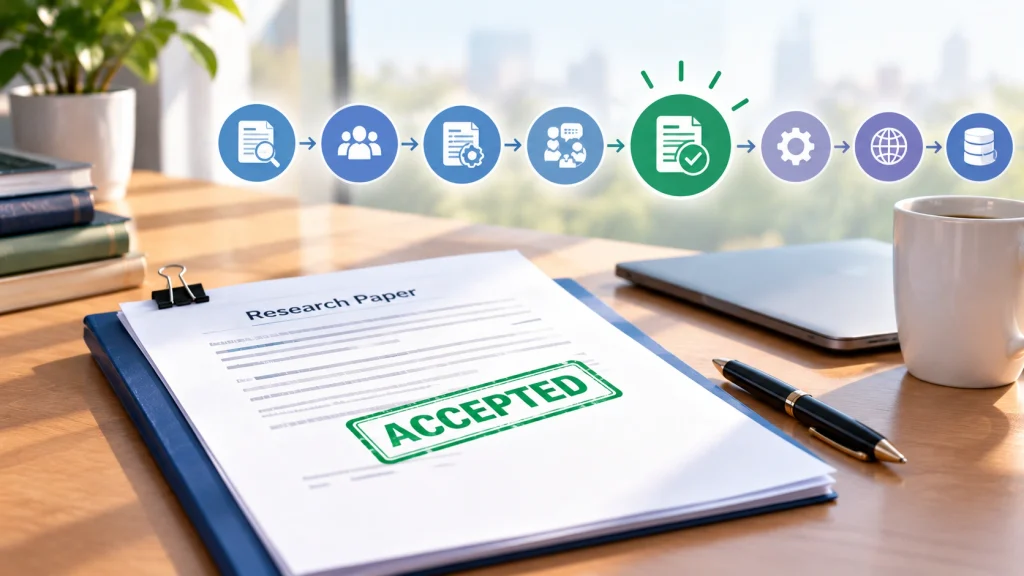
Acceptance means the journal has decided to publish the manuscript. This is a major milestone. But the paper may not yet be publicly available.
That distinction matters. If your university requires a published article rather than an accepted manuscript, acceptance alone may not satisfy the requirement.
Check the exact policy that applies to you.
Stage 12: Production
After acceptance, the manuscript may enter production.
The publisher can handle:
- Copyediting.
- Typesetting.
- Proof preparation.
- Metadata.
- DOI assignment.
- Figure processing.
- Author proof review.
The author may receive proofs. Review them carefully.
Look for:
- Author names.
- Affiliations.
- Tables.
- Figures.
- Equations.
- References.
- Special characters.
- Funding information.
Production errors can be corrected more easily before final publication.
Stage 13: Online Publication
Many journals publish articles online before placing them into a traditional issue. The terminology varies.
You may see terms such as:
- Online first.
- Early view.
- Advance article.
- Articles in press.
- Early access.
Once published online, the article may have a DOI and full bibliographic information. However, this does not necessarily mean every database has indexed it yet.
Stage 14: Indexing
Indexing is another stage. This is particularly important for researchers who need Scopus or Web of Science coverage. A journal can be indexed by a database. That does not mean every newly published article appears immediately. Database processing can take time. Researchers should therefore avoid treating publication and indexing as one event.
مدة نشر البحث في مجلة علمية
The phrase مدة نشر البحث في مجلة علمية refers to the time needed to move a manuscript through a journal’s publishing process.
That duration depends on several variables.
The journal may process one manuscript quickly and take longer with another.
Factors include:
- Editorial workload.
- Reviewer availability.
- Manuscript complexity.
- Number of revision rounds.
- Author response time.
- Production workload.
Researchers should therefore use journal-provided information as a planning reference rather than a guaranteed deadline.
كم يستغرق نشر بحث في سكوبس؟
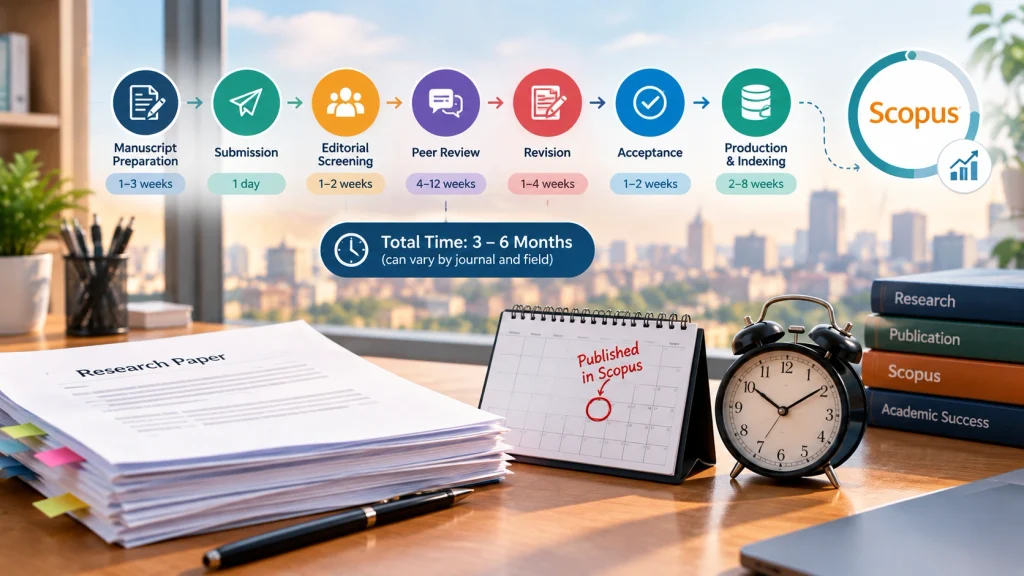
This question requires an important clarification. There is no Scopus publication time. Scopus is an indexing database. It does not conduct the peer review of your manuscript.
The journal handles submission, editorial assessment, peer review, revisions, and acceptance. The article then moves through publication. After publication, database processing may occur. Therefore, the actual sequence is:
Research → manuscript → journal → peer review → acceptance → publication → indexing
A researcher asking كم يستغرق نشر بحث في سكوبس should therefore distinguish between journal publication and Scopus indexing.
مدة النشر في مجلات سكوبس
The phrase مدة النشر في مجلات سكوبس can also be misleading. Scopus-indexed journals do not share one universal timeline.
Each journal controls its own:
- Editorial workflow.
- Reviewer process.
- Revision process.
- Production schedule.
Researchers should evaluate the specific journal rather than assume that Scopus status predicts publication speed. Indexing status tells you about database coverage. It does not create a standard review timeline.
Acceptance ≠ Publication ≠ Indexing
This deserves emphasis.
Imagine your paper receives acceptance on January 10.
That does not necessarily mean:
January 10: Published
or
January 10: Indexed in Scopus
You may instead have:
January 10: Accepted
February: Production
March: Published online
Later: Database indexing
The actual sequence depends on the publisher and database. If you have a deadline, work backward from the milestone your institution actually requires.
How Long Does Each Stage Take?
There is no universal timetable.
A realistic planning framework looks like this:
| Stage | Planning Consideration |
| Research preparation | Highly variable |
| Manuscript preparation | Depends on complexity |
| Journal selection | Several days to several weeks |
| Submission | Usually immediate |
| Technical screening | Variable |
| Editorial screening | Variable |
| Reviewer assignment | Highly variable |
| Peer review | Highly variable |
| Revision | Days to months |
| Acceptance | Depends on decision and revisions |
| Production | Publisher dependent |
| Online publication | Publisher dependent |
| Indexing | Database and publisher-dependent |
These should be treated as planning categories, not guarantees. A journal’s stated average review time can also change.
What Can Make Publication Faster?
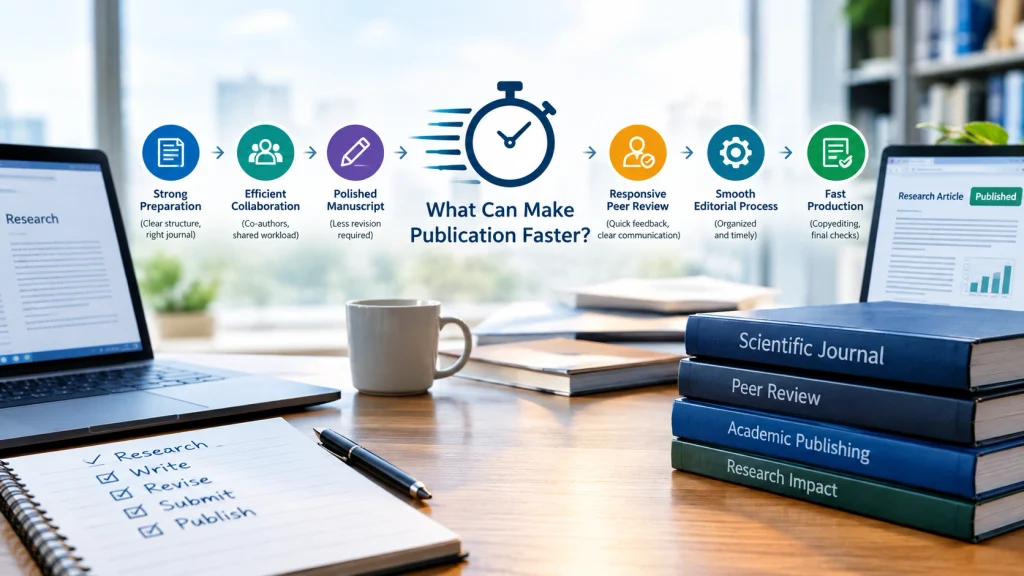
You cannot control every part of the process. But you can reduce avoidable delays.
Choose the Right Journal
A strong scope match reduces the chance of immediate rejection.
Follow the Author Guidelines
Do not make editors request basic corrections.
Prepare the Manuscript Carefully
A clear manuscript is easier to evaluate.
Use Professional Editing When Necessary
Language and structural problems can slow the review process.
Check References
Incorrect citations create unnecessary corrections.
Prepare Figures Properly
Poor figures can create production problems.
Respond to Reviewers Systematically
Address every comment clearly.
Prepare a Journal Backup
If the paper is rejected, you can move quickly to the next appropriate journal.
What Can Make Publication Take Longer?
Several factors can extend the timeline.
Poor Journal Fit
The manuscript may receive a desk rejection.
Reviewer Shortages
The editor may struggle to find reviewers.
Major Revisions
The manuscript may require substantial changes.
Additional Analysis
Reviewers may request further work.
Multiple Review Rounds
A revised manuscript may return to reviewers.
Production Delays
Typesetting and proof processes can vary.
Indexing Delays
Database processing is separate from journal acceptance.
What About Fast-Track Publication?
Some journals offer expedited or fast-track options.
Researchers should examine these carefully.
Fast-track does not mean guaranteed acceptance.
It also does not necessarily mean immediate indexing.
Never select a journal simply because someone promises publication within days. A legitimate peer-review process still requires academic evaluation.
What If You Have a Fixed Deadline?
Work backward. Suppose you need a qualifying publication by June.
Do not start with:
“I need the paper published by June.”
Start with:
What does my institution define as qualifying?
Then determine whether it requires:
- Acceptance.
- Online publication.
- Issue publication.
- Scopus indexing.
- Web of Science indexing.
- A specific quartile.
These milestones have different timelines. Build a buffer. Do not plan to submit one week before the deadline.
مراحل نشر البحث العلمي: A Practical Planning Model
Researchers searching for مراحل نشر البحث العلمي are often trying to understand where delays can occur.
The process can be viewed as four broad phases.
Phase 1: Preparation
Research completion, manuscript writing, editing, and journal selection.
Phase 2: Editorial Evaluation
Submission, technical checks, and editorial screening.
Phase 3: Peer Review
Reviewer assignment, review, decision, revision, and resubmission.
Phase 4: Publication
Acceptance, production, online publication, and indexing.
This model makes the publication process easier to understand.
It also shows why publication time cannot be reduced to peer review alone.
A Better Way to Plan Your Publication

Use three dates.
Earliest Realistic Date
The fastest reasonable scenario.
Expected Date
Your most realistic planning target.
Contingency Date
The date that accounts for revisions or delays.
This is better than promising yourself one exact publication date.
For example:
Target: September
Expected: October
Contingency: November or later
The exact dates depend on the journal.
The principle is what matters.
How Fast Publications Support the Process
Publication timelines depend on many factors. Researchers cannot control editorial workload or reviewer availability. They can control the quality of the manuscript they submit.
Fast Publications provides services covering research article assistance, scientific and technical editing, manuscript editing, journal submission support, publication strategy services, plagiarism and similarity reports, and resubmission support.
These services can help researchers prepare manuscripts before submission and address problems during the publication process.
However, no ethical publishing service can guarantee acceptance, peer-review outcomes, publication dates, or indexing timelines.
Those decisions remain with the journal and relevant indexing databases.
Conclusion
So, how long does it take to publish a research paper? There is no universal number. The publication timeline depends on the research, manuscript, journal, reviewers, revisions, production process, and indexing workflow.
The most important distinction is simple:
Acceptance is not the same as publication.
Publication is not the same as indexing.
For researchers searching كم يستغرق نشر البحث العلمي, the answer should therefore focus on the entire publication journey. The same applies to مدة نشر البحث العلمي and مدة النشر في مجلات سكوبس.Researchers who understand these stages can plan more realistically.
This matters especially when publication supports a PhD requirement, faculty promotion, funding condition, or institutional research target.
Do not plan around an attractive promise such as “fast publication.” Plan around the complete academic process. A well-prepared manuscript, appropriate journal, realistic timeline, and contingency plan give you a much stronger publication strategy.
Frequently Asked Questions
How long does it take to publish a research paper?
There is no fixed timeline. The process depends on the journal, review process, revisions, production, and indexing.
كم يستغرق نشر البحث العلمي؟
لا توجد مدة ثابتة لنشر البحث العلمي. تختلف المدة حسب المجلة، والتحكيم، والتعديلات المطلوبة، والإنتاج والنشر والفهرسة.
How long does peer review take?
It varies by journal, discipline, reviewer availability, and manuscript complexity.
What is the مدة نشر البحث في مجلة علمية?
The duration varies between journals. Researchers should check the specific journal’s stated editorial and publication timelines.
How long does it take to publish a paper in Scopus?
There is no universal Scopus publication timeline. The journal handles peer review and publication, while indexing occurs separately.
What are the مراحل نشر البحث العلمي?
The main stages include manuscript preparation, journal submission, technical screening, editorial assessment, peer review, revision, acceptance, production, online publication, and indexing.
Does acceptance mean my paper is published?
No. Acceptance means the journal has agreed to publish the manuscript. Production and online publication may happen later.
Can I guarantee publication by a specific deadline?
No. Researchers can reduce avoidable delays, but editorial decisions, peer review, production, and indexing remain outside their full control.
Does fast-track publication guarantee acceptance?
No. Legitimate expedited services do not remove the journal’s editorial and peer-review decisions.