If you are preparing a research manuscript for submission to a Scopus-indexed or Web of Science journal, the way you handle participant data matters as much as your methodology. Two terms appear everywhere in research ethics guidelines, data protection law, and IRB requirements. They are routinely confused: anonymization and pseudonymization.
They sound similar, but they are not. Confusing them has led to GDPR enforcement actions, journal retractions, and IRB non-compliance findings. The European Data Protection Board (EDPB) published landmark guidelines on pseudonymization in January 2025, and in September 2025, the EU Court of Justice issued a ruling that redefined when pseudonymized data is considered personal data.
This guide explains both concepts clearly, shows where they differ, and tells you which one to use for your research so your manuscript is compliant, publishable, and ethically sound.
| Anonymization permanently removes all identifiers so individuals can never be re-identified. Once truly anonymized, data falls outside GDPR. Pseudonymization replaces identifiers with codes but retains a key that allows re-identification, meaning pseudonymized data remains personal data under GDPR and full compliance obligations still apply. |
What Is Anonymization?
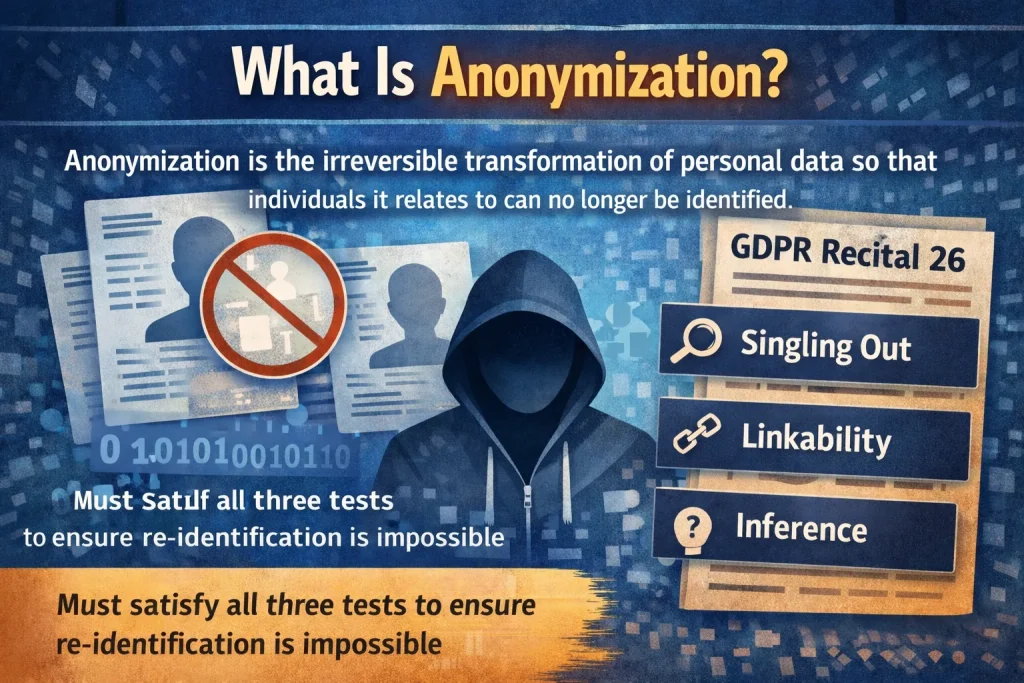
Anonymization is the process of irreversibly transforming personal data so that the individuals it relates to can no longer be identified, directly or indirectly by any means that are reasonably accessible.
Under GDPR Recital 26, data is considered truly anonymous only if re-identification is not possible using any method reasonably available, considering current technology, cost, and time. The Article 29 Working Party (now the EDPB) established a three-test standard that anonymized data must satisfy:
- Singling out — Can a record be isolated to a specific individual?
- Linkability — Can two or more records belonging to the same person be linked?
- Inference — Can information about an individual be inferred from the dataset?
If the data passes all three tests, it may be considered anonymous. Once data is genuinely anonymized, it falls outside the scope of GDPR and most national data protection laws. It mean you can share it publicly, use it in open-access publications, and store it indefinitely without triggering consent or retention obligations.
Common Anonymization Techniques
- Data suppression: Removing direct identifiers (names, national IDs, email addresses)
- Data aggregation: Combining records so individual-level data is not visible
- Generalization: Replacing specific values with ranges (e.g., age 34 becomes “30–39”)
- Data masking: Replacing characters with placeholders (e.g., j***@g*****.com)
- Noise addition: Introducing statistical noise to prevent exact identification
The Limits of Anonymization
True anonymization is harder than it appears. Research has repeatedly shown that supposedly anonymized datasets can be re-identified by combining them with other publicly available information. This is why the EDPB standard is significantly higher than most researchers expect and why organizations that classify pseudonymized data as anonymous and treat it accordingly have faced enforcement actions across Europe.
What Is Pseudonymization?
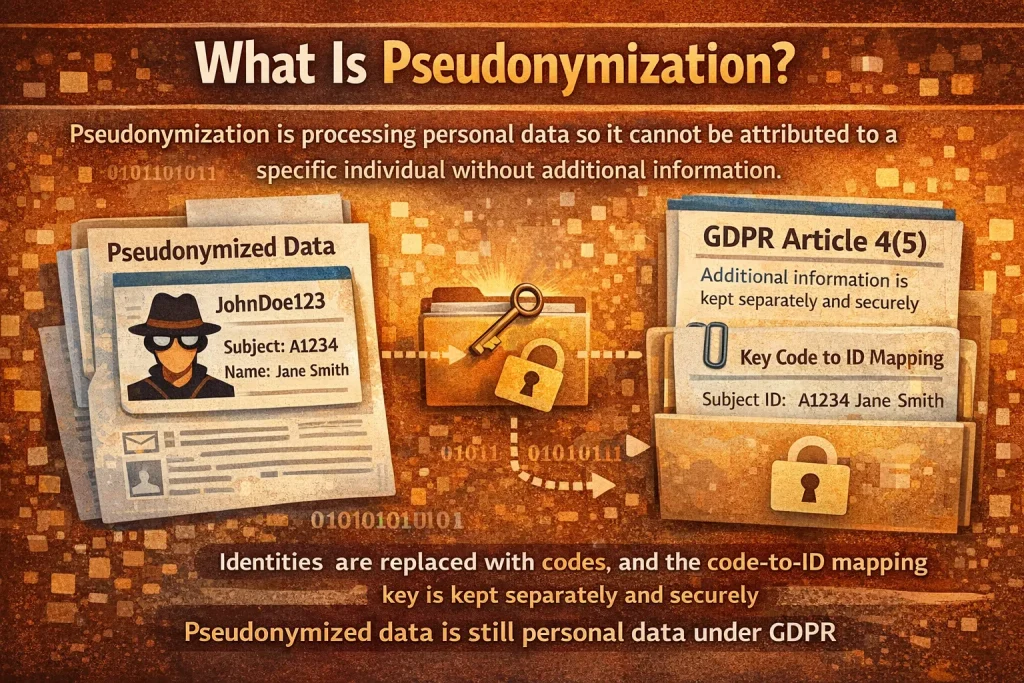
Pseudonymization is defined in GDPR Article 4(5) as the processing of personal data in such a manner that it can no longer be attributed to a specific data subject without the use of additional information provided that additional information is kept separately and is subject to technical and organizational measures.
In plain terms: you replace identifying information (a patient’s name, ID number, or email address) with a code. You store the code-to-identity mapping in a separate, secured system. The data remains useful for research because its structure and relationships are intact, but any person who accesses the pseudonymized dataset without the key cannot identify the individuals in it.
Crucially, pseudonymized data is still personal data under GDPR. The entity that holds both the pseudonymized data and the key holds personal data and must comply with all GDPR obligations.
The EDPB’s 2025 Pseudonymization Guidelines
In January 2025, the European Data Protection Board released comprehensive guidelines on pseudonymization for public consultation. These guidelines outline four core requirements:
- Transform personal data using cryptographic algorithms (e.g., message authentication codes, hash functions with salt) or lookup tables.
- Store the pseudonymization key separately and apply strict access controls, decentralized storage, and organizational security measures.
- Implement technical and organizational measures (TOMs) to safeguard against unauthorized re-identification.
- Continuously monitor re-identification risks and document all decisions in a Data Protection Impact Assessment (DPIA) when required.
The September 2025 ECJ Ruling: A Landmark Clarification
In European Data Protection Supervisor v Single Resolution Board (C-413/23 P), the EU Court of Justice issued a ruling on 4 September 2025 that clarified when pseudonymized data is treated as personal data. The Court held that pseudonymized data is not automatically personal data for all parties. Its classification depends on whether the recipient can reasonably re-identify individuals, taking into account technical, organizational, and legal factors.
This decision expands options for organizations sharing pseudonymized data for AI training, analytics, and secondary research but only where the recipient demonstrably cannot re-identify individuals. Researchers must now conduct case-by-case assessments and document their findings carefully.
Anonymization vs Pseudonymization: Side-by-Side Comparison
| Feature | Anonymization | Pseudonymization |
| GDPR Scope | Falls OUTSIDE GDPR | Remains INSIDE GDPR |
| Reversibility | Irreversible (permanent) | Reversible with key |
| Re-identification risk | None (theoretically) | Possible with additional info |
| Data utility | Lower (identifiers removed) | Higher (structure retained) |
| Best for | Public data sharing, statistics | Clinical research, longitudinal studies |
| EDPB guidelines | Must meet 3-test standard | EDPB 2025 guidelines apply |
| Enforcement risk | Minimal if truly anonymous | Full GDPR obligations |
Which Should You Use in Your Research?
The choice depends on your research design, how you intend to use the data, and whether you need to link records across time or to individual participants.
Use Anonymization When:
- You are publishing aggregate statistical findings and do not need to track individuals
- You are sharing data publicly or with third-party researchers who have no ongoing relationship with your institution
- You are preparing open-access datasets for a journal requiring data availability
- Re-identifying participants at any point in the future is neither necessary nor legally permissible
- You can verify that the data passes the EDPB three-test standard
Use Pseudonymization When:
- Your research involves longitudinal data collection where you must track the same individuals across multiple time points
- You are conducting clinical research, patient monitoring, or epidemiological studies
- IRB or ethics review requires the ability to withdraw participant data upon request
- You need to link datasets across different phases of a study
- Partners or sub-processors need access to data but should not hold identifiers
| Researcher Tip Many academic journals now require a data availability statement with your submission. Clarifying whether your dataset is anonymized or pseudonymized and under which framework is increasingly expected by editors and peer reviewers. Getting this language right early can prevent delays at the manuscript revision stage. |
Practical Implications for Your Manuscript
When you submit a research paper involving human participant data, editors and reviewers increasingly check for proper data protection language. Here is what to include:
In Your Methods Section
- Specify whether data is anonymized or pseudonymized
- Name the technique used (e.g., hash-based pseudonymization with salted keys, k-anonymity, data suppression)
- State where the pseudonymization key is stored and who holds access
- Reference the ethical approval received (IRB, REC, or equivalent) and whether a DPIA was conducted
In Your Ethics Statement
- Confirm GDPR or applicable national law compliance
- State whether data sharing is possible and under what conditions
- If using secondary data, confirm it was genuinely anonymized before you received it
Common Mistakes That Lead to Rejection
- Claiming data is “fully anonymized” when it is actually pseudonymized, reviewers increasingly catch this
- Not addressing re-identification risk when working with small or specialized populations
- Using the terms interchangeably in your methods, this signals to reviewers a lack of methodological rigor
GDPR Compliance Checklist for Researchers
Before submitting your manuscript, use this quick reference:
- Have you confirmed whether your data is truly anonymous or pseudonymized?
- If pseudonymized: Is the key stored separately from the data?
- Have you completed a DPIA where high-risk processing is involved?
- Have you documented your technical and organizational measures?
- Does your ethics statement accurately reflect your data protection approach?
- If sharing data with third parties: Have you assessed whether they can re-identify individuals?
- Are all staff handling data trained on your pseudonymization procedures?
Conclusion
The difference between anonymization and pseudonymization is not a technicality. It determines whether your data falls under GDPR, how your ethics statement should be written, and how your manuscript handles data availability requirements. With EDPB’s 2025 pseudonymization guidelines and the September 2025 ECJ ruling now reshaping compliance expectations, researchers need to be precise about the language and methods they use.
If you are unsure how to describe your data handling approach in your manuscript, or if your research is intended for a Scopus-indexed or high-impact journal with strict ethical compliance expectations, our team at Fast Publications can help you navigate this with confidence.
| Need Help Getting Your Manuscript Published? Fast Publications provides expert journal submission support, manuscript editing, and research compliance guidance for Scopus, Web of Science, and high-impact journals worldwide. Explore our Journal Submission Support: fastpublications.com/journal-submission-support |