You may be familiar with terms Q1, Q2, Q3, and Q4 journals within academic publishing. Quartiles are frequently employed to rank journals according to their impact, reputation, and performance regarding citations. But what do they represent and how should it be used by researchers when they are making a decision on where to publish?
At Fast Publications, we assist researchers in selecting the appropriate journals for their papers to have greater acceptance and visibility. In this article, we are going to define the difference between Q1, Q2, Q3 journals, how quartiles are calculated, and how you can strategically use them to propel your academic career.
What Are Journal Quartiles? Q1 vs Q2 vs Q3 Journals
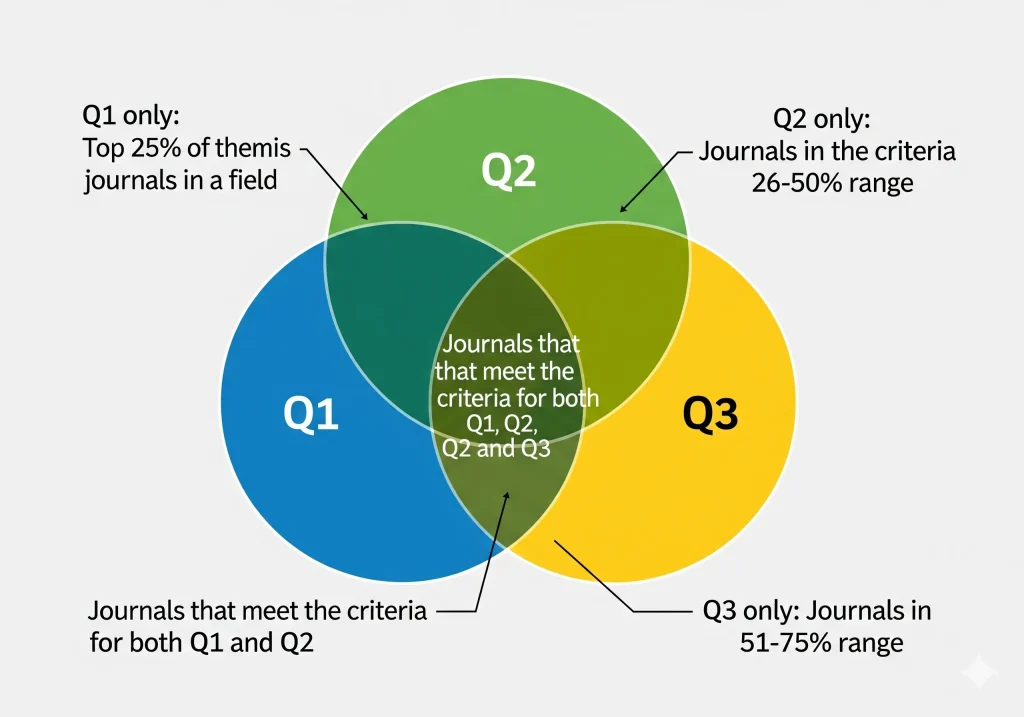
Journal quartiles split academic journals into four quartiles on the basis of their impact factor or citation count within a given subject category. The ranking is most often derived from Scopus (through SCImago Journal Rank – SJR) or Web of Science (through Journal Citation Reports – JCR).
Q1 journals: Highest 25% of journals in a discipline.
Q2 journals: 25%–50% rank.
Q3 journals: 50%–75% rank.
Q4 journals: Lowest 25% of journals.
This categorization is beneficial as it enables researchers to evaluate the prestige and impact of a journal compared to other journals in the same field.
Q1 Journals: The Elite

Publication in Q1 journals is usually regarded as the “gold standard” in academic publishing.
Features of Q1 journals:
Greatest citation impact.
Global visibility and high readership.
Highly strict peer-review processes.
Institutions prefer them for promotions, grants, and recognition.
Benefits:
Enhances academic reputation.
Higher citation and collaboration possibilities.
Confirms funding applications.
Drawbacks:
Competition is very tight with low acceptance rates.
Longer review periods because of high submission numbers.
At Fast Publications, we assist writers in creating solid submissions to Q1 journals, with manuscripts adhering to stringent formatting, novelty, and methodological quality.
Q2 Journals: Balanced Prestige and Accessibility
Q2 journals remain very prestigious and usually offer a balance between visibility as well as acceptance rates.
Features of Q2 journals:
Good citation impact, albeit lower than Q1.
High readership as well as academic reputation.
Peer-review processes are comprehensive but can be less rigorous than Q1.
Advantages:
Greater chances of acceptance than Q1.
Still considered important for career advancement and academic recognition.
Faster timelines than top-tier journals.
Challenges:
Can be less prestigious than Q1.
Average citations could be lower.
For most researchers, publishing in Q2 journals is a strategic compromise, earning respect without facing the high level of competition from Q1 journals.
Q3 Journals: Affordable but Credible

Q3 journals are in the mid-lower quartile but are nonetheless valid sources to share research.
Features of Q3 journals:
Moderate citation influence.
Readership is more specific than in the case of Q1 and Q2.
Peer-review requirements are still there, although acceptance rates are more.
Benefits:
Simpler acceptance than with Q1 and Q2.
Shorter publication timeframes.
Even indexed in Scopus or Web of Science, providing global visibility.
Obstacles:
Reduced prestige in academic assessment.
Citations can be restricted.
At Fast Publications, we regularly recommend first-career scholars to publish in Q3 journals as a stepping stone, particularly if speed and early visibility matter most over quality.
How Are Journal Quartiles Calculated?
The distinction between Q1, Q2, Q3 journals is on ranking distribution within a subject category:
Gather citation data (through Scopus or Web of Science).
Rank journals by descending citation metrics (Impact Factor, SJR, or H-index).
Split into quartiles:
Top 25% → Q1
25–50% → Q2
50–75% → Q3
Bottom 25% → Q4
Example: Suppose there are 200 journals in a field, the top 50 will be Q1, the next 50 Q2, and so on.
Why Do Journal Quartiles Matter for Researchers?
It is critical for career and research visibility to know journal quartiles.
Institutional requirements: It is a requirement at many universities that faculty publish in Q1 or Q2 journals.
Grant applications: Funders take into account the quality of the journals on which research is published.
Career advancement: Q1 and Q2 publications have greater impact on promotion and tenure considerations.
Visibility of research: More readers and citations typically mean higher quartile journals.
Strategic Publishing: The Right Journal Quartile Choice
At Fast Publications, we advise selecting journals on both career and research requirements:
If prestige is your aim: Aim for Q1 journals.
If acceptability is important: Q2 provides visibility with improved chances of acceptance.
If speed and convenience are important: Q3 is a good option, particularly for researchers in the early stages of their careers.
Shared Misconceptions Regarding Journal Quartiles
“Only Q1 journals are important.” Not the case, Q2 and Q3 journals remain important and valued for scholarly development.
“Q3 journals are inferior quality.” Untrue, Q3 journals still endure peer review and indexing.
“Publishing in Q4 is useless.” Though not as prestigious, Q4 journals offer an opportunity for new researchers to come into the publication arena.
Final Thoughts
The main difference between Q1, Q2, Q3 journals is prestige, citation impact, and difficulty of acceptance. Though Q1 journals are the most prestigious, Q2 and Q3 journals are also of great value, especially for researchers who value accessibility, quicker turnaround, or are new to publishing.
At Fast Publications, we guide you through this maze of complexity, whether your objective is high-impact visibility or a quicker path to publication. The selection of the journal is not merely prestige, it’s getting the best outlet for your research.
FAQs
1. What are Q1 in journals?
Q1 journals are the highest 25% of journals in a discipline, recognized by high citation impact and prestige.
2. Are Q2 journals good?
Yes. Q2 journals are respectable and tend to offer a balance of credibility and greater acceptance opportunities.
3. Is it possible for me as a PhD student to publish in Q3 journals?
Yes, definitely. Q3 journals are an appropriate starting point for young researchers and continue to offer international exposure.
4. How can I determine whether a journal is Q1, Q2, or Q3?
You can look up databases such as Scopus (through SCImago) or Web of Science to obtain quartile rankings.
5. Is publishing in Q4 journals wrong?
Not really. Although less high-profile, Q4 journals also get you noticed and offer early-career researchers experience.
6. Does Fast Publications assist with targeting Q1 and Q2 journals?
Yes. We help with selection of the right journal, manuscript refinement, and strategies for submission to the best quartile journals.