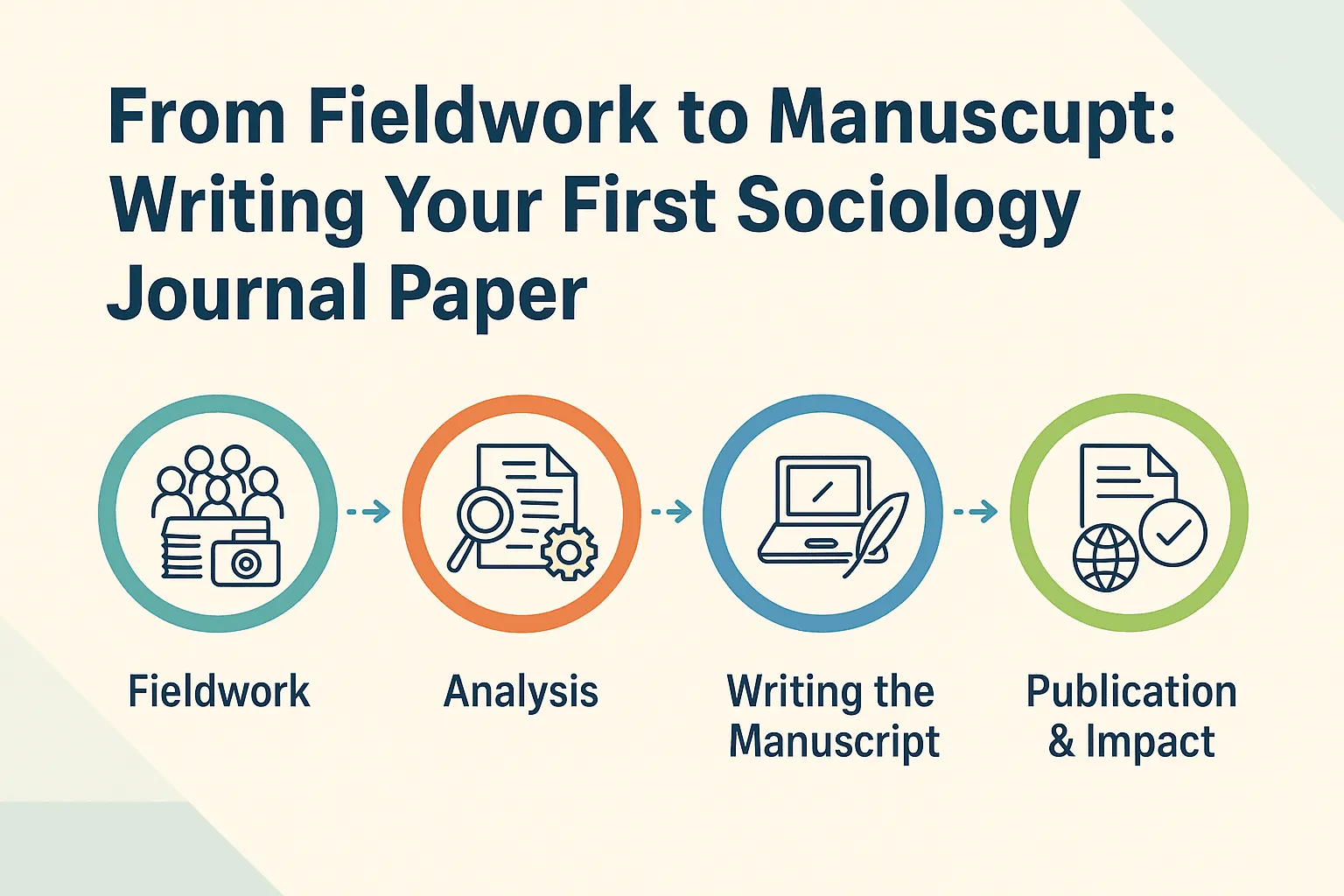
Writing your first sociology research paper can feel like a long journey, from the moment you step into the field with a notebook and recorder to the day you submit your polished manuscript. Each stage requires not just analytical skill but also clarity, structure, and adherence to academic standards. At Fast Publications, we guide early-career sociologists and researchers through every step of that journey. Whether your work involves ethnography, surveys, or social theory, understanding how to transform raw fieldwork into a publishable article is crucial for academic success.
Understanding the Transition from Fieldwork to Writing
The first challenge new researchers face is converting lived experience into analytical writing. Fieldwork produces an overwhelming amount of data, interviews, observations, notes, and transcripts. The key is to start by asking: What does my data reveal about the question I will answer?
Avoid the temptation to include every story or quote. Instead, focus on data that supports your research objectives and helps answer your central question. Reviewers appreciate concise, well-organised analysis that demonstrates clear reasoning rather than descriptive overload.
Build a Strong Theoretical Foundation
A sociology paper is only as strong as its theoretical grounding. Before writing, identify the sociological framework that best supports your interpretation, be it symbolic interactionism, conflict theory, feminism, or post-structuralism.
Theoretical clarity helps readers understand why your findings matter. It connects your work to existing sociological conversations and allows other scholars to situate your study within broader debates.
Avoid name-dropping theorists without integrating their ideas meaningfully. Instead, explain how each concept informs your analysis.
Outline Your Paper Early
A well-organised structure can make the difference between clarity and confusion. Most sociology research papers follow a standard structure:
- Abstract: Summarises your aims, methods, and findings.
- Introduction: Frames the research question and explains why it matters.
- Literature Review: Synthesises previous studies and identifies research gaps.
- Methodology: Details how you collected and analysed your data.
- Findings: Presents evidence using concise quotes, examples, or tables.
- Discussion: Interprets findings in light of theory and prior research.
- Conclusion: Highlights key insights and implications for future research.
Having this outline before you begin writing ensures that your argument stays cohesive and well-paced.
Write with Analytical Precision
Early drafts often read like extended descriptions of fieldwork rather than analysis. Reviewers look for sociological reasoning, the why behind the observations. After describing an event, always explain what it reveals about the larger phenomenon you’re studying.
For example, instead of writing:
“Participants often gathered informally after meetings.”
Expand it to:
“Informal gatherings after meetings reinforced community solidarity and served as spaces where social hierarchies were negotiated outside formal structures.”
That one sentence moves from observation to sociological insight, a critical difference between field notes and publishable writing.
Pay Attention to Methodological Transparency
Many first-time authors receive reviewer comments like “methods are unclear” or “sampling rationale missing.” Avoid this by clearly explaining how you collected your data, why you chose your participants, and how you analysed the material.
Be specific:
- How many interviews were conducted?
- What was the duration of the fieldwork?
- How did you code your qualitative data?
Methodological transparency signals credibility and builds trust with readers. It also demonstrates that your findings are grounded in rigorous research practices.
At Fast Publications, our qualitative research editing specialists ensure your methods section is detailed, coherent, and aligned with the expectations of top sociology journals.
Manage Your Data Ethically
Ethics are central to sociology. Always maintain participant confidentiality and secure consent when using direct quotes or personal stories. If you’re writing about vulnerable groups, anonymise identifying details carefully.
Explain how ethical standards were maintained in your study. Many journals now require a clear ethics statement. A transparent ethical approach not only meets publication requirements but also strengthens the moral authority of your research.
Use Simple and Clear Language
Good sociology writing is about clarity, not complexity. Avoid jargon-heavy sentences that obscure meaning. Reviewers and readers appreciate writing that communicates deep ideas in accessible terms.
For instance, instead of writing:
“The social actor’s positionality within the intersubjective discourse framework informs their praxis.”
Say:
“Each participant’s position in social hierarchies shaped how they interpreted shared experiences.”
That’s still academic, but clearer, direct, and far more readable.
Professional editing services, such as Fast Publications’ Sociology Research Paper Support, can help refine your tone, remove redundancy, and ensure stylistic consistency across your manuscript.
Integrate Citations Seamlessly
Citations should flow naturally within your argument. Avoid stacking multiple references without context. Instead, show how each source connects to your research.
Weak: (Smith, 2019; Jones, 2020; Ali, 2021)
Building on Smith’s (2019) work on social mobility and Jones’s (2020) critique of structural inequality, Jack (2021) extends the debate by examining how urban migration reshapes perceptions of class.
Using a consistent citation style (APA, ASA, or Chicago) is crucial. Incorrect referencing is one of the top causes of desk rejection. Our manuscript preparation services ensure that your paper meets the formatting standards of your target journal.
Revise and Seek Feedback Before Submission
First drafts are rarely final. Share your manuscript with mentors, colleagues, or writing groups before submitting. Constructive criticism helps you identify gaps in reasoning, unclear phrasing, or weak transitions.
When revising, read your paper as if you were a reviewer. Ask:
- Is the argument logically structured?
- Do data support claims?
- Is the tone objective and academic?
After revision, a professional editing and proofreading review ensures that your paper is polished, consistent, and error-free.
Choose the Right Journal
Even the best paper can be rejected if submitted to the wrong journal. Identify journals that align with your topic, theoretical framework, and methodological approach. Review recent issues to gauge scope and tone.
Some journals prioritise empirical studies; others value theoretical contributions. Adjust your paper’s framing and abstract to match the journal’s focus.
Fast Publications provides sociology research paper publication help, including journal selection advice and a submission-readiness assessment, helping authors avoid unnecessary rejection cycles.
Conclusion
From fieldwork to publication, writing a sociology paper is a process of transformation. You start as a researcher collecting stories and end as an author shaping those stories into scholarly knowledge.
By maintaining theoretical clarity, methodological transparency, and linguistic precision, your first paper can make a meaningful impact in the field.
At Fast Publications, we help sociologists refine their manuscripts for clarity, structure, and compliance with journal requirements. With expert editors and field specialists, we ensure your research moves seamlessly from field notes to published pages. Your insights deserve global reach. Let Fast Publications help you publish them with confidence.