The thesis question is: How many chapters does a thesis have? is haunting to all postgraduate learners. You do not wish to leave out anything that will please your committee, and you are afraid that you will be including stuff that is fluff and will undermine your argument. Although the exact number depends on the subject and university policies, most effective theses are structured on the basis of five to six chapters.
Going through these structural rules may need professional Research Paper Help to make sure that your story is concise and scholarly.
The Standard Five-Chapter Model
Most scientific and social science studies are conducted using the gold standard, namely the Big Five structure. This form gives a rational presentation of the first problem to the last conclusion.
Chapter 1: The Introduction
The first chapter preconditions you. You need to define the research problem, the importance of the research and your research questions. This is where you capture the interest of the reader and make him understand why your study should be there.
Chapter 2: The Literature Review
This chapter allows you to know your discipline. You are not merely stating abstracts of books, you are simply synthesizing the work of others to locate a gap. This is the point of difficulty of many students since they write about things and not about them. Professional Research Paper Help can help you to arrange these sources in themes and not a chronological list.
Chapter 3: Methodology

Think of this as your “recipe.” You will need to explain the way you collected and analyzed your data. Regardless of the techniques you adopted in qualitative interviews or quantitative surveys, another researcher can follow your footsteps by simply reading this chapter.
Chapter 4: Results
You are not biased in the presentation of your findings in the results chapter. Do not interpret the data yet. Break down the information with the help of tables, charts, and graphs. This chapter only dwells on what the data says.
Chapter 5: Discussion and Conclusion
This is the worst part of your thesis. You make a connection between your findings and your literature review in Chapter 2. Did you verify or disprove the results of other researchers? You also discuss the deficiencies of your work and propose a field of future research.
How do you know when you need to add more chapters?
Five chapters are not a fence, but a floor. You may have to expand, depending on your project.
- The Six-Chapter Model (Split Discussion): Other authors like splitting the chapters of the research into a Findings chapter and an Analysis chapter. This is typical in multi-layered qualitative studies in which the story needs to be set free.
- The Compilation Thesis: When you are doing an edition of Thesis by Publication, your format will appear different. Your introduction will be followed by three or four independent research papers (which will serve as chapters), and a summary on the conclusion.
- Humanities Research: In case you have to write a thesis in History or Literature, your chapters may be structured in chronological or thematically based order and not in the scientific method.
Basic Fallacies in Thesis Structure
Despite the rate of a clear number of chapters, many students get lost in the drafting process.
- Chapter Imbalance: This is a typical error: to write a 60-page literature review, and a 10-page results chapter. The core of the document should be your original contribution (the results).
- Absence of Transitions: The chapters ought to be connected one right up to the next. When your chapters sound like individual essays, then your thesis has no red thread, and that is the story that would hold everything.
- Excessive complexity of the Scope: Students tend to attempt to work out all the problems in their discipline. A good thesis is a thesis that addresses one particular problem in a profound manner.
What Fast Publications Can Do
In Fast Publications, we know that the technical requirements of a thesis may prevent one from focusing on the research itself. Our Research Paper Help is concerned with readability, coherence and integrity. We assist you with the mapping of your chapters, and you spend months of revision before you write your first word.
We provide:
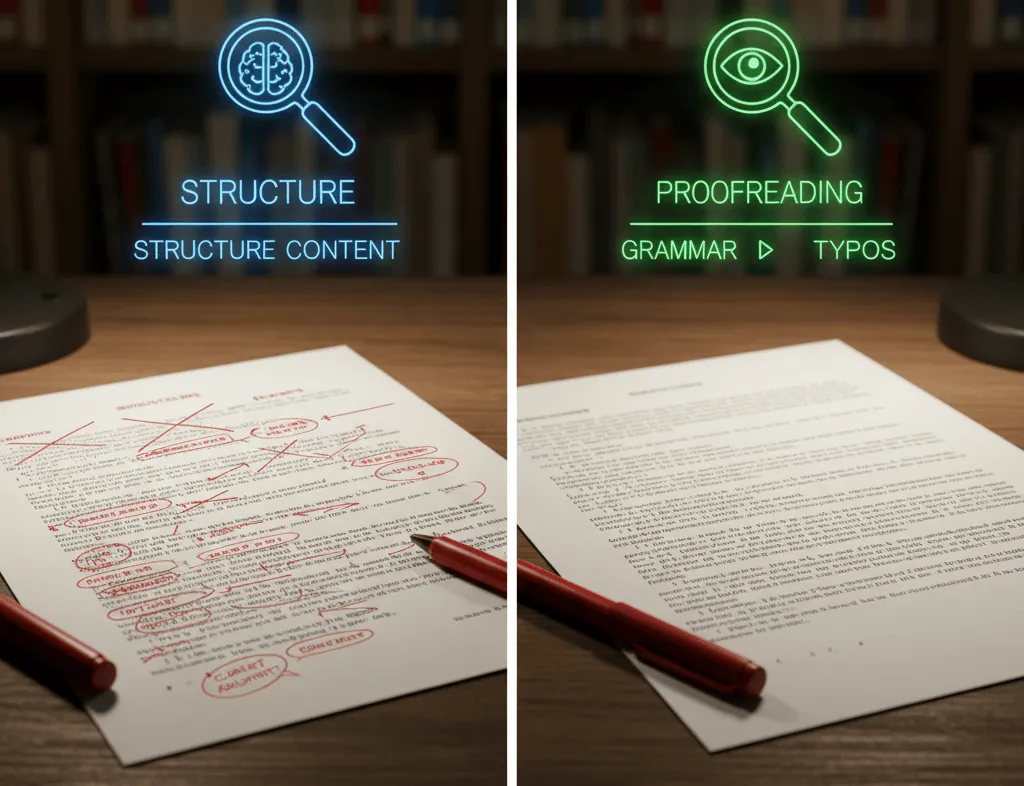
- Structural Audits: Have you left out important information in your methodology chapter?
- Thematic Mapping: We assist you in structuring your literature review into a significant argument.
- Formatting the Excellence: We also make sure that your citations and headings are to the right standards of your university.
Final Thoughts
The aim is still the same, whether your thesis consists of five or eight chapters, it must be clear and contribute to something. Begin with the default model and only add when your data needs it. With a narrow and focused concentration on an efficient and rational organization, you increase the ease with which your committee is able to say yes to your defense.