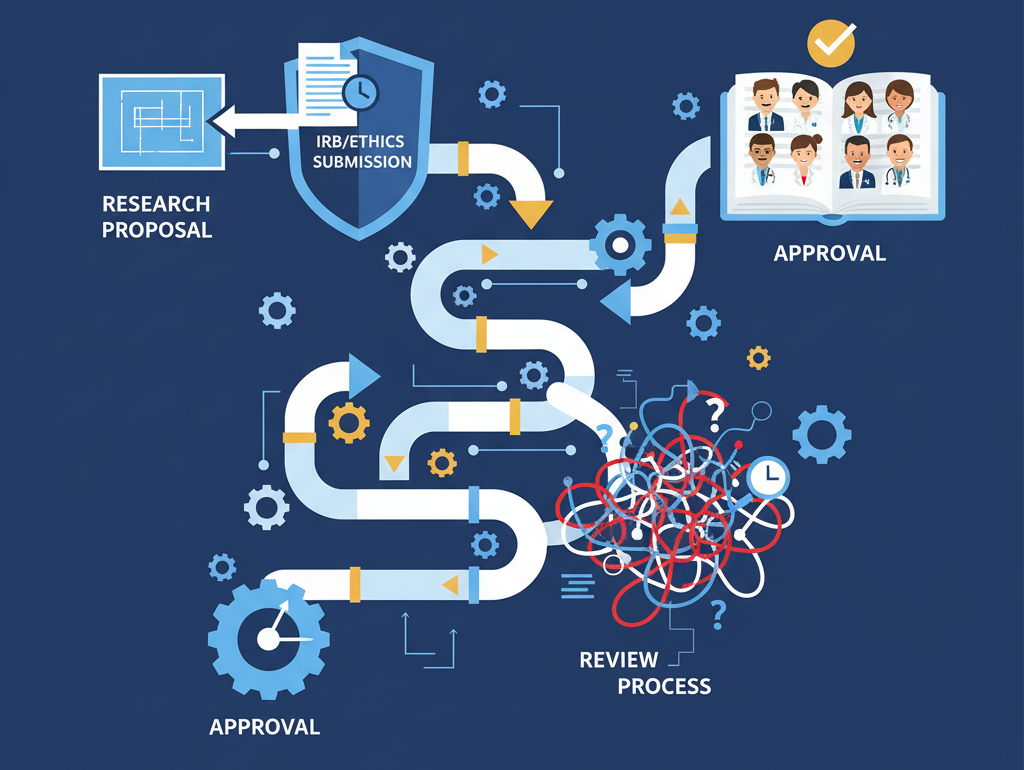
The institutional Review Board (IRB) or Ethics Board is a very important and in many cases a very demanding phase of research. It makes your study ethical and safeguards the human subjects. However, this step may be seen by many researchers as a bottleneck which postpones publication. In cases of consultancies that provide Journal Submission Assistance and want to be published as quickly as possible, it is necessary to simplify this process.
Researchers can use this to demystify the IRB/Ethics Board review process and find strategies that assist them in planning and avoiding the most frequent ethical challenges.
IRB /Ethics Board Mandate
The initial one is to know the purpose of the existence of IRBs and Ethics Boards. These committees examine any research conducted on a human subject to make sure that it is within the ethical and legal limits. Three major principles lead their decisions:
- Beneficence: Do good to the participants and society as much as possible and as little as possible.
- Respect of Persons: Guarantee personal autonomy and provide an additional protection to the vulnerable groups like children or prisoners. This is the principle which informs the consent process.
- Justice: Ensure that researchers distribute the benefits and the burdens of research equally.
Pre-Submission Preparation: Preparation of the Groundwork

The best path to the pinnacle of approval and eventually publication is a proper submission.
1. Extraction of the Right Review Type
The first one is that they apply to a review category that is not the correct one.IRBs usually categorise the reviews into:
- Exempt: Research where the risks are minimal, e.g. anonymous surveys or education research.
- Expedited: The least risky research that has non-invasive data collection.
- Full Board: Studies that are of greater risk than minimal or where the study subject is vulnerable.
2. Build a Flawless Protocol
The main feature of your submission is your research protocol. It has to be uniform, elaborate and simple to understand. Include:
- Goals: Be able to describe your research objectives and questions.
- Methodology: Elaborate participant recruitment, data collection and data analysis.
- Risk/Benefit Analysis: Document all the possible risks and provide the way they are going to be reduced. Prove that the gains are more than losses.
3. The Informed Consent Challenge
The Informed Consent Form (ICF) reflects the principle of the respect of persons and is the most scrutinized section of your work.
What to Include
A good ICF should explain, using simple language:
- The reason why the research was conducted and the identity of the researcher.
- Procedures and estimated time duration of the study.
- Emerging risks or discomposure.
- Anticipated advantages (or claim that there are no advantages possible)
- Potential substitutes (existent or not).
- The way confidentiality and data security will be ensured.
- A declaration that the participation is voluntary and can be canceled any time.
- Contact information of IRB and the researcher.
4. Ensure Readability
ICFs that are too complicated are often rejected by boards. Aim for the 8th reading level. Use simple words and short sentences. It is not aimed at legality but understanding. Having clear consent fosters trust and accelerates consent.
Addressing Vulnerable Populations and Data Security
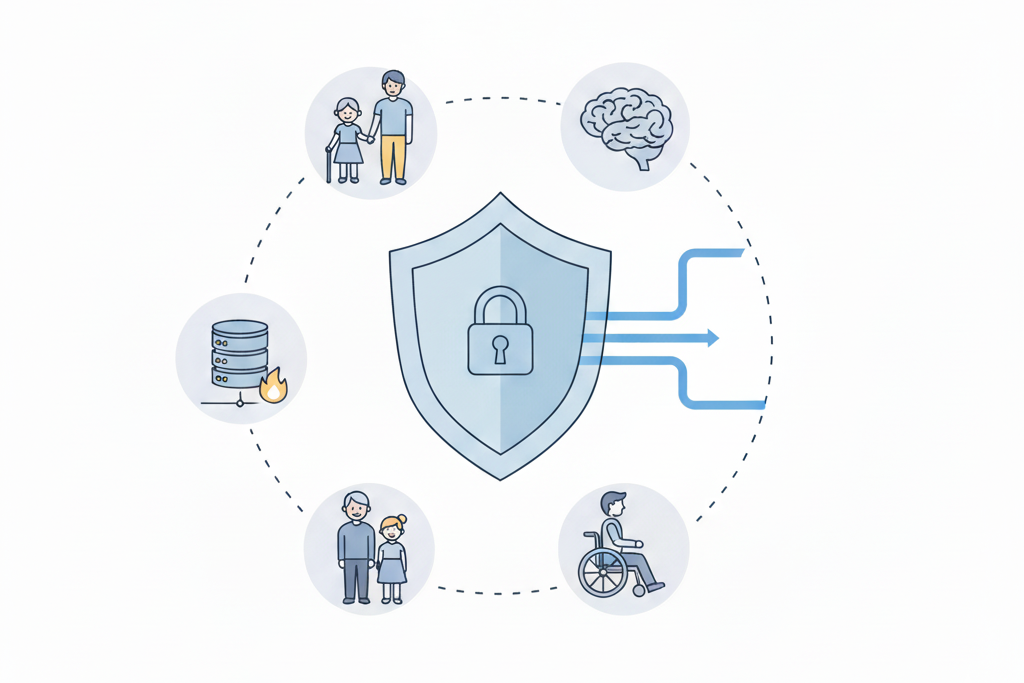
In case your research is with vulnerable populations, additional documentation is needed.
1. Vulnerable Populations
Provision of suitable consent documentation including:
- Assent Forms: simplistic explanations of the same when the minors or persons with limited understanding are involved.
- Proxy Consent: Procedures of the permission of a legally authorized representative.
2. Data Protection
There is an increasing ethical issue of data security. Explain how you will:
- Anonymize data by use of codes rather than names.
- Keep store information under super-protected files or locked storage.
- Destroy data, safely, after the retention period.
- Send data in an encrypted manner when passing electronically.
The inclusion of these details is important in that it helps in assuring the reviewers that the privacy of participants is safeguarded.
Responding to Revisions: The Feedback Loop
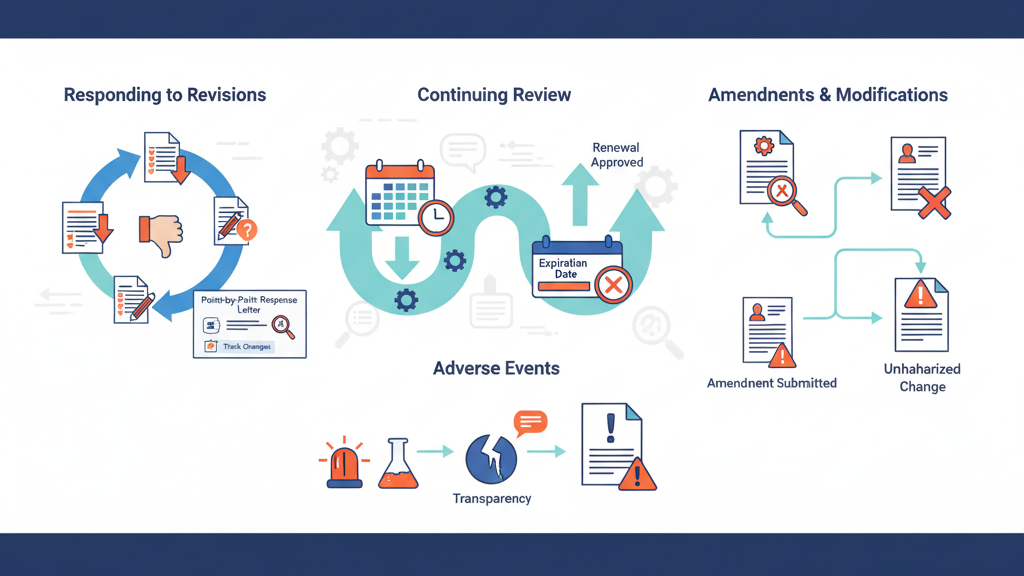
A limited number of studies are approved upon. It is a natural thing and it usually enhances your research.
1. Comprehend the Position of the Reviewer
The purpose of reviewers is to safeguard the participants, and not to hinder research. Their remarks indicate the points of ambiguity or possible danger.
2. Respond Strategically
- Response to Each Comment: Write a point by point response letter. Although you may disagree, please explain why we should.
- Track Changes: This allows highlighting changes to speed up the re-evaluation of the reviewer.
- Be Professional: Be polite and perceive criticism as a constructive comment.
An unambiguous, courteous reply can cut approval time by several folds, which is very important in aiming to make a quick publication.
3. Post-Approval Responsibilities and Amendments
The step of approval is not the last step. Constant compliance is very important to ensure that there is ethical integrity.
4. Continuing Review
In cases where the study takes over a year, the majority of boards have a continuing review which expires the approval. Failure to meet this deadline may also bring your research to a complete stop, a phenomenon that may cripple the publishing schedules.
5. Amendments and Modifications
There has been a significant evolution in the approach to finalize the contract. The way the finalization of the contract is going has undergone a significant transformation. Any modification to your approved protocol, even slight modifications should be passed by way of an amendment. Making unauthorized changes is a major breach of ethics.
6. Adverse Events
Notice of any unexpected issues or negative events must take place as soon as possible, according to institutional policies. Transparency is one way of maintaining your credibility and guarding your research history.
Conclusion: Ethics as a Booster
The process of the IRB/Ethics Board can be tedious, however, a properly timed ethical process can make the journey to publication even faster. When documents are transparent, consistent and infused with ethical considerations, the reviewers are faster in their response, the revision becomes lesser and the acceptance is predictable.
In the case of Fast Publications, which provide Journal Submission Assistance, the art of this step is crucial. Ethics reviews that are efficient and smooth will not just help protect the integrity of the research, but will also provide the basis on which data can be collected at a greater rate, analyzed more effectively, and the journal submitted much more quickly.
Ethics is not an obstacle, it is an impetus. Transparency, preparation, and open communication with the reviewers would enable researchers to make the ethical review process a formal, productive process towards quality, publishable science.