
Publishing your manuscript with a journal is only the first checkpoint in the research publishing process. When your paper reaches the Peer reviewers, you will most likely receive comments from the reviewers. The reviewers’ comments are meant to make your work stronger, help simplify your arguments, and make your work scholarly enough. But for a lot of authors, particularly new researchers, the experience can be daunting, stressful, and even overwhelming at times.
Knowing how to write a response to reviewer comments in an academic paper is an essential skill. How you navigate this phase usually decides whether your paper is finally accepted, revised, or rejected. At Fast Publications, we are experts at guiding authors to write professional, convincing, and polite responses that improve acceptance rates. This blog provides an in-depth guide on responding well to reviewer comments and transforming criticism into a growth opportunity.
Why Reviewer Comments Matter?
Reviewer comments are not a barrier, they are a guide. Peer reviewers critique your work through new eyes, pointing out spots where clarification, more evidence, or methodological improvement is needed. Through their observations, your manuscript is guaranteed to:
- Meet international scholarly standards.
- Fills knowledge gaps.
- Maintains accuracy and credibility.
- Aligns with the journal’s scope and audience.
Dismissing or ignoring reviewer comments nearly always results in rejection. Conversely, authors who address comments constructively demonstrate professionalism, integrity, and dedication to enhancing scholarship.
General Principles for Responding Reviewer Comments
As you craft your response letter and revised manuscript, follow these principles:
- Be professional and respectful: Refrain from an overly defensive or dismissive tone, even when disagreeing.
- Be clear and specific: Indicate specifically how you have responded to each suggestion.
- Be thorough: Answer each comment, no matter how minor.
- Be consistent: Make your manuscript revisions equal to your response letter.
- Be concise: Offer detail without repetition.
At Fast Publications, we train authors to find the ideal balance: courteous but assertive, descriptive but compact.
Step-by-Step Guide to Writing Your Response

1. Read All Comments Carefully
Avoid the temptation to begin revising right away. Study reviewer comments repeatedly and go through them with your co-authors. Misunderstanding a reviewer’s intention can be a waste of time.
2. Segregate the Feedback
Split comments into:
Major revisions: Changes in methodology, extra data, reorganization of sections.
Minor revisions: Language polishing, format changes, additional references.
This segregation will enable you to prioritize tasks and allocate time accordingly.
3. Prepare a Response Letter
Most journals demand a line-by-line response. The standard format consists of:
Quoting the reviewers’ statement.
Explaining your response.
Identifying precisely where the revision is found (page and line numbers).
4. Acknowledge and Appreciate Feedback
Begin your letter by thanking the reviewers and editors for their time and useful comments. Establishing a positive tone creates a strong impression.
5. Make Revisions Visible
Always mark manuscript changes, using track changes, colored text, or underlining. This is time-saving and shows transparency.
6. Justify When Necessary
When you don’t agree with a suggestion, explain why graciously. Include supporting references, data, or methodological justification. Never dismiss a comment bluntly.
Examples of Effective Responses
Reviewer Comment: “The introduction lacks recent references.”
Author Response: “We appreciate the reviewer for making such a helpful suggestion. We have now added five recent research papers (Smith et al., 2021; Lee, 2022; Kumar et al., 2023; etc.) to the introduction to make the background section stronger (Page 3, Lines 45–62).”
Reviewer Comment: “The sample size is too small to draw valid conclusions.”
Author Response: “We thank this point. Although enlarging the dataset is not in the scope of this study, we have updated the limitations section (Page 12, Lines 310–330) to address this concern and referenced similar studies with analogous sample sizes.”
This tactic demonstrates respect for criticism while keeping your thought process open and professional.
Common Errors to Avoid
Disregarding comments: All points need to be covered.
Being defensive: Refrain from using phrases such as “the reviewer is wrong.” Use “we respectfully disagree” instead.
Making vague responses: Do not say “we corrected this” without the description of how.
Inconsistent changes: Let your manuscript validate the statements in your response letter.
Over-apologizing: Thank reviewers graciously, but do not overdo self-blame.
How Fast Publications Supports Authors with Reviewer Comments
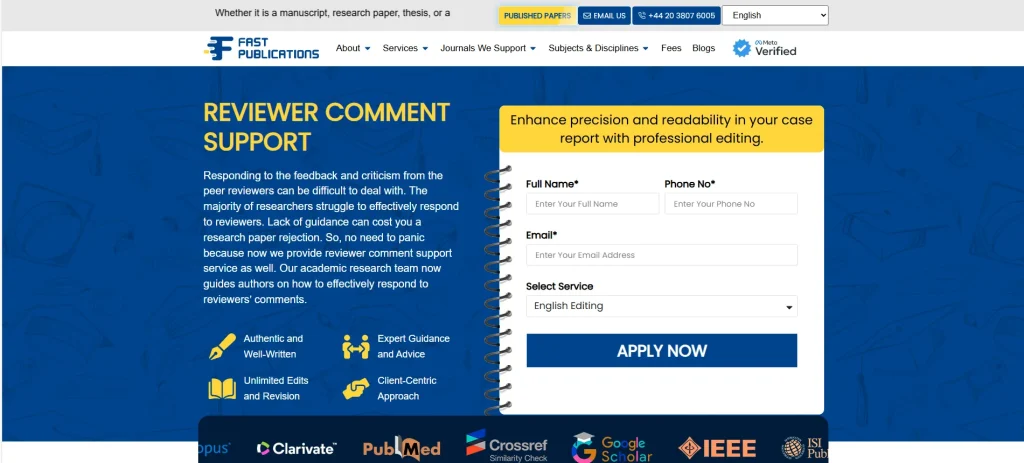
Reviewing reviewer comments is the most challenging phase of publication. Our professional team makes it easier by offering:
Reviewer response drafting Expert, point-for-point responses.
Revision of full manuscript: Maintaining consistency between letter and paper.
Clarity checks: Making easy revision for reviewers to understand.
Editorial consultation: Advising authors on how to deal with disagreements diplomatically.
We turn reviewer feedback into an organised blueprint for acceptance.
Turning Criticism into Opportunity
It’s understandable to feel discouraged by facing lengthy comments, but even the highest cited studies had rounds of revision. Remember:
- Peer review is not rejection, it’s collaboration.
- Criticism refines arguments and enhances clarity.
- Revisions demonstrate academic maturity and toughness.
At Fast Publications, we welcome authors and researchers to approach each reviewer comment as a chance to polish their manuscript and increase its ultimate influence.
Frequently Asked Questions (FAQs)
1. How long should my response letter be?
It depends on the manuscript, but usually 2–6 pages. The most important thing is to be thorough, not long.
2. What if I disagree with a reviewer’s suggestion?
You can disagree, but you must offer evidence and be respectful.
3. Do I need to respond to trivial comments?
Yes, even small things count. Failing to address them can annoy reviewers.
4. Should I underline changes in the manuscript?
Most journals would like tracked changes or highlighted revisions to be more transparent.
5. Do Fast Publications offer the whole process?
Yes, we provide end-to-end support up until acceptance.
6. What happens if my paper gets rejected after revisions?
Rejection is usual. We assist authors in editing and re-submission to top journals.
Final Thoughts
Dealing with reviewer comments is not merely an administrative task, it is a critical phase that determines your manuscript’s path to publication. By coming into the process with a professional attitude, patience, and accuracy, you turn feedback into a growth hack.
With Fast Publications on your side, you don’t have to go through reviewer reactions by yourself. Our editors and researchers assist you in making your responses professional, convincing, and compatible with journal guidelines, providing you the best opportunity for publication success.