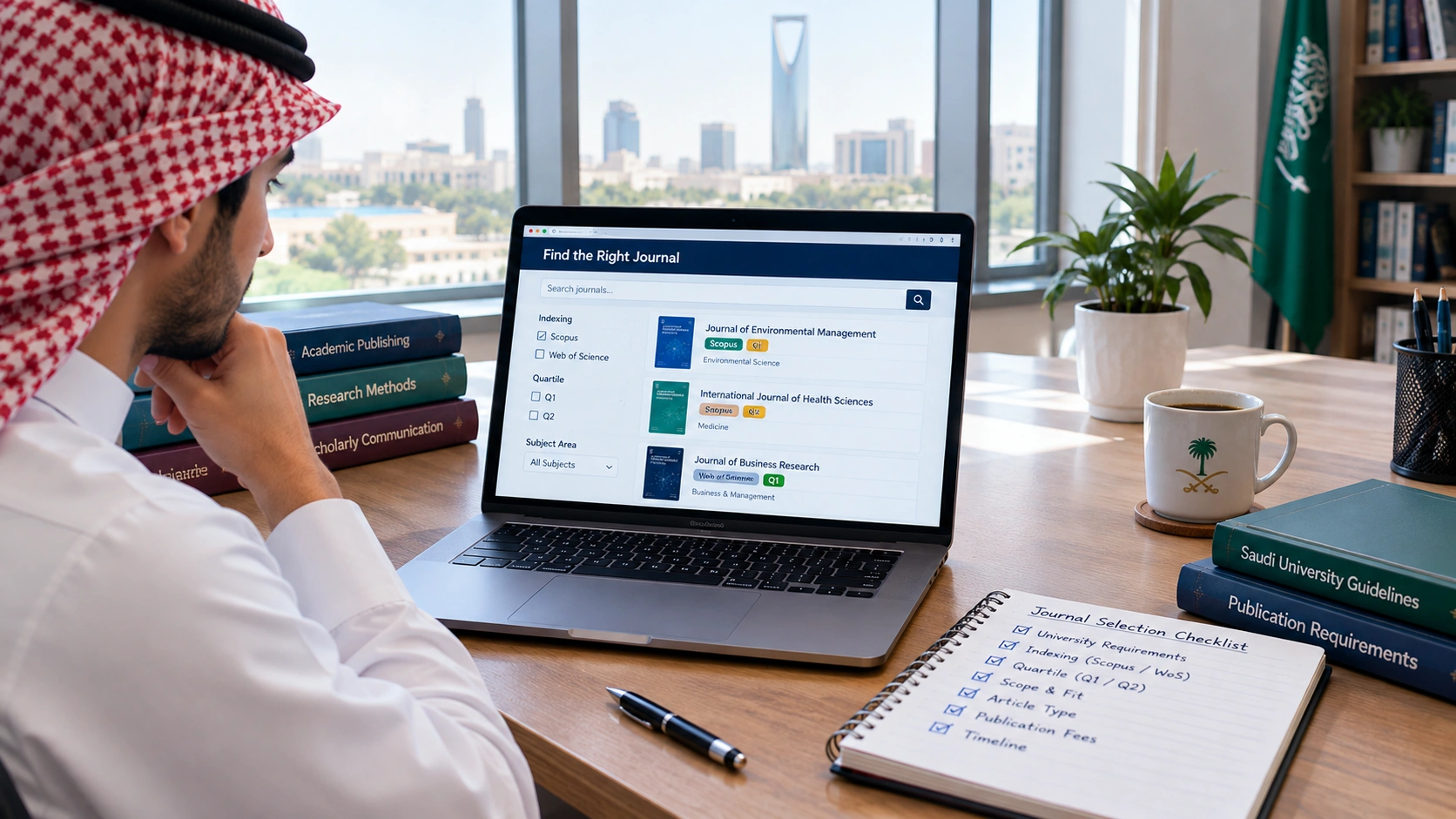
Choosing a journal can become one of the most important decisions in the research publication process. For researchers in Saudi Arabia, the decision can involve more than academic relevance. The target journal may need to meet specific university or institutional requirements.
Those requirements can involve indexing, quartile, discipline, authorship, and publication status. Some researchers therefore begin by searching for Q1 journals. Others search for Scopus-indexed journals. Some look specifically for Web of Science journals.
However, choosing a journal based on one factor can create problems later. A highly ranked journal may not fit your research. An indexed journal may not satisfy your university’s requirements. A suitable journal may also have an article type that does not match your manuscript.
Therefore, researchers need a structured approach. This guide explains how to approach journal selection in Saudi Arabia. It also covers Scopus, Web of Science, Q1 and Q2 requirements, journal scope, publication costs, and submission considerations.
The same approach can help researchers across the UAE, Qatar, Kuwait, Bahrain, Oman, and the wider Middle East.
Why Journal Selection Matters for Saudi Researchers
A journal is not simply a place to upload your manuscript. Your choice can affect whether the publication meets your academic objective. For some researchers, the goal may be an institutional promotion requirement. For others, the objective may involve graduation, scholarship requirements, research funding, or academic visibility.
The required journal can therefore differ from one researcher to another.
A university may recognize specific indexing databases. A research support program may specify Q1 or Q2 journals. Some disciplines may also follow different standards. This means researchers should understand their requirements before submitting.
Do not wait until publication to ask whether the journal qualifies. Check before you invest time and money.
Start With Your University’s Requirements
The first step in journal selection in Saudi Arabia should be your own institution. Every researcher should identify the exact publication requirements.
Start by asking:
Which database does my university recognize?
Does it require Scopus?
Is Web of Science necessary?
Does it accept both?
Next, ask:
Does the university require a particular quartile?
You may need a Q1 journal.
You may need a Q2 journal.
Some programs may accept several quartiles. Others may apply different requirements to different disciplines. You should also check whether the journal must remain indexed at the time of publication. These details can affect your entire publication strategy.
Scopus and Web of Science Are Not the Same Requirement

Researchers often use the terms “Scopus” and “Web of Science” interchangeably. They should not. Both are major academic indexing systems.
However, universities and institutions may treat them differently. A requirement for a Web of Science journal does not automatically mean that any Scopus journal will qualify. The reverse can also apply.
Therefore, confirm the database required by your university. Then verify the journal through the appropriate source.
Do not rely solely on information published on a journal’s website. The journal’s own marketing material may not provide enough information about current coverage.
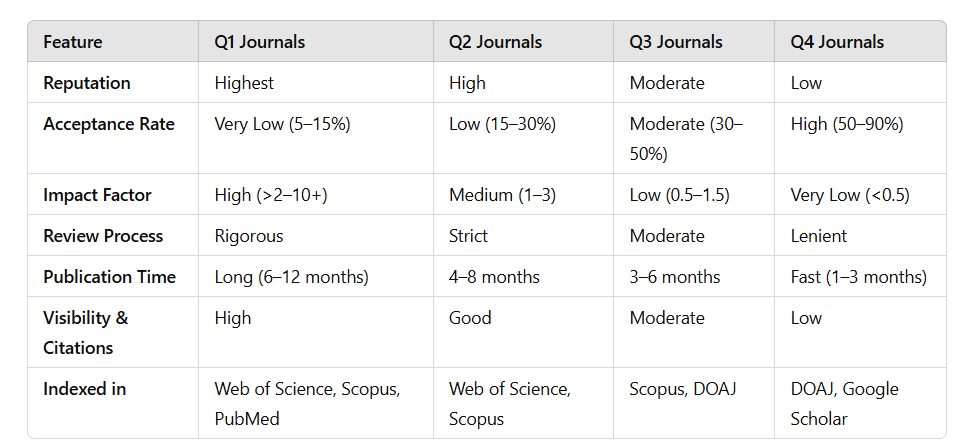
What Does Q1 or Q2 Actually Mean?
Q1 and Q2 refer to journal quartiles.
Q1 generally represents journals within the highest quartile of a particular category.
Q2 represents the second quartile.
However, quartile information needs context. A journal may have different rankings across subject categories. The ranking can also depend on the database and reporting year. Therefore, saying that a journal is simply “Q1” may not tell you everything.
Researchers should identify:
- The database
- The subject category
- The ranking year
- The relevant quartile
- The metric used
- Their university’s accepted criteria
This is particularly important when your publication will support an institutional requirement.
Never Choose a Journal Based Only on Q1
A Q1 journal can look like the obvious choice. However, the highest quartile does not automatically mean the best choice for your paper. The journal may publish research outside your specific topic. Its methodology expectations may also differ.
The journal may focus on a narrow population. It may primarily publish theoretical research. Your paper may instead use an applied research design. These differences matter.
A strong Q1 journal selection strategy in Saudi Arabia therefore considers journal fit first. Quartile should remain an important factor when your university requires it. It should not replace academic judgment.
Find the Journal’s Exact Scope
Read the journal’s aims and scope carefully. Do not rely only on the journal title. Two journals can have similar names while targeting different research areas. Read the scope page. Then read several recent articles.
Study Recent Papers Before Choosing
Recent papers can tell you more than a journal’s homepage.
- Select several papers from the past year or two.
- Compare them with your manuscript.
- Look at their research questions.
- Study their methodologies.
- Examine their geographical settings.
- Review their theoretical frameworks.
- Check their article lengths.
- Also examine how authors present their results.
This process can help you understand whether your paper belongs in the journal. For Saudi researchers, this step can also reveal whether a journal publishes research from the GCC or Middle East. That can help you assess whether the journal has an established interest in regional research.
Do Not Assume International Journals Reject Local Research

Saudi researchers sometimes worry that international journals will not accept studies focused on Saudi Arabia. That assumption can be misleading. International journals publish research from specific countries all the time. The key issue is academic contribution. A Saudi study can provide valuable evidence for international researchers.
For example, research on:
- Artificial intelligence
- Digital transformation
- Healthcare
- Renewable energy
- Tourism
- Hajj and Umrah
- Education
- Smart cities
- Logistics
- Water management
- Sustainability
- Construction
- Business
- Public health
can have relevance beyond Saudi Arabia. The manuscript should explain that wider relevance. Do not simply describe Saudi conditions. Explain what the findings contribute to the existing literature.
Make Your Saudi Context Part of the Contribution
Saudi Arabia offers a distinctive research environment. The country is undergoing major economic, technological, social, and infrastructure changes. These changes create research opportunities across many disciplines.
For example, a study of artificial intelligence adoption in Saudi businesses can contribute to the wider literature on technology adoption.
A study of renewable energy can provide evidence from an important energy market.
A study of tourism can examine a rapidly developing tourism environment, while study of healthcare can contribute evidence from a changing healthcare system. The location should therefore support your academic argument. It should not simply appear because you want the paper to sound Saudi-focused.
Check Whether Your Research Fits the Journal’s Audience
- A journal has readers. Those readers have particular research interests. Before submitting, identify the journal’s audience. Are its readers academics?
- Clinicians?
- Engineers?
- Business researchers?
- Policy researchers?
- Social scientists?
- Interdisciplinary researchers?
Then consider whether your findings will interest them. This question is especially useful when comparing several journals. A paper can technically fit a journal’s scope but still have limited appeal to its readership. Good journal selection considers both.
Check the Article Type
Not every journal accepts every type of manuscript.
Your paper may be:
- Original research
- Review article
- Systematic review
- Meta-analysis
- Case study
- Short communication
- Technical note
- Methods paper
- Conference-derived article
Check whether your target journal accepts your article type. Also check whether the journal imposes separate requirements.
A systematic review may require specific reporting standards. A clinical article may require additional documentation and a technical paper may require extensive methodological detail. Never assume that all research articles follow the same format.
Check the Word Count Before Editing
Journals often specify word limits. Some count references. Others exclude references from the total. Some journals also limit the abstract.
Figures and tables may have separate requirements. Check these rules before completing your final manuscript. Otherwise, you may spend considerable time editing a paper that remains too long.
A journal may also have strict supplementary material requirements. Review the complete author guidelines.
Examine the Journal’s Publication Frequency

Publication frequency can help you understand a journal’s operation.
Some journals publish monthly. Others publish quarterly. Some use continuous publication. Frequency alone does not determine quality.
However, it can provide useful context. Researchers seeking timely publication should understand how the journal handles accepted articles. Check whether accepted manuscripts appear online before issue assignment. Also distinguish between:
Submission to first decision
and
Acceptance to publication
These are not the same thing.
Understand the Difference Between Review Time and Publication Time
Researchers often search for “fast Scopus publication.”
However, speed can mean several different things.
A journal may provide a quick first decision.
That does not mean the article will be published quickly.
Another journal may have a longer review process but publish accepted papers rapidly.
Therefore, look at the entire timeline.
Consider:
Submission → Editorial screening → Peer review → Revision → Acceptance → Production → Publication
This provides a more realistic picture.
Never choose a journal solely because someone promises fast publication.
Check Article Processing Charges
Publication costs can vary significantly. Some journals charge article processing fees. Others operate through subscriptions. Some provide fee waivers or discounts.
Before submitting, identify the relevant charges. Check whether the fee applies to your article type. Also determine when payment occurs. Do not assume that every indexed journal follows the same model.
For researchers working with institutional funding, check whether the university or grant can cover the fee.
Be Careful With Very Cheap or Very Expensive Offers
Price does not determine journal quality. An expensive APC does not automatically indicate a prestigious journal. Likewise, a low-cost journal does not automatically indicate poor quality.
- Look at the journal’s publisher.
- Review its editorial board.
- Check its peer-review process.
- Verify indexing.
- Read published papers.
- Examine publication ethics policies.
These factors provide much more useful information.
Verify Scopus Indexing Before Submission
Researchers searching for مجلات سكوبس may encounter many websites claiming that their journals are indexed.
- Do not rely on advertisements.
- Verify the journal independently.
- Check the journal title.
- Check its ISSN.
- Confirm the publisher.
- Review the current database coverage.
- Also check whether your university recognizes that specific journal.
This matters because indexing can change. A journal that once appeared in a database may not necessarily remain covered forever. Therefore, verification should become part of every Scopus journal selection Saudi Arabia process.
Check Web of Science Coverage Separately
- The same principle applies to Web of Science. Do not assume that a journal is covered simply because it displays a Web of Science logo.
- Check the official source.
- Confirm the exact journal.
- Review its coverage.
If your university requires a particular Web of Science collection, confirm that as well. This distinction can become important when institutional rules refer specifically to Journal Citation Reports or another Web of Science category.
Watch for Predatory Journals

Publication pressure can make researchers vulnerable to questionable journals. Some may send unsolicited invitations. Others may advertise guaranteed acceptance. Some may promise publication within a few days. These offers require caution.
A legitimate journal should provide clear information about:
- Editorial leadership
- Peer review
- Publisher identity
- Publication ethics
- Fees
- Contact details
- Submission procedures
- Indexing
Never submit a manuscript simply because a journal promises fast acceptance. No legitimate service can guarantee that a reputable journal will accept your research.
Look Beyond the Journal’s Marketing
A professional-looking website does not prove journal quality. Researchers should examine the actual publication record.
- Read recent articles.
- Check editorial information.
- Verify indexing independently.
- Look at the publisher’s other journals.
- Search for corrections or retractions where relevant.
Also investigate whether the journal’s contact information appears legitimate. This process takes time. However, it can prevent much bigger problems later.
Consider Journal Reputation Carefully
Reputation can influence how researchers perceive a publication. However, reputation should not become the only factor. A journal with a strong reputation may have a highly selective acceptance process.
Another reputable journal may offer a better subject fit. Researchers should balance reputation with:
- Scope
- Indexing
- Quartile
- Audience
- Article type
- Review process
- Publication costs
- Institutional eligibility
The best journal is the one that meets your academic objective while genuinely fitting your research.
Journal Selection for PhD Students in Saudi Arabia
PhD students in the Kingdom may face different publication requirements from faculty members. Some programs require publications before graduation. Others may have specific journal categories.
Scholarship students can also have separate institutional requirements. Therefore, PhD students should confirm their program rules early. Do not wait until the final year.
A publication strategy can take months. Peer review may require multiple rounds of revision. A rejection can add additional time. Early journal planning can therefore reduce unnecessary delays.
Journal Selection for Researchers Across the Middle East
The same principles apply beyond Saudi Arabia. Researchers in the UAE, Qatar, Kuwait, Oman, and Bahrain also work within institutional publication systems. However, the exact requirements vary.
Therefore, regional researchers should check their own university rules. A journal suitable for one institution may not meet another institution’s requirements. This is why generic lists of “best Scopus journals” can be misleading. Journal selection should always start with your research and your institutional objective.
Arabic Search Intent Shows a Broader Research Need
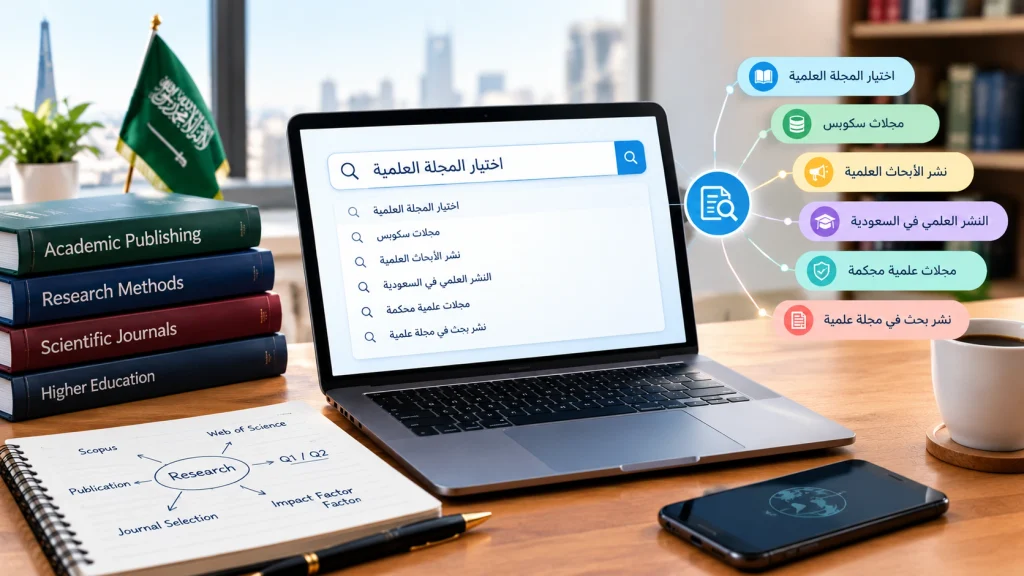
Arabic-speaking researchers may search for journal information using terms such as:
- اختيار المجلة العلمية
- نشر الأبحاث العلمية
- النشر العلمي في السعودية
- مجلات سكوبس
- النشر في مجلات سكوبس
- نشر بحث في مجلة علمية
- المجلات العلمية المحكمة
These searches reflect different stages of the publication process. Some researchers want to select a journal. Others want to understand indexing. Some are looking for submission assistance.
Others need help preparing their manuscripts. That is why academic publishing websites should address these different search intents separately.
Do Not Stuff Arabic Keywords Into English Content
Arabic keywords can support Saudi SEO. However, they should appear naturally. Adding Arabic phrases to every section can make an English article look unnatural.
It can also create a poor user experience. Use Arabic terms where they genuinely reflect search intent.
For example, a short section can explain common Arabic searches for Scopus journals. The rest of the article should remain natural English. For larger Arabic search opportunities, create dedicated Arabic content. That approach gives you stronger topical coverage.
Create Separate Arabic Content for Arabic Researchers
If Saudi Arabia becomes a major target market, Fast Publications should eventually develop a dedicated Arabic content section. The Arabic content should not simply translate English articles. It should target Arabic questions directly.
For example:
كيف يختار الباحث السعودي المجلة العلمية المناسبة؟
كيف يمكن التحقق من فهرسة المجلة في سكوبس؟
ما الفرق بين مجلات Q1 وQ2؟
كيف يختار الباحث مجلة علمية محكمة؟
ما الأخطاء التي تؤدي إلى رفض البحث العلمي؟
These articles can target searches that English content cannot capture effectively.
Build a Journal Shortlist
Do not select one journal immediately. Create a shortlist. Five potential journals can be enough for the first comparison.
For each journal, record:
| Factor | Journal 1 | Journal 2 | Journal 3 |
| Subject fit | Strong | Medium | Strong |
| Scopus/WoS | Yes. | Yes. | Yes. |
| Quartile | Q1 | Q2 | Q1 |
| Article type | Yes. | Yes. | No |
| APC | Check | Check | Check |
| Review timeline. | Check | Check | Check |
| University eligibility | Check | Check | Check |
This simple comparison can expose important differences. It also prevents researchers from choosing emotionally.
Score Journal Fit Before Submitting
You can create a simple scoring system.
For example:
Research scope: 30%
Institutional eligibility: 25%
Indexing and quartile: 20%
Article type and requirements: 10%
Audience: 5%
Publication cost: 5%
Timeline: 5%
The percentages can change depending on your goals. For a university requirement, institutional eligibility may deserve greater weight. For an early-career researcher, scope and acceptance feasibility may matter more. The point is to make the decision deliberate.
Prepare Your Manuscript for the Selected Journal

Once you choose the journal, prepare your manuscript specifically for it.
- Review the author guidelines.
- Adjust the structure.
- Check the word count.
- Format references.
- Prepare tables.
- Format figures.
- Write the required declarations.
- Prepare supplementary files.
- Then review the manuscript again.
This is where journal submission Saudi Arabia support can become useful. A technically strong paper can still face problems if the submission does not follow instructions.
Improve the Manuscript Before Submission
- Journal selection cannot fix a weak manuscript.
- Before submission, review the research itself.
- Check the research question.
- Strengthen the literature review.
- Clarify the research gap.
- Review the methodology.
- Check statistical analysis.
- Improve the discussion.
- Strengthen the conclusion.
- Then edit the language.
Researchers should treat manuscript preparation and journal selection as connected processes. The target journal should influence how the manuscript is presented.
Consider Professional Editing
Academic English can become a barrier when the research itself is strong. This does not mean every researcher needs professional editing. However, professional review can help identify problems that authors may overlook.
These can include:
- Grammar
- Academic tone
- Sentence clarity
- Terminology
- Logical flow
- Technical consistency
- Reference formatting
- Structural problems
Fast Publications provides research article writing, manuscript editing, scientific and technical editing, journal selection, submission support, and publication strategy services. The purpose should be to improve the manuscript. It should never involve fabricating data or creating misleading research claims.
What Fast Publications Can Help With
Choosing a journal can become complicated when several requirements overlap. Fast Publications supports researchers through different stages of the publication process. Our journal selection advice can help researchers compare journals based on subject fit, indexing, requirements, and publication objectives.
Its manuscript editing services can improve language and academic presentation. Its scientific and technical editing can address discipline-specific presentation. Journal submission assistance can help researchers prepare the final submission. Resubmission support can also help when a manuscript receives a rejection and the author wants to identify the next suitable journal.
These services are particularly useful when researchers need a structured publication strategy rather than a simple journal list.
What Researchers Should Never Expect From a Journal Service
Researchers should be cautious with services that promise guaranteed publication. No legitimate service controls a journal’s editorial decision.
- Peer reviewers can request revisions.
- Editors can reject manuscripts.
- Journals can also change their requirements.
Therefore, professional publication support should focus on preparation and strategy. The service should help you make better decisions. It should not sell acceptance as a certainty.
A Practical Journal Selection Process
A simple process can make journal selection much easier.
Step 1: Identify Your Requirement
Determine whether your institution requires Scopus, Web of Science, Q1, Q2, or another category.
Step 2: Define Your Research
Identify your subject, methodology, population, and main contribution.
Step 3: Build a Shortlist
Find journals that genuinely publish research like yours.
Step 4: Verify Indexing
Check the journal through the relevant database.
Step 5: Check Quartile
Confirm the category, database, and ranking year.
Step 6: Review Recent Papers
Compare your manuscript with recently published research.
Step 7: Check Fees and Timeline
Understand APCs, review processes, and publication procedures.
Step 8: Check University Eligibility
Make sure the journal meets your institutional requirements.
Step 9: Prepare the Manuscript
Adapt your paper to the journal’s guidelines.
Step 10: Submit Carefully
Review every document before submission. This process can reduce avoidable journal selection mistakes.
Conclusion
Journal selection should never be an afterthought. For Saudi researchers, the decision can affect graduation, promotion, funding, research visibility, and institutional recognition. That makes careful selection essential.
Start with your university requirements. Then examine your research. Identify suitable journals. Verify indexing. Check Q1 or Q2 status when required.
Study recent publications. Review fees and timelines. Then prepare your manuscript specifically for the selected journal. The same process applies to researchers across the wider Middle East.
However, institutional requirements always come first. A journal that works for one researcher may not work for another. That is why a strategic approach is more valuable than a generic list of “best Scopus journals.”
For researchers searching for اختيار المجلة العلمية, مجلات سكوبس, نشر الأبحاث العلمية, or النشر العلمي في السعودية, the fundamental principle remains the same. Choose the journal based on your research and your academic objective. Then prepare the manuscript to meet its requirements.
Fast Publications can support researchers through journal selection, manuscript editing, scientific and technical editing, submission assistance, and broader publication strategy. The goal is not simply to submit a paper.The goal is to submit it to the right journal, for the right reason, with the right preparation.
Frequently Asked Questions
How do I choose a journal for publication in Saudi Arabia?
Start with your university’s requirements.
Then identify journals that match your research scope.
Verify indexing, quartile, article type, fees, and submission requirements before selecting your final journal.
Which is better for Saudi researchers, Scopus or Web of Science?
Neither database is automatically better for every researcher.
The correct choice depends on your university, discipline, promotion rules, funding requirements, and research objectives.
Do Saudi universities require Q1 journals?
Requirements vary between universities and programs.
Some institutional programs may prioritize Q1 or Q2 publications.
Always check the current requirements that apply to your specific program.
How can I select a Q1 journal?
Start with research fit.
Then verify the journal’s Q1 status, subject category, database, and ranking year.
Finally, check whether your institution recognizes that journal.
Can I publish Saudi research in an international journal?
Yes.
Research based in Saudi Arabia can have international value when the manuscript explains its broader academic contribution.
How can I verify a Scopus journal?
Check the journal through the official Scopus source.
Confirm its title and ISSN.
Also verify current coverage rather than relying on the journal’s website alone.
What does اختيار المجلة العلمية mean?
اختيار المجلة العلمية means “scientific journal selection” or “academic journal selection.”
It is a common Arabic search concept for researchers looking for an appropriate journal for their research.
What does نشر الأبحاث العلمية mean?
نشر الأبحاث العلمية means “publishing scientific research.”
The phrase commonly relates to the broader process of preparing and publishing academic research.
What are مجلات سكوبس?
مجلات سكوبس means “Scopus journals.”
Researchers commonly use the term when searching for journals indexed in Scopus.
Can Fast Publications guarantee journal acceptance?
No.
Fast Publications can support manuscript preparation, editing, journal selection, and submission.
However, acceptance remains the decision of the journal’s editors and peer reviewers.