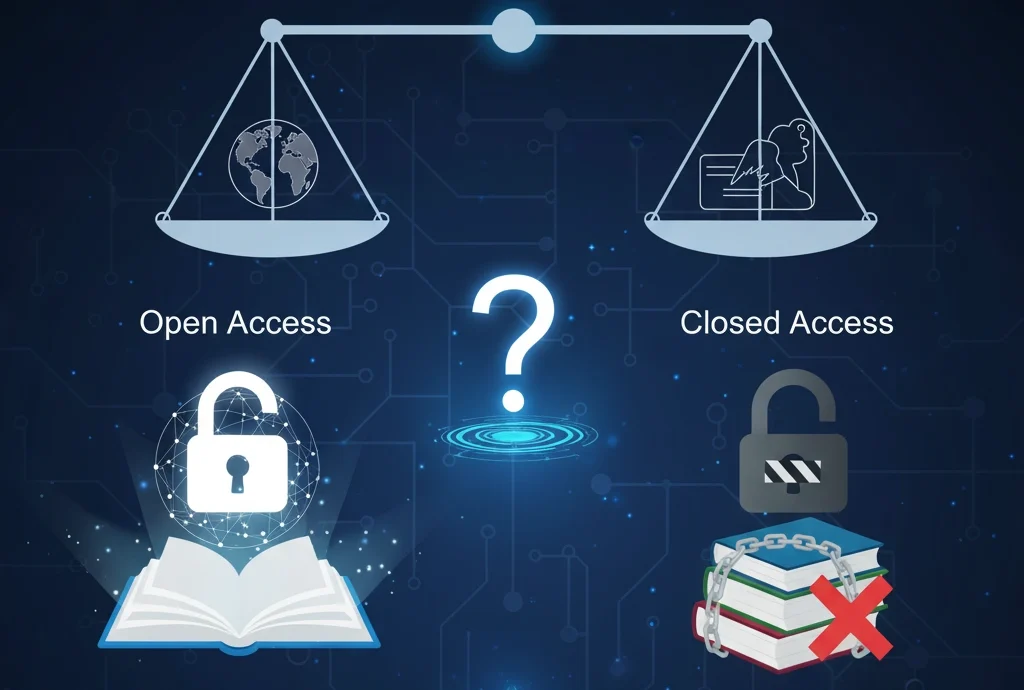
The world of academic publishing is faced with an immense change. The closed-access (subscription-based) approach has become the unchallenged norm throughout centuries. However, the recent skyrocketing of open access (OA) has sparked a critical debate regarding how research will be consumed in future. It is not a matter of just philosophy, but a practical choice that every researcher is faced with at this point.
Which model is set to be dominant in the next ten years? This is a complex question that is influenced by the requirements of funding, technological advances, and the impact of research. At Fast Publications, we are making this consequential choice on behalf of our researchers, realising which journal to choose. Whether through OA or closed methodology, it will achieve the greatest visibility, credibility, as well as future career development.
The Two Publishing Models
Fundamentally, the difference between the models regards the person who funds the publication and who can be permitted to view the results.
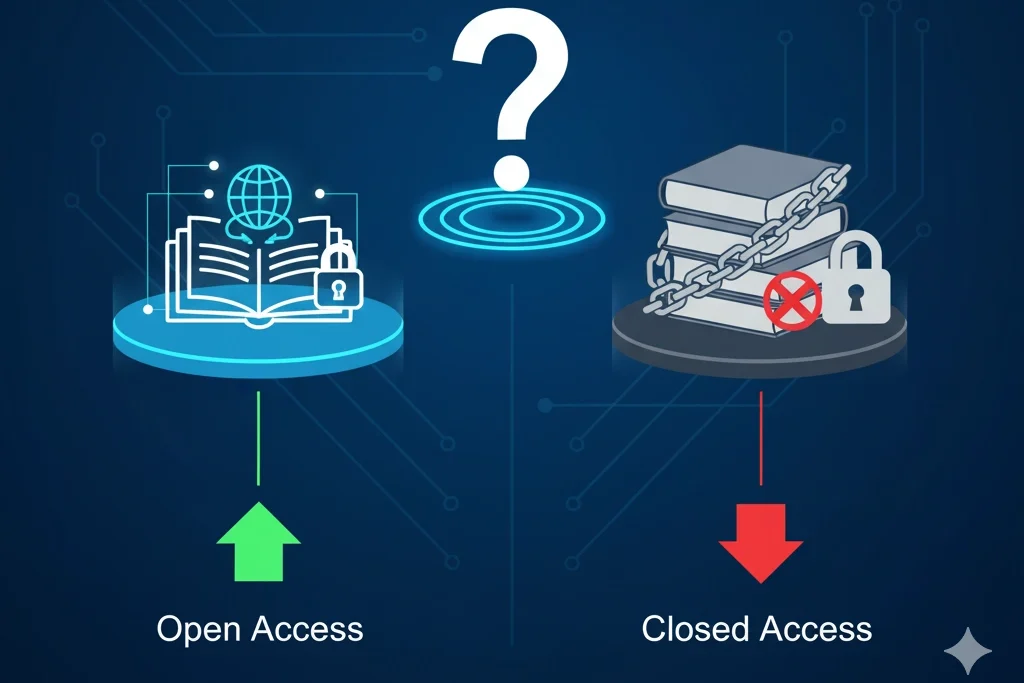
- Open Access (OA): In this model, the article that is published in the end is availed freely on the internet. Publication fees, such as peer review fees and hosting fees, are usually paid through an Article Processing Charge (APC). The first one is the fact that it has a global reach without restrictions.
- Closed-access: A closed-access (subscription-based) marketplace is run on the Premium Subscription Business model. This conventional framework limits access to subscribers to individuals who buy a subscription or via an organisation. In the case of libraries, which bear the excessive expense of subscription fees, ordinarily, authors make publications free.
The Open Access Academic Boom
The awareness behind OA cannot be ignored. Many forces drive its growth:
- Funder Mandates Publicly funded research-based initiatives like Plan in Europe and policies by the National Institutes of Health (NIH) in the United States insist that such research be made publicly available.
- Increased Visibility and Impact, empirical research continues to find that OA articles receive more downloads and citations earlier, and thus induce a faster impact of studies.
- Publisher Adaptation: This trend has been completely adopted by the major publishers.
Elsevier, Wiley and Springer Nature now provide comprehensive OA collections and so-called hybrid arrangements.
The Lingering Strengths of Closed Access
Although OA is taking over, closed-access journals will never go away. To them, they retain great advantages:
- Prestigious Legacy: A number of the most respected journals in the world are subscription-only, including those run by Nature (and Science). The publication in these titles is priceless for the tenure and promotion commission.
- Strict Infrastructure: Years of experience have honed their peer-review and editorial procedures, of which so many researchers still understand quality and exclusivity.
- Author Financial Model: To researchers who have no special publication grants, the option to publish without pre-pub fees is an essential potential benefit.
The Hybrid Model
The hybrid journal has become a compromise to this separation. They are journals which have a subscription-based OA fee option. On the one hand, this can give it a certain level of flexibility, but this may be subject to double-dipping, by subscribing and charging at the same time as APCs.
The driving forces of the coming decade are the following.
Publishing has a direction that will be dictated by several closely related factors:
- Policy and Funding: More and more content will inevitably be pushed into open repositories as more OA is made by governments and research funding agencies.
- The Equity Imperative: OA opens knowledge so that researchers in developing countries and at lesser institutions can share the most recent discoveries, thus increasing collaboration worldwide.
- Technological Innovations: Discovery tools with AI implementation and the connection to preprint servers will make OA research more visible and faster.
- The Sustainability Question: APCs are expensive, and they may become an additional barrier to researchers without relevant funds. This has agitated the creativity in other designs, like diamond OA, which ensures no charges to the readers or authors.
We propose Open Access to predominate numerically thanks to the benefits of policy and visibility. Nevertheless, closed access will continue to hold a status quo of authority in certain fields in due course.
Pitfalls For Researchers
Several pitfalls should be avoided, particularly by those engaged in research.
This system is changing, and it should be handled carefully. Researchers must avoid:
- Predatory Journals: Fraudulent publishers have used the OA model to their benefit. In any case, check the indexing and reputation of a journal.
- Overlooking Indexing: It can be damaging to a CV to leave a given journal without publication, just as it can equally be disastrous to publish in a non-indexing OA journal.
- Budget Oversight: Delays may occur greatly through failure to obtain funding for an APC even after its acceptance.
- Confusion with license: There is confusion surrounding the copyright/ licensing conditions (as is the case with Creative Commons), and this might restrict subsequent utilisation of one’s own work.
Fast Publications: Your Reliable Partner
No expertise is greater in this complex world than professional advice. Fast Publications is the company that offers certainty and transparency by:
- Strategic Journal Choosing: We assist in the identification of valid high-impact journals of early closures by leading publishers like Elsevier, Wiley, and Springer Nature on OA and closed journals.
- Predatory Journal Safeguards: Here, it will be ensured that the submissions are carried out to get recognition in indexed journals.
- Complete Integrity of Support: Starting with formatting manuscripts and plagiarism checks, and going down to the submission systems, we make life easier.
- Lifetime Confidentiality: Non-Repository Policy. We have a confidentiality assurance that guarantees intellectual property safety.
Conclusion
It is not which model will win, but how they will co-exist. The future foreshadows an open-access-controlled ecosystem in the volume, whereby subscription models still hold onto high status.
It is important to make a strategic decision that is based on the field of study and resources. By having Fast Publications as a partner, you will be comfortable in both worlds. Make sure that your research gets the visibility and recognition it deserves in the decade to come.