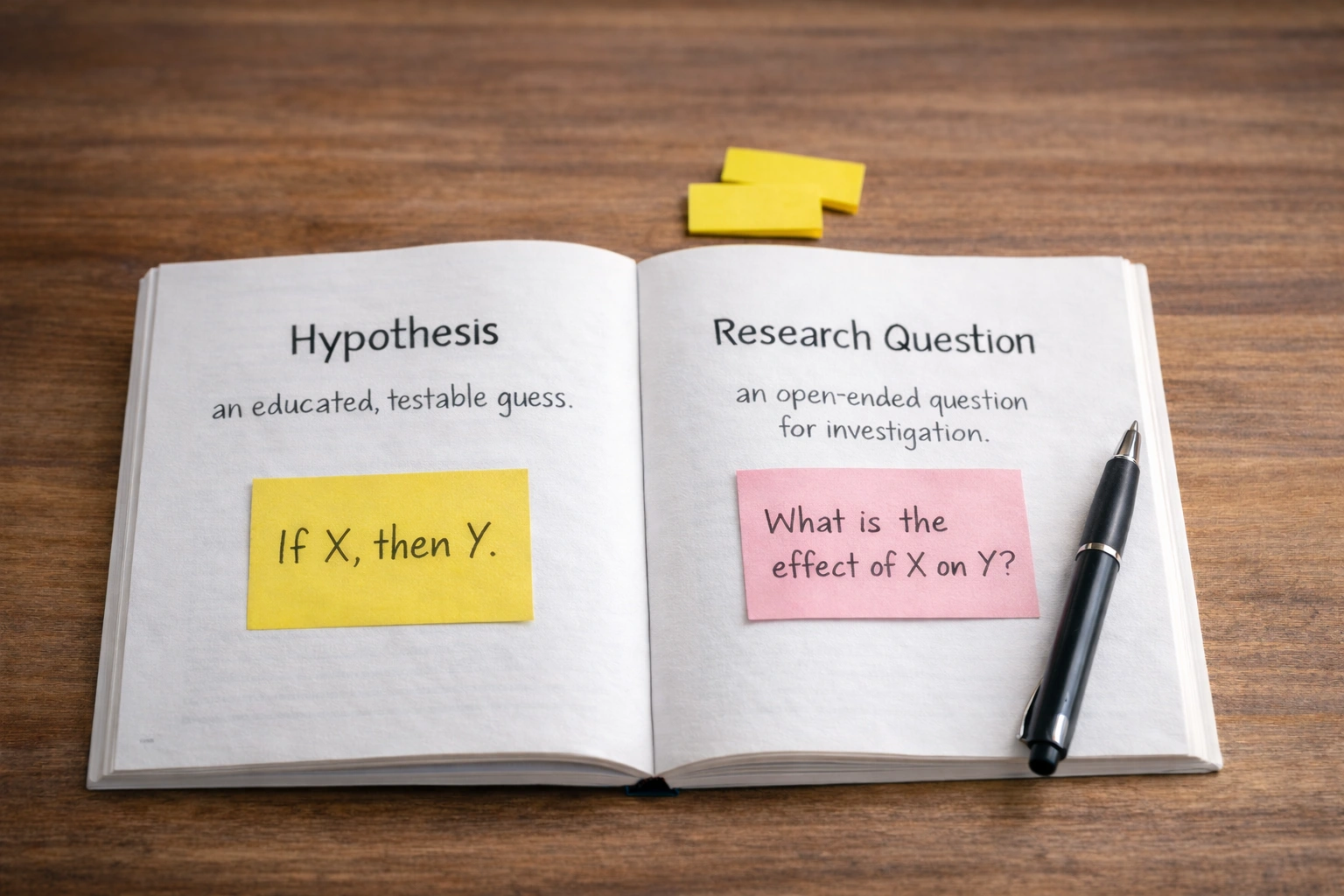
When writing an academic paper, the most expensive error is the one made in not separating a research question from a hypothesis. This is, to the reviewers, a significant indicator of methodological confusion. It will undermine trust in your design, analysis and findings of your research. The result is lengthy revisions, rejections and delays. In the case of authors who seek Fast Publications, it is crucial to be clear at the beginning. The difference is the key to a good manuscript, something many of us would seek the aid of Research Paper Help to do.
What Is a Research Question?
A research question is an open-ended question that is measured, concise and precise in nature and is what your research wishes to answer. It defines the extent and the path but does not determine outcomes. It functions to inform exploration, particularly where there is little knowledge. Consider it the research guide that defines goals, a review of the literature, and methods. It typically begins with What, How or Why to explore phenomena, relationships or experiences.
What Is a Hypothesis? Otherwise known as (Direct and Testable Explanation)
A hypothesis is a falsifiable statement concerning the relationship of two or more variables. It is a definite declaration, not an inquiry, anticipating a result on the foundation of theory or former statistics.
Example: “Application of intervention X will effectively raise outcome Y in comparison with a control group.”
Its power is falsifiability; data should be capable of showing it to be wrong or right. Therefore, confirmatory research, mainly quantitative studies, is driven by hypotheses and the statistical analysis plan.
Key Differences at a Glance
A research question explores, and a hypothesis predicts, which is functional. The questions are open and flexible; qualitative is great when the research is new. Hypotheses are specific and definitive, and need to be tested in an experiment. In case you apply a hypothesis-seeking question, or the other way around, your methodology violates and seems unrigorous.
Journals require regularity: qualitative research requires guiding questions; quantitative experiments require clear, falsifiable hypotheses. Adherence to this standard is necessary in Fast Publications as it expedites the verification and eliminates fundamental criticism.

Why should You Have a Research Question?
Exploratory work requires the use of a research question. This includes ground-breaking research, intricate social phenomena, or subjective experience. Qualitative research, like ethnography, case studies, or grounded theory, is based on research questions. Extensive literature reviews mapping a field are also appropriate.
Problem statement: What is the perception of nurses regarding the use of AI tools in palliative care? This question is thought-provoking and does not compel anyone to reply. A common affair of Research Paper Help is proper framing so that an exploratory design is valid and consistent.
When is a Hypothesis to be Utilised?
Apply a hypothesis in a confirmatory study which aims to investigate a certain relationship or effect. This applies to experimental, quasi-experimental, and correlational designs in medicine, psychology, engineering, etc. The prediction requires adequate prior knowledge or theory to be made.
Example: Patients who will be given a daily dose of supplement Z will experience a decrease in markers of inflammation (CRP) by 20% more than those who receive a placebo. This gives a precise and measurable statistical test expectation. Reviewers test your hypotheses at first sight.
Converting a Research Question to a Hypothesis
Transforming a question into a hypothesis is an indication of maturity in study. Begin with a general research question. Identify the key variables. Make predictions of the relationships between the variables using theory or pilot data.
Example:
- Research question: Does the quality of sleep have an impact on academic performance among undergraduates?
- Variables: Sleep quality (independent), academic performance (dependent).
- Prediction: The scores on sleep quality will have a positive relationship with semester GPAs.
- Testable Hypothesis: “The correlation between self-reported sleep quality and GPA is significant and positive in undergraduate students.”
Top-tier journal reviewers and Fast Publications demand this concise, testable format.
Popular Fallacies Reviewers Signal Instantly
These errors are flagged:
- Hybrid statements presenting themselves as questions but expressed as hypotheses (ex, Does X cause Y?).
- Imprecise, immeasurable claims like X will enhance Y.
- Inequivalences in which a hypothesis is provided, but methods are outlined which pertain to exploratory qualitative work.
- The preacher effect of over-specified hypotheses in an underpowered pilot.
Such errors necessitate amendments on a significant scale, as not only do they reveal the incorrect research logic, but also destroy the faith in the following findings.
Presenting them in Your Manuscript the Right Way
At the end of the introduction, you must provide your main research question or hypothesis, which is to be placed after the problem statement and literature gap. Condense it in a sentence or subheading. Any study objectives must derive directly from it. All decisions of methodology, be it population, measures, or statistical tests, have to branch off that question or hypothesis.
It is this logical chain which is necessary for a publishable manuscript. Research Paper Help provides the greatest cruciality in aligning these elements to many people.
The Fast Publications Advantage
Methodological precision is one of the features of Fast Publications. Jurisdictional journals do away with infrastructural confusion. Reviews of study designs focus on distinct hypothesis-question differentiation. They approve your main point, make sense, are statistically effective and well explained, and you do not need objections on the part of reviewers. Pre-emptive refining accelerates editorial.
Conclusion
The most important key to your manuscript is the precise framing of your research question or hypothesis. It promises a logical approach, purposeful analysis, and powerful dialogue. This is the clarity which wins the trust of reviewers and increases your chances of acceptance.