Science has a well-documented credibility problem. Decades of research meta-analyses across psychology, biomedicine, economics, and ecology have found that a significant proportion of published findings cannot be replicated when independent researchers attempt to reproduce them. The causes are structural, not personal.
When journals preferentially publish studies that produce statistically significant, novel, or positive results – and reject studies with null, mixed, or confirmatory findings – researchers are incentivised to design studies that are likely to find something rather than studies designed to rigorously test something. This incentive structure produces p-hacking (running multiple analyses until one reaches p < 0.05), HARKing (Hypothesising After Results are Known – presenting post-hoc hypotheses as if they were pre-specified), selective outcome reporting, and inadequately powered studies.
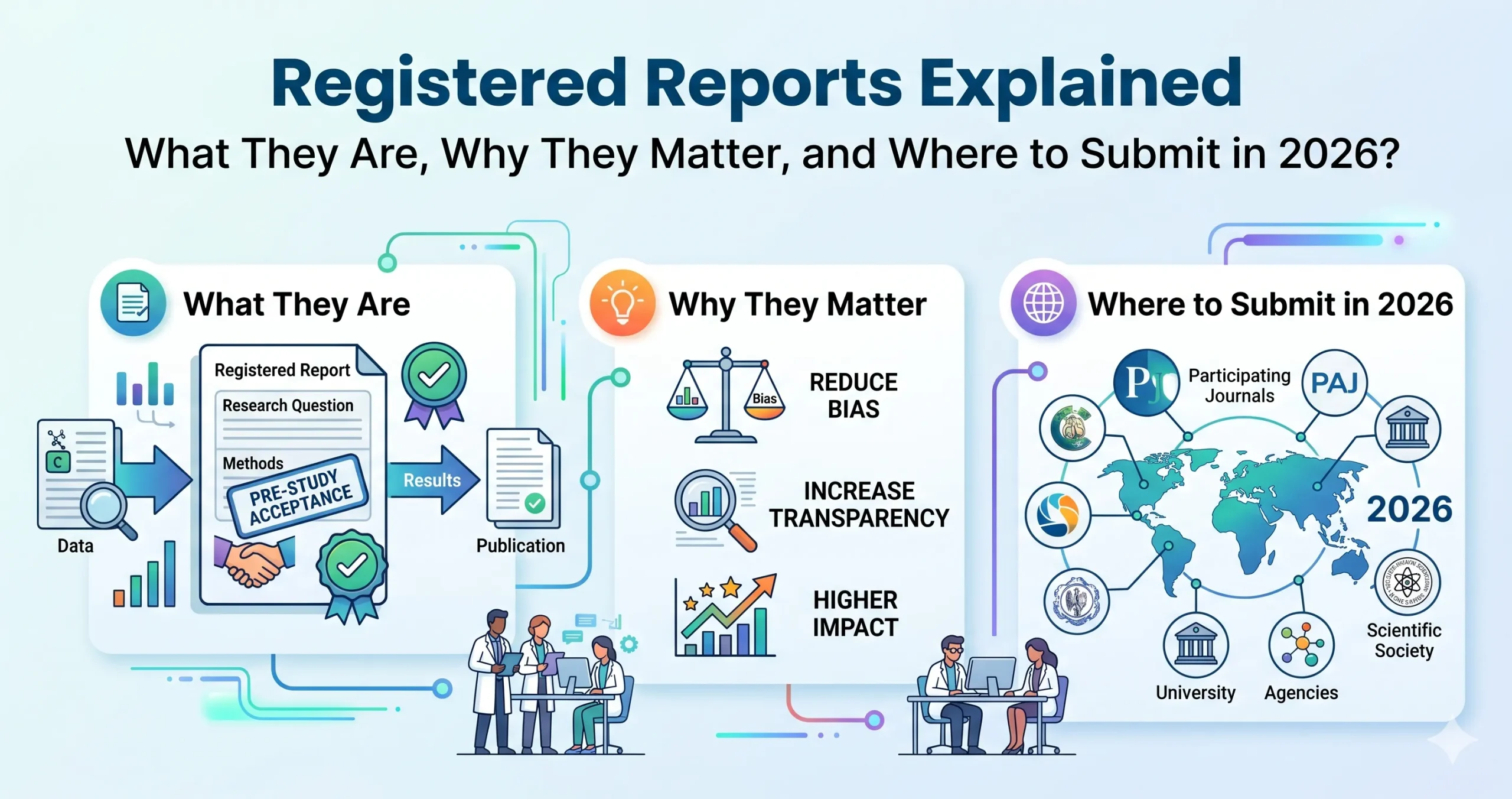
Registered Reports (RRs) are a publishing format that structurally eliminates most of these problems by moving the point of peer review from after the results are known to before data collection begins. As of 2025, over 300 journals across disciplines have adopted this format and its growth shows no signs of slowing.
| Key Definition A Registered Report is a two-stage publishing format in which researchers submit their introduction, hypotheses, and full methods for peer review before collecting any data. If the protocol passes review, the journal issues an In-Principle Acceptance (IPA) – a conditional guarantee to publish the final paper regardless of whether the results are significant, null, or mixed. Publication is based on methodological quality, not outcome. |
The Two-Stage Structure of a Registered Report
Stage 1: Protocol Submission and In-Principle Acceptance
At Stage 1, you submit a manuscript that includes:
- A thorough introduction reviewing the literature and motivating the research question
- Clearly stated, pre-specified hypotheses
- A complete methods section: design, participants, procedure, measures, and materials
- A detailed analysis plan: primary analysis, statistical tests, model specifications, and how assumption violations will be handled
- A power analysis and sample size justification
- Stopping rules for data collection
- Plans for handling deviations from the protocol
The journal sends this Stage 1 manuscript to peer reviewers – the same reviewers who would evaluate a standard submission. The key difference: reviewers evaluate the importance of the research question and the quality of the methodology without knowing the results. They cannot be influenced by whether the findings are statistically significant.
If the protocol passes review (typically after one or two revision rounds), the journal issues an In-Principle Acceptance. The IPA is a formal commitment: as long as you follow the registered methodology and the conclusions align with the underlying data, the journal will publish the paper regardless of the results.
Stage 2: Results and Final Publication
After completing your data collection and analysis exactly as described in your registered protocol, you submit your Stage 2 manuscript – the complete paper including results, discussion, and conclusions. Reviewers assess whether you adhered to the registered plan, whether any deviations are transparently documented, and whether the conclusions are appropriately supported by the data.
Exploratory analyses – analyses not pre-specified in the protocol – are fully permitted and encouraged. They must simply be clearly labelled as exploratory to distinguish them from the confirmatory, pre-registered analyses. A Registered Report is not a straitjacket. It is a transparency mechanism.
| What In-Principle Acceptance Actually Means IPA is conditional, not unconditional. The journal commits to publish if: (1) you collected data as registered, (2) you reported all pre-specified analyses, (3) any deviations are transparently documented, and (4) your conclusions are warranted by your data. If you discover a significant methodological error after IPA, you must disclose it immediately. The journal may revoke IPA if the deviation is severe enough to undermine the study’s validity – but transparent deviations with clear justifications are typically accepted. |
Why Registered Reports Produce More Trustworthy Science?
They Eliminate Publication Bias by Design
Publication bias is arguably the most damaging systemic problem in academic research. When null results are not published, the literature becomes a distorted record that overestimates effect sizes and leads to failed replications. Registered Reports guarantee publication for well-designed studies before results exist – making it structurally impossible for the decision to publish to be influenced by the direction or significance of findings.
They Stop P-Hacking Before It Starts
P-hacking happens when researchers run multiple analyses and report only those that cross the significance threshold. Because Registered Reports require the analysis plan to be reviewed and accepted before any data exists, any deviation from the plan must be transparently disclosed in the final paper. Reviewers and readers can see exactly what was planned versus what was actually done.
They Incentivise Proper Statistical Power
Studies with inadequate statistical power are common in the published literature. A standard manuscript can be accepted even if the design was underpowered, because reviewers cannot know whether the power analysis was retroactively generated to justify a convenient sample size. In a Registered Report, the power analysis is reviewed before data collection – giving reviewers the opportunity to require a larger sample if the original justification is insufficient.
They Encourage Rigorous Replication Research
Replication studies face a structural disadvantage in standard publishing: journals are reluctant to publish attempts to replicate existing findings, particularly if the replication fails. Registered Reports are explicitly format-compatible with replication studies, since in-principle acceptance can be granted based on the rigour of the replication design regardless of whether it confirms or refutes the original finding.
Registered Reports vs Standard Papers: What Changes in Your Workflow
The workflow shift is significant – but most researchers find that it forces improvements they should have been making anyway.
- Pre-specify everything: Your hypothesis, your sample size, your primary outcome, your analysis model, your exclusion criteria, and your missing data strategy must all be decided and documented before data collection. This is not a burden – it is what rigorous research design looks like.
- No selective reporting: Every pre-registered analysis must be reported, regardless of the result. If something does not work out, you report it and explain it. This builds a more honest and complete scientific record.
- Deviations are allowed but must be disclosed: If you discover during the study that a pre-specified analysis was incorrect or impractical, you can deviate – but you must document what changed and why in the Stage 2 submission.
- Exploratory analyses are still encouraged: Results that were not anticipated in your Stage 1 submission can still be reported – simply labelled as exploratory. The format rewards transparency, not rigidity.
- Timeline is longer: Stage 1 review adds time to the publication process. However, once IPA is granted, the Stage 2 review is typically faster because the core methodology has already been approved. Overall time-to-publication is often comparable.
Where to Submit: Journals Accepting Registered Reports in 2026
Over 300 journals currently accept Registered Reports as a regular submission option or through special issues. The Center for Open Science maintains the definitive, updated list at cos.io/rr. Below is a representative selection of high-impact journals accepting RRs as of 2026:
| Journal | Discipline | Publisher | RR Format |
| Nature Human Behaviour | Psychology, Social Science | Springer Nature | Regular submission option |
| PLOS ONE | Multidisciplinary (Science) | PLOS | Regular submission option |
| Cortex | Neuroscience, Psychology | Elsevier | Regular submission option |
| Royal Society Open Science | Multidisciplinary | Royal Society | Regular + PCI-RR pathway |
| Advances in Methods & Practices in Psychological Science | Psychology Methods | SAGE / APS | Regular submission option |
| BMC Medicine | Medicine, Health Sciences | BMC / Springer | Special issues + regular |
| American Political Science Review | Political Science | Cambridge / APSA | Regular submission option |
| Journal of Development Economics | Economics | Elsevier | Regular submission option |
| Ecology & Evolution | Ecology, Biology | Wiley Open Access | Regular submission option |
| European Journal of Personality | Personality Psychology | Wiley | Regular submission option |
This is a small subset. The full list at cos.io/rr includes journals in education, public health, economics, political science, environmental science, sociology, neuroscience, and more. Use the list’s filter function to find journals in your specific discipline.
The PCI-RR Pathway: A Cross-Journal Registered Reports Route
Peer Community In Registered Reports (PCI-RR) is a non-profit, journal-independent platform that offers peer review of Stage 1 RR protocols. A positive recommendation from PCI-RR reviewers is accepted by over 35 RR-Friendly journals as equivalent to in-principle acceptance – meaning you can get your protocol reviewed once and then choose from multiple compatible journals for final publication.
This is particularly valuable for researchers whose work spans disciplines or who are uncertain which specific journal is the best fit at the time of protocol submission. PCI-RR also assigns DOIs to peer reviews, making the review process itself citable and transparent. Submission to PCI-RR is free.
How to Use the PCI-RR Pathway
- Submit your Stage 1 manuscript to PCI-RR via their platform at rr.peercommunityin.org
- Receive peer review and revision rounds through PCI-RR reviewers – independent of any specific journal
- If recommended, receive PCI-RR endorsement and select a compatible RR-Friendly journal for final publication
- Submit your Stage 2 manuscript directly to the chosen journal, which accepts it without additional peer review of the core methodology
Is Your Study Right for a Registered Report?
Registered Reports are not ideal for every type of study. They work best when:
- Your study involves confirmatory hypothesis testing – you have a specific, directional prediction you want to test
- You are conducting experimental or quasi-experimental research where the analysis plan can be fully specified in advance
- You are conducting a pre-registered replication of an existing study
- Your research question is high-stakes enough that publication bias is a real concern – particularly for studies where a null result would be as important as a positive one
Registered Reports are less well-suited to:
- Exploratory or discovery-oriented research where hypotheses cannot be pre-specified (though exploratory components can still be incorporated)
- Secondary data analysis where you have already seen the data – though a Secondary Data Preregistration template exists for cases where prior exposure is limited and documented
- Qualitative studies where the research question is emergent and the analysis is deliberately inductive – though some journals have adapted the format for qualitative work
Practical Tips for Writing a Strong Stage 1 Submission
- Specify your hypotheses in testable, directional form – vague hypotheses are the most common reason for Stage 1 rejection
- Include your power analysis output as an appendix or supplementary file, not just a summary statement
- Pre-specify your analysis model completely – including all covariates, interaction terms, and how you will handle missing data
- Write your introduction to a publishable standard – reviewers at Stage 1 assess the quality of your literature review and the strength of your theoretical justification
- Address potential weaknesses proactively – if your design has known limitations, acknowledge them and explain why your study is still worth conducting
- Use OSF to host your Stage 1 protocol – most journals require you to link to a time-stamped, publicly accessible version of your pre-registered protocol
Conclusion
Registered Reports represent a fundamental realignment of academic publishing incentives, away from novelty and statistical significance, toward rigour, transparency, and honest science. They protect researchers from the pressures that produce questionable research practices, give null results the same publication pathway as positive ones, and produce a scientific record that is meaningfully more trustworthy than the standard alternative.
With over 300 journals now accepting this format across every major discipline and the PCI-RR pathway making cross-journal submission accessible. There has never been a better time to consider whether your next study belongs in a Registered Report.
If you need help identifying the right journal, preparing your Stage 1 protocol, or navigating the Registered Reports submission process, the Fast Publications team provides expert guidance at every stage.
| Ready to Submit Your Research to the Right Journal? Fast Publications helps researchers worldwide with manuscript editing, journal selection, Registered Reports submission support, and full publication strategy – from first draft to accepted paper. Explore Journal Submission Support: fastpublications.com/journal-submission-support |