Presenting research at a conference can be an important academic milestone. However, a conference paper does not always represent the full potential of your research. Conference papers often have strict page limits. They may also present preliminary findings.
Some papers focus on a single research question or limited dataset. A journal article usually requires much more depth. It should provide stronger context, detailed methods, deeper analysis, and broader discussion.
Therefore, converting a conference paper into a journal article involves more than adding paragraphs. You need to develop the research. You also need to consider publication ethics.
Most importantly, the journal version should offer meaningful value beyond the conference version. This is where conference paper-to-journal-article conversion becomes useful.
At Fast Publications, we help researchers develop existing research into stronger journal manuscripts. The process focuses on structure, analysis, scientific clarity, editing, formatting, and appropriate journal preparation. The objective is not to make the conference paper longer. The objective is to make it more complete.
Can a Conference Paper Become a Journal Article?
Yes, in many cases. Researchers often present preliminary research at conferences. They then develop that work into a more comprehensive journal article. However, the journal article should not simply reproduce the conference paper. It should provide additional scholarly value.
That value can come from:
- Expanded analysis
- Additional data
- New experiments
- Deeper literature review
- Stronger theoretical discussion
- More detailed methodology
- Extended results
- Broader interpretation
- New research questions
The exact requirements depend on the journal and the conference. Therefore, researchers should check the relevant publication policies before submission.
Why Conference Papers Often Need Major Development?
Conference papers serve a different purpose from journal articles. A conference paper often supports discussion at an academic event. Researchers may present early findings. They may also use conference feedback to improve their work. Journal articles normally require a more complete scholarly argument.
They often provide greater methodological detail. They also require a deeper engagement with existing research. That difference explains why simple expansion rarely works. Adding five pages to a conference paper does not automatically create a journal article.
The research itself needs development.
Start by Comparing Both Versions
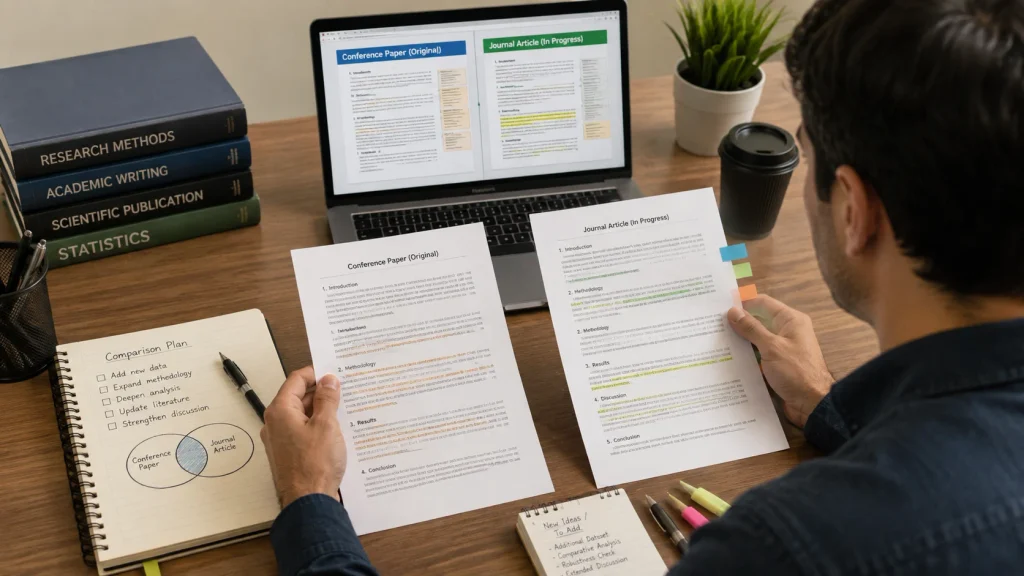
Before rewriting anything, compare the conference paper with your current research. Create two documents. Keep the original conference paper available. Then create a new working manuscript. Now identify what has changed since the conference.
Step 1: Read the Conference Paper Critically
Do not immediately start adding text. First, read the paper as a journal reviewer. Identify its strongest sections. Then identify its weakest sections.
Look for:
- Missing literature
- Limited analysis
- Short methodology
- Weak discussion
- Narrow conclusions
- Unsupported claims
- Missing limitations
- Outdated references
This review gives you a development plan. You can then expand the paper with a clear purpose.
Step 2: Check the Conference Publication Status
This step matters greatly. Determine whether your conference paper was:
- Presented only
- Published as an abstract
- Published as an extended abstract
- Published in conference proceedings
- Published online
- Assigned a DOI
These differences can affect journal submission. A conference presentation usually creates fewer concerns than a published proceedings paper. However, published conference material may require disclosure. Always check the target journal’s policy. Also check the conference publisher’s copyright terms. Do not assume that you can reuse everything without restrictions.
Step 3: Check for Textual Overlap
One of the biggest mistakes involves copying the conference paper into the journal manuscript. The journal version should contain substantial development. Some overlap may remain unavoidable.
For example, your research topic and methodology may require similar descriptions. However, large sections of identical text can create problems. This is particularly important when the conference paper already has a formal publication record. Review the original wording carefully. Then rewrite sections where appropriate. Cite the earlier conference version when the journal requires disclosure.
Step 4: Expand the Research Question
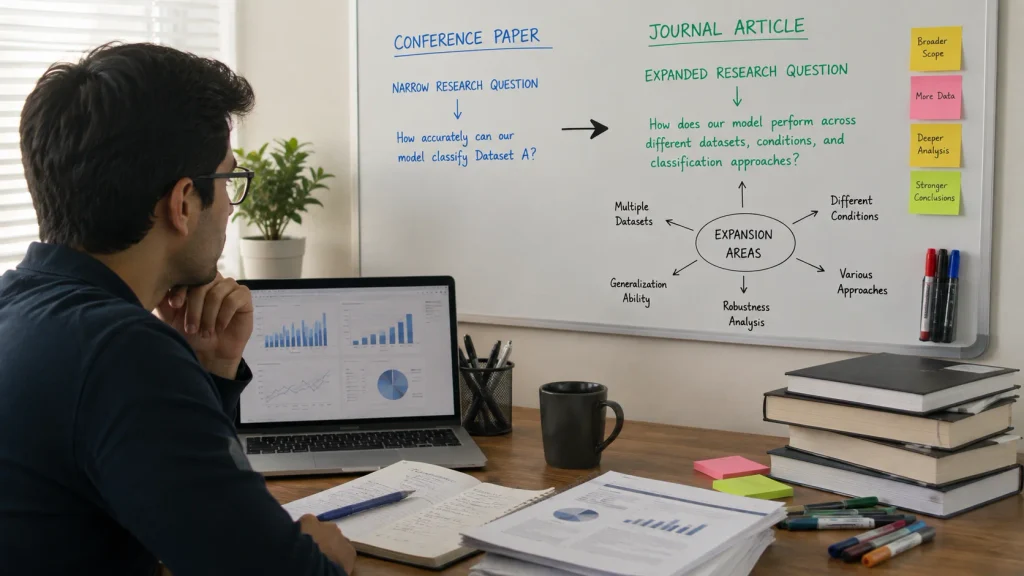
A conference paper may answer a narrow question. The journal version can sometimes address a broader question.
For example, a conference paper might ask:
How accurately can one model classify a specific dataset?
The journal article might investigate:
How does the model perform across different datasets, conditions, and classification approaches?
The second question creates room for deeper research.
However, do not invent a broader question merely to make the paper longer.
The expanded question must remain connected to your actual research.
Step 5: Expand the Literature Review
Conference papers often use limited literature because of space constraints. Journal articles usually require stronger contextualization. Review newer studies published since the conference.
Look for:
- New theories
- New methods
- Competing findings
- New datasets
- Recent debates
- Research gaps
Then integrate the literature into your argument. Do not simply add citations at the end of paragraphs. Explain how the new research affects your study. A strong literature review does more than show you’ve done your reading.
It establishes why your research matters.
Step 6: Update Older References
Research moves quickly in many fields. A conference paper may contain references that were current at the time. Months later, newer research may exist.
- Review your reference list again.
- Remove irrelevant sources when appropriate.
- Add important recent studies.
- Also check whether newer research challenges your conclusions.
If it does, discuss that development honestly. That can strengthen the article.
Step 7: Strengthen the Methodology
A conference paper may describe the methodology briefly. A journal article should usually provide more detail.
Depending on your research, explain:
- Study design
- Research setting
- Participants
- Sampling
- Data sources
- Variables
- Instruments
- Procedures
- Analytical methods
- Software
- Ethical considerations
The reader should understand how the research produced the findings. Avoid assuming that conference attendees already know the background. A journal article should stand independently.
Step 8: Add New Data When Available

New data can provide strong value. Perhaps you collected additional responses after the conference. Maybe you conducted another experiment. Perhaps your dataset now covers a longer period.
You might also have access to another population or research setting. Additional data can strengthen the journal version. However, the new data should answer a clear research need. Do not add data simply to increase the word count.
Every addition should strengthen the research argument.
Step 9: Expand the Analysis
This is often the most important difference.
A conference paper may present the primary findings.
A journal article can go deeper.
For quantitative research, you might add:
- Additional statistical tests
- Robustness analysis
- Subgroup analysis
- Sensitivity analysis
- Comparative models
- Effect sizes
- Confidence intervals
For qualitative research, you might expand:
- Coding
- Theme development
- Comparative interpretation
- Negative cases
- Reflexivity
- Contextual analysis
The appropriate analysis depends on your study.
Do not add methods that your research cannot support.
Step 10: Compare Alternative Methods
A journal article can sometimes provide more methodological depth. Suppose your conference paper used one analytical method. You might compare it with another established approach. This can show why your selected method performs well.
It can also reveal limitations. However, methodological expansion should answer a research question. Do not add unnecessary statistical tests simply because they look impressive. More analysis does not automatically mean better research.
Step 11: Expand the Results Section
The results section should reflect the additional work. If you collected more data, report it clearly. If you conducted additional analysis, explain the findings. Use tables and figures where they improve understanding. Avoid repeating the same result several times.
For example, you can present detailed values in a table. Then use the text to highlight the most important findings. This keeps the article focused.
Step 12: Improve Figures and Tables
Conference presentations often use simplified visuals. Journal articles can provide more detailed figures. Review every figure from the conference version. The same applies to tables. A journal reader should not need your conference slides to interpret the data.
Step 13: Develop the Discussion

The discussion often needs the greatest expansion. A short conference discussion may simply state the main implication. A journal discussion should go further.
Explain:
- What the findings mean
- Why the findings matter
- How they compare with previous studies
- Why results may differ
- What they contribute
- What limitations remain
- What future research should examine
Do not simply repeat your results. Interpret them. This is where the journal article can demonstrate greater scholarly depth.
Step 14: Explain Unexpected Findings
Unexpected findings can become valuable parts of the journal article. Perhaps one group performed differently. Maybe your model produced an unusual result. Perhaps participants reported something that contradicted previous research.
Do not hide these findings. Investigate them. Compare them with existing studies. Offer reasonable explanations. Then acknowledge uncertainty. Unexpected results can create meaningful discussion when handled carefully.
Step 15: Strengthen the Conclusion
A conference paper may end with a short conclusion. The journal version should provide a more developed closing argument. Summarize the central contribution. Then explain its broader significance. Avoid introducing completely new findings. Also avoid exaggerated claims. Your conclusion should remain consistent with your evidence.
Step 16: Add a Clear Limitations Section
Journal reviewers expect researchers to acknowledge limitations. A conference paper may mention them briefly. The journal version can explain them properly.
Consider limitations involving:
- Sample size
- Sampling method
- Data quality
- Study setting
- Measurement tools
- Research design
- Generalizability
- Analytical assumptions
Do not treat limitations as weaknesses that must remain hidden. Transparent limitations can improve credibility.
Step 17: Explain the Journal Article’s New Contribution
This question should guide the entire conversion:
What does the journal article add?
Your answer should be specific.
For example:
The journal article expands the conference study by adding three datasets, conducting comparative analysis, and examining the findings across different demographic groups. That is a meaningful development.
A weak answer would be: The journal article provides more details. Editors need to see substantive value.
What Counts as Meaningful Development?

There is no universal percentage that defines sufficient expansion. Do not rely on claims such as “add 30% new content.” Journals differ. Fields also differ. Instead, consider the scholarly contribution.
A meaningful journal version may include:
- New research questions
- New data
- New analysis
- New theoretical interpretation
- New experiments
- Expanded methodology
- Deeper discussion
The important question remains:
Does the journal article provide substantial value beyond the conference version?
Be Transparent About the Conference Paper
Transparency protects researchers. If the journal requires disclosure, mention the conference version.
You may need to provide:
- Conference title
- Presentation date
- Proceedings information
- DOI
- Previous publication details
Follow the target journal’s policy. Some journals allow conference papers as a foundation. Others impose specific conditions. Never assume that conference publication automatically permits journal republication.
Watch for Self-Plagiarism
Self-plagiarism can occur when researchers reuse substantial portions of their own previous work without proper disclosure. The fact that you wrote the original paper does not remove publication ethics concerns.
Review reused:
- Text
- Figures
- Tables
- Data
- Results
- Methods
Cite your previous work where appropriate. Disclose the relationship between the two publications. Also check copyright restrictions. Your previous publisher may hold rights over published material.
What About the Same Dataset?
Using the same dataset does not automatically make a journal article unacceptable. Researchers can sometimes produce multiple publications from one dataset. However, each article should answer a distinct research question and provide separate scholarly contributions. Avoid dividing one study into many small papers simply to increase publication numbers, as editors may view excessive fragmentation negatively. By utilizing a professional publication strategy service, you can properly define your manuscript’s distinct scope and clearly communicate what the journal article contributes.
Can You Reuse Conference Figures?
Sometimes. However, copyright can become an issue. Check who owns the published figure. If the conference proceedings publisher holds copyright, you may need permission.
You may also need to create a new figure. If you reuse material, follow the relevant attribution rules. Do not assume that being the original author gives you unrestricted reuse rights.
How Can Conference Feedback Improve the Journal Article?
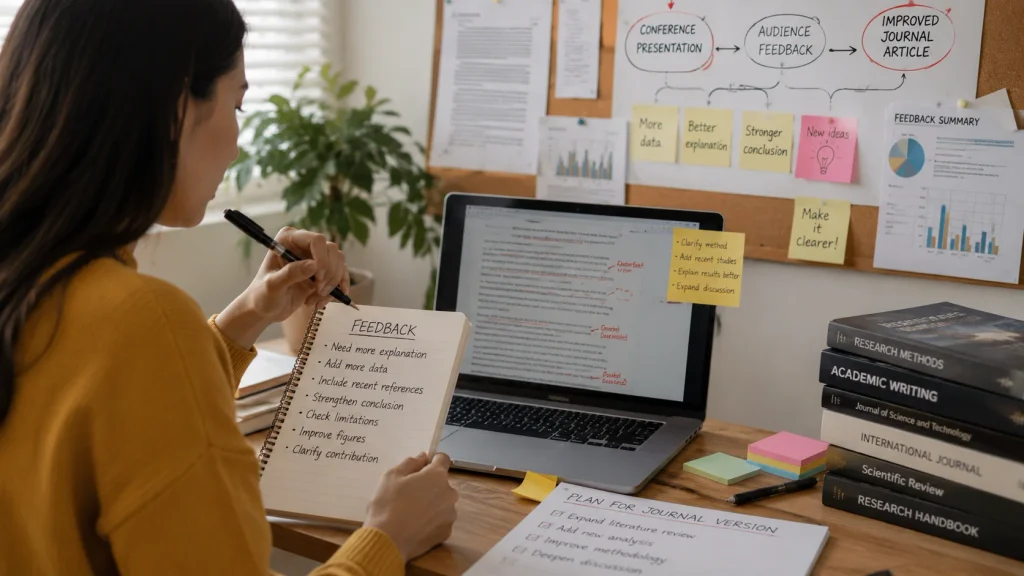
Conference presentations provide something valuable. They expose your research to other researchers. Audience questions can reveal weaknesses.
You may discover that:
- A concept needs clarification.
- A method needs more explanation.
- A figure confuses readers.
- A conclusion seems too broad.
- A literature gap needs stronger support.
Write down this feedback. Then use it during revision. Conference discussion can become a practical roadmap for journal development.
Should You Add More Authors?
Not simply because the paper is becoming a journal article. Authorship should reflect actual scholarly contributions. If another researcher performs substantial new analysis, they may qualify for authorship.
However, adding someone without meaningful contribution creates authorship concerns. Follow the target journal’s authorship policy. Discuss authorship with your research team before submission. Do not wait until the final submission stage.
Choosing the Journal After the Conference
The conference venue does not automatically determine the journal. Your expanded research may now fit a different journal. For example, your conference paper may have focused on a narrow technical result.
The expanded journal paper may now address a broader interdisciplinary question. Therefore, reassess journal scope.
Review:
- Scope
- Audience
- Article type
- Recent publications
- Indexing
- Review process
- Publication model
- Author guidelines
Do not simply submit to the first journal that accepts similar topics.
Prepare the Manuscript for the Target Journal
Once you select a journal, review its requirements.
Check:
- Word limit
- Abstract structure
- Keywords
- Reference style
- Figure requirements
- Table format
- Supplementary files
- Ethical declarations
- Data availability
- Cover letter
The journal version should follow its requirements from the start. This can reduce unnecessary reformatting later.
Use Editing After the Research Development
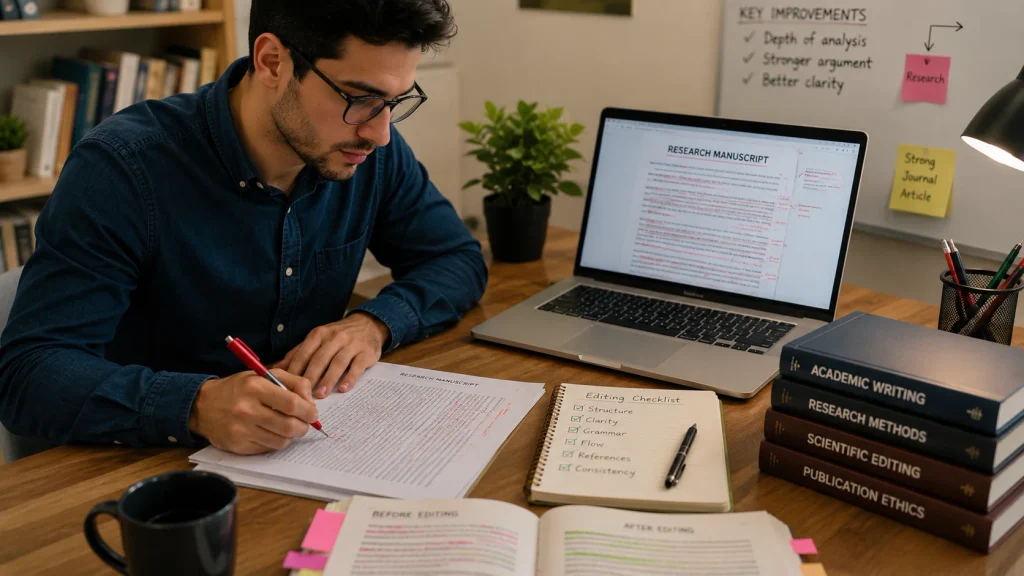
Editing should not replace research development. First, strengthen the content. Then improve the language. This order matters. There is little value in polishing a conference paper that still lacks sufficient analysis.
Once the research is complete, professional editing can improve:
- Clarity
- Grammar
- Terminology
- Structure
- Academic tone
- Logical flow
- Consistency
Fast Publications provides manuscript editing and scientific and technical editing support for researchers preparing manuscripts for publication.
Where Conference Paper to Journal Article Conversion Helps?
Conference Paper to Journal Article Conversion can provide a structured way to develop an earlier research paper into a fuller manuscript.
The process can involve:
- Reviewing the original paper
- Identifying missing research depth
- Mapping additional material
- Restructuring sections
- Expanding literature
- Developing analysis
- Strengthening discussion
- Reviewing figures and tables
- Improving academic language
- Preparing the manuscript for journal requirements
The researcher remains responsible for the underlying research. Professional support should improve presentation and development. It should never invent findings.
A Practical Conversion Workflow
A useful workflow can look like this.
Stage 1: Audit the Conference Paper
Identify its strengths and weaknesses.
Stage 2: Check Publication Policies
Confirm whether the conference version can support a journal submission.
Stage 3: Define the New Contribution
Determine what the journal article adds.
Stage 4: Update the Literature
Add relevant and recent research.
Stage 5: Expand the Methodology
Provide enough detail for independent evaluation.
Stage 6: Develop the Analysis
Add appropriate analysis or new evidence.
Stage 7: Expand the Discussion
Interpret findings in greater depth.
Stage 8: Address Limitations
Explain what the research cannot establish.
Stage 9: Rewrite the Manuscript
Create a coherent journal article.
Stage 10: Check Originality
Review overlap with the conference version.
Stage 11: Edit and Format
Apply professional editing and journal requirements.
Stage 12: Submit Transparently
Disclose the conference version when required.
Common Mistakes Authors Should Avoid During Conversion

Simply Adding More Words
Length does not create scholarly value.
The journal version needs deeper research.
Copying the Conference Paper
Large-scale duplication can create ethical problems.
Ignoring the Original Publisher
Copyright restrictions may affect reuse.
Hiding the Conference Version
Disclosure requirements vary by journal.
Follow them carefully.
Adding Random Analysis
Every analysis should serve the research question.
Repeating the Same Results
A journal article should provide deeper interpretation.
Choosing the Same Journal Automatically
The expanded paper may fit another journal better.
Forgetting New Literature
The research landscape may have changed since the conference.
A Before and After Example
Imagine a conference paper examines machine learning for crop disease detection.
The conference paper includes:
- One dataset
- Three algorithms
- Basic accuracy results
- Short literature review
- Brief discussion
The journal article could expand the study by adding:
- Multiple datasets
- Additional performance measures
- Model comparison
- Error analysis
- Explainability analysis
- Recent literature
- Agricultural implications
- Limitations
- Future research directions
That creates a much stronger article.
The key difference is not word count.
The difference is research depth.
What Reviewers May Ask
Journal reviewers may question the relationship between the conference and journal versions.
They may ask:
What is new in this manuscript?
Be ready to answer.
They may also ask:
How does this work extend the previous publication?
Your manuscript and cover letter should make that clear.
If the journal requires a disclosure statement, provide one.
Transparency makes the editorial process easier.
Conclusion
A conference paper can become the foundation for a strong journal article. However, conversion requires more than expansion. The research needs development. The literature needs updating.
The methodology may need greater detail and the analysis may need additional depth.
The discussion should explain the broader meaning of the findings.
Most importantly, researchers need to handle the relationship between the two publications responsibly.
- Check the conference publication status.
- Review copyright terms.
- Check journal policies.
- Disclose previous versions when required.
- Avoid unnecessary duplication.
- Then focus on creating a manuscript that provides genuine additional value.
Conference Paper to Journal Article Conversion works best when researchers treat the conference paper as a starting point rather than a finished journal manuscript.
At Fast Publications, we help researchers develop manuscripts for stronger journal submission. Our support can include manuscript editing, scientific and technical editing, formatting, journal submission assistance, and publication preparation.
The final article should still represent your research. Professional support can help present that research more clearly and develop the manuscript more effectively. The strongest conference-to-journal conversion does not simply make an old paper longer.
It makes the research more complete, more rigorous, and more useful to the academic community.
Frequently Asked Questions
Can I turn a conference paper into a journal article?
Yes. Researchers often develop conference work into fuller journal articles. However, the journal version should provide meaningful additional value.
Can I use the same research data?
Possibly. The journal article should provide a distinct contribution and follow the target journal’s publication ethics requirements.
Do I need to cite my conference paper?
You may need to cite or disclose it. The exact requirement depends on the journal and the status of the conference publication.
Can I copy my conference paper into the journal article?
You should not simply copy the entire paper. Substantial development usually remains necessary.
How much new content should a journal article contain?
There is no universal percentage. The important issue is whether the journal version provides meaningful scholarly development.
Can I reuse figures from my conference paper?
Sometimes. Check copyright ownership and the journal’s requirements before reusing published figures.
What if my conference paper was only presented?
A presentation without formal publication may create fewer duplication concerns. Still, check the target journal’s policy.
What if the conference paper appeared in published proceedings?
You should review the proceedings publisher’s copyright terms and the target journal’s policy before submitting.
Should I choose a new journal?
Possibly. The expanded research may fit a different journal better than the original conference venue.
Can professional editing help with conversion?
Yes. Editing can improve clarity, structure, terminology, and consistency after the research has been properly developed.