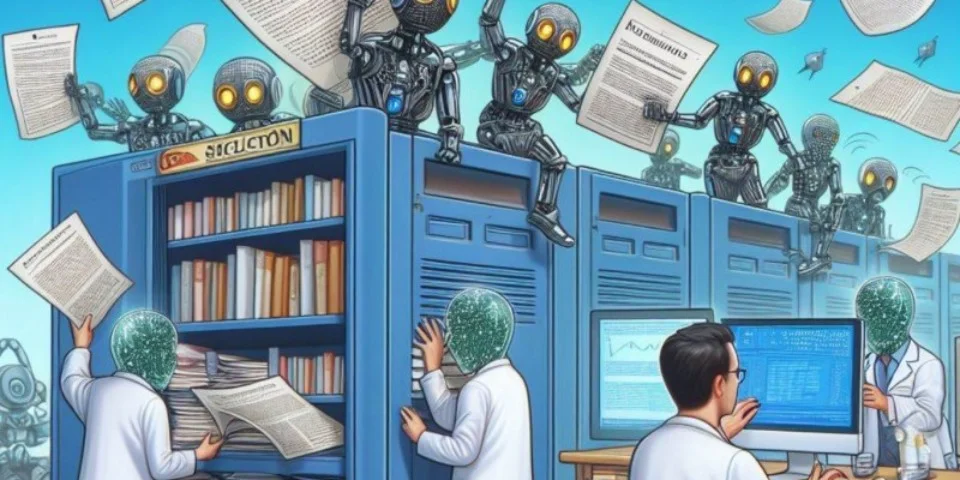
Artificial intelligence is changing how researchers write, organize, analyze, and communicate scientific information. Tools powered by generative AI can help improve language, summarize information, brainstorm ideas, and assist with manuscript preparation. As the use of these tools increases, AI generated research papers have also become an important topic in academic publishing. Journals and publishers are increasingly establishing policies to address AI-assisted manuscripts, authorship, disclosure, originality, and research integrity. For researchers, understanding these expectations is essential before submitting a manuscript. Responsible AI use does not simply mean using or avoiding AI; it means understanding journal requirements, verifying AI-assisted content, protecting research integrity, and maintaining human responsibility for the final paper.
What Are AI-Generated Research Papers?
AI-generated research papers are manuscripts that contain content produced or substantially assisted by artificial intelligence tools. Generative AI can produce text, summarize information, suggest structures, improve language, and perform other tasks that may be useful during research writing.
However, there is an important distinction between AI-assisted manuscripts and papers that are largely generated by AI.
Researchers may use AI for:
Correcting grammar, spelling, and punctuation.
Improving sentence structure and readability.
Brainstorming research ideas or potential outlines.
Summarizing information for initial understanding.
Translating or improving academic language.
Organizing notes and manuscript sections.
Assisting with coding or data-analysis tasks.
Generating preliminary text that is later reviewed and rewritten by the authors.
Why Are Journals Concerned About AI-Generated Manuscripts?
The increasing use of AI in academic publishing creates opportunities but also raises several concerns. Journals need to ensure that published research is accurate, original, ethical, and scientifically reliable.
Accuracy and AI Hallucinations
Generative AI systems can produce convincing but incorrect information. They may generate inaccurate statements, unsupported claims, or references that do not exist. Researchers therefore need to independently verify information generated by AI before including it in a manuscript.
AI output should be treated as assistance rather than an authoritative scientific source.
Plagiarism and Originality
AI-generated text can create concerns about originality and inappropriate reproduction of existing material. Authors remain responsible for ensuring that their manuscripts meet the journal’s requirements for originality and do not contain plagiarized or improperly reused content.
Using an AI tool does not remove an author’s responsibility for checking the originality and sources of the submitted work.
Research Integrity
Research papers must accurately represent the methods, data, results, and conclusions of a study. AI-generated content should never be used to fabricate data, manipulate findings, create false references, or misrepresent research procedures.
Maintaining research integrity is particularly important because errors introduced during AI-assisted writing can affect the reliability of the published scientific record.
Authorship and Accountability
Another major issue concerns authorship. A research paper requires individuals who can take responsibility for its content, respond to questions, and address potential problems after publication.
AI systems cannot independently accept responsibility for the scientific content of a manuscript. Human researchers therefore remain accountable for the final version of the paper.
How Are Journals Responding to AI-Assisted Manuscripts?
Journals and publishers are developing journal AI policies to clarify how researchers can use generative AI during manuscript preparation. Although policies differ between publications, several common principles are emerging.
Journals may:
Require authors to disclose certain uses of generative AI.
Prohibit AI tools from being listed as manuscript authors.
Require authors to verify AI-generated information.
Establish rules for AI-generated text, images, or other content.
Require human authors to remain responsible for the final manuscript.
Apply existing publication ethics and research-integrity requirements to AI-assisted submissions.
Because policies can change as AI technology develops, researchers should check the current author guidelines of their target journal before submitting a manuscript.
Where Can Researchers Use AI in Manuscript Preparation?
AI tools can be useful in several stages of academic writing, but researchers should maintain human oversight throughout the process.
| AI Use | What Researchers Should Consider |
| Grammar and language improvement | Review the revised text to ensure the scientific meaning has not changed. |
| Improving readability | Confirm that technical terminology and intended meaning remain accurate. |
| Brainstorming ideas | Independently evaluate whether suggested ideas are scientifically appropriate. |
| Literature assistance | Verify information against the original scholarly sources. |
| Summarizing research | Compare AI-generated summaries with the original publications. |
| Data analysis assistance | Check calculations, methods, assumptions, and statistical results independently. |
| Generating manuscript text | Carefully review, edit, and verify all generated content. |
| Generating references | Confirm that every citation exists and accurately supports the statement. |
The key principle is that AI should assist the research process rather than replace scientific judgment.
AI Disclosure Requirements for Research Papers
One of the most important developments in AI disclosure in research papers is the expectation that authors may need to inform journals when generative AI has been used in manuscript preparation.
Disclosure requirements vary according to the journal, publisher, type of AI tool, and purpose of its use. For example, a journal may distinguish between basic language correction and generating substantial portions of manuscript content.
Depending on the journal’s instructions, AI-related information may need to be included in an appropriate section such as:
Acknowledgments.
Methods or other designated manuscript sections.
Submission declarations.
Cover letters or submission forms.
Authors should not assume that one disclosure approach applies to every journal. Always consult the specific journal’s latest instructions before submission.
Can AI Tools Be Listed as Authors?
AI tools should not be treated as human authors of research papers. Authorship involves responsibility for the research and manuscript, including the ability to review the work, respond to questions, address errors, and accept accountability.
Researchers using AI writing tools should therefore distinguish between AI assistance and authorship.
Human authors remain responsible for:
The accuracy of the manuscript.
The originality of the work.
The integrity of the research.
The accuracy of citations and references.
Compliance with ethical requirements.
Disclosure of AI use when required.
Approval of the final submitted version.
How Researchers Can Use AI Responsibly
Before submitting an AI-assisted manuscript, authors should:
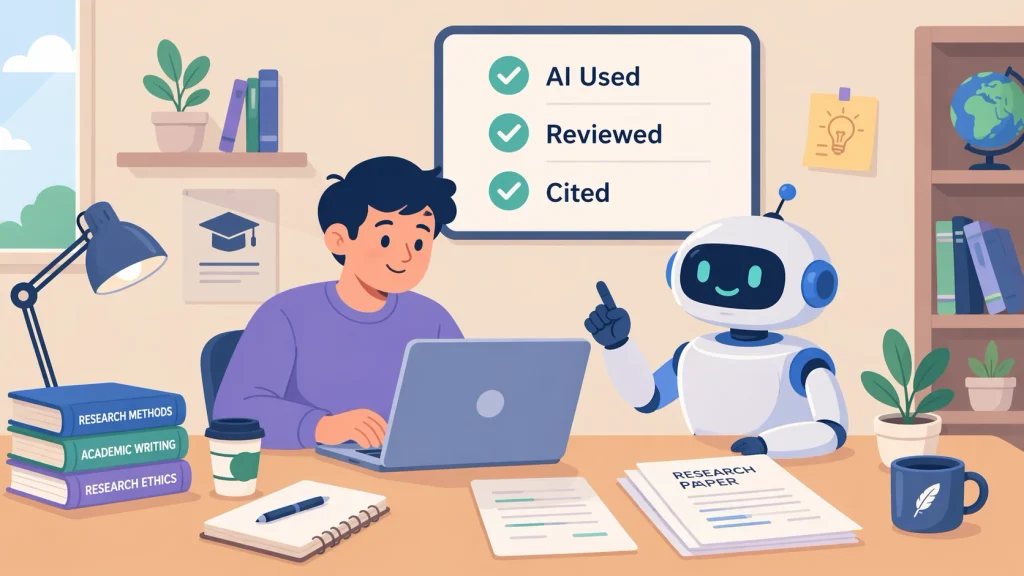
Check the journal’s AI policy before submission.
Disclose AI use when required.
Verify all AI-generated facts, claims, and references.
Never use AI to fabricate data, results, or citations.
Protect confidential and unpublished research information.
Maintain human review and approval of AI-assisted content.
Ensure AI editing does not change scientific meaning.
Check the manuscript for originality and plagiarism.
Follow journal publication ethics and research-integrity requirements.
AI-Generated Research Papers and the Future of Academic Publishing
The role of AI in academic publishing is likely to continue developing as generative AI tools become more sophisticated. Researchers may increasingly use AI for language editing, literature organization, coding, data analysis support, and other aspects of research communication.
At the same time, publishers are likely to continue refining their policies around AI-generated manuscripts, disclosure, authorship, research integrity, and transparency.
The future of academic publishing is therefore unlikely to be based simply on whether researchers use AI. Instead, greater emphasis will be placed on how AI is used, whether its use is disclosed when necessary, and whether researchers maintain responsibility for the scientific content.
Responsible use of AI can potentially make parts of the research-writing process more efficient, but scientific judgment, critical thinking, verification, and accountability remain essential.
Conclusion: Use AI Responsibly When Preparing Research Papers
AI can provide useful support during manuscript preparation, but researchers remain responsible for the scientific quality and integrity of their work. When preparing AI generated research papers, authors should verify AI-assisted content, check references, protect research information, follow journal policies, and disclose AI use when required. Responsible use of AI can support academic writing without replacing human judgment and accountability. Fast Publications can also assist researchers with professional research paper support, manuscript preparation, and publication-related requirements to help prepare work for journal submission.