Research assumptions can be well hidden in a careful peer-reviewer world, and then become a sharp issue. In particular, reviewers of methods-heavy disciplines actively seek these background assumptions. This is a frequent, expensive mistake and mixes assumptions with hypotheses or constraints, evokes instant distrust and can ruin a properly-formed study. Vague assumptions hold up a publication by inviting a methodological challenge. On the other hand, explicit assumptions keep your work safe, enhance your credibility, and the reviewing process.
This guide provides practical examples and a clear guideline to get the section correct. To scholars dedicated to writing a strong, publication-quality work, this rigorous method of assumptions is an essential element of professional Research Article Writing and a strategic move toward quick, successful publication.
What Are Research Assumptions? (Plain Explanation)
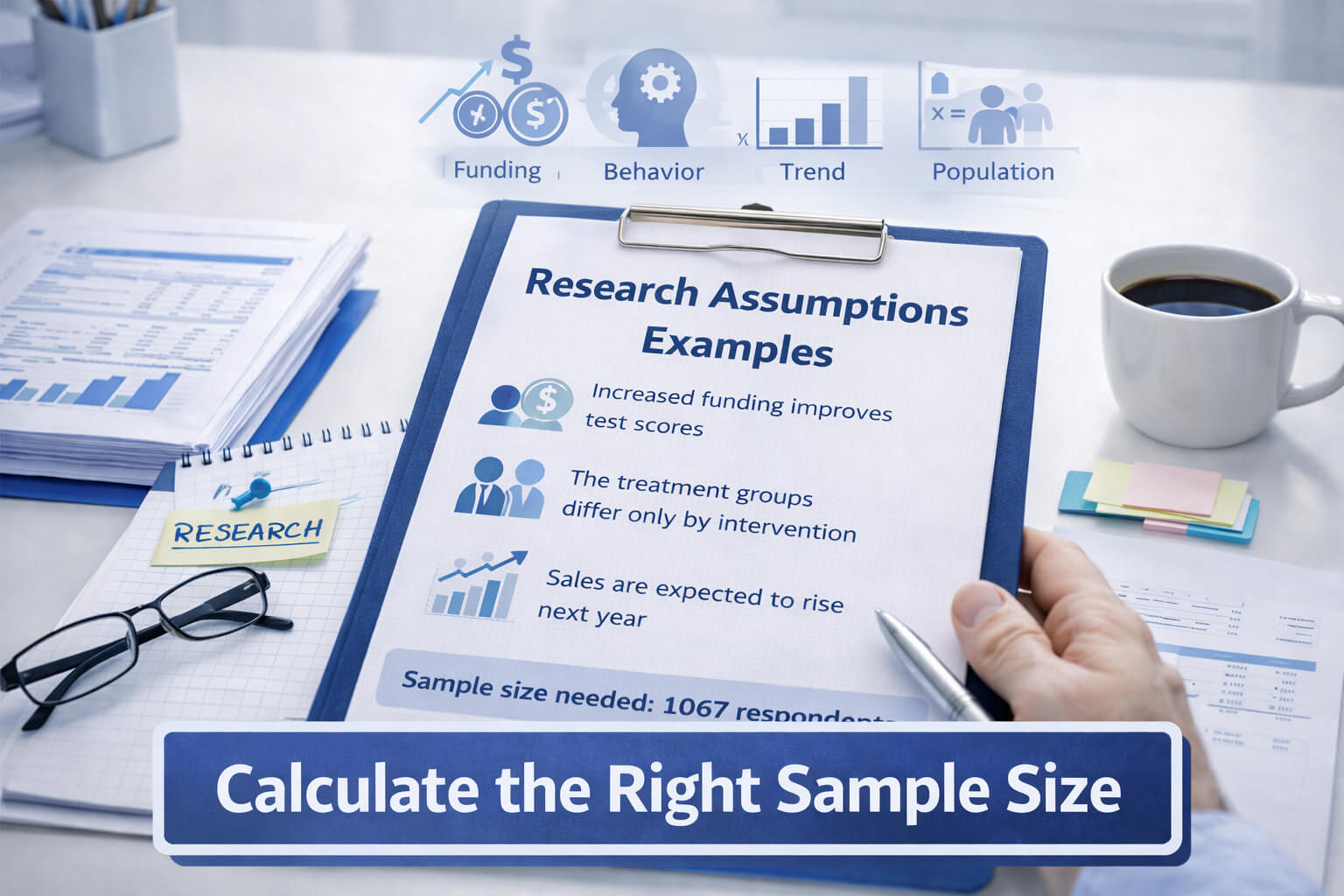
Research assumptions are the unproven assumptions that guide your study design, methodology and analysis. They are the things that you take as true and move on. They exist in every study, whether it is assuming that survey respondents are answering honestly or assuming that a laboratory device measures what it says. This is not to do away with assumptions but rather to make them explicit. Transparency allows those who review you to glimpse the rational basis of your work. Specific assumptions simplify editorial verification, cut back-and-forth, and Fast Publications.
Research Assumptions vs Hypotheses vs Limitations
The error of mixing up these three is a cardinal sin in academic writing. This is the most important difference:
- Research Assumptions: What you hold to be true before you start to do your study. They do not get assessed in the present study. (e.g., “We suppose that participants possess a general level of financial literacy knowledge).
- Hypotheses: What you think will occur. These are theoretical propositions, and can be tested. (e.g., We hypothesise that the intervention will raise financial literacy scores by 15%.)
- Limitations: The study limitations or weaknesses that can guide the interpretation of findings. (e.g., “A limitation is that financial literacy was assessed through self-report, which can be a biased measure.)
Why Journals that Expect the Research Assumptions?
Being clear about what is assumed is a non-negotiable condition of rigorous research, for three important reasons:
- Transparency & Reproducibility: It allows other researchers to know the conditions under which they can replicate your study.
- Methodological Accountability: It will make you explain your methods and models of analysis.
- Avoiding Overinterpretation: It stipulates where your conclusions are sound, and makes it impossible to buy into unjustified assumptions.
With these points, you are pre-empting a significant type of reviewer criticism. This defence framing erases one of the most effective barriers on the way to easy acceptance and enhances your likelihood of Fast Publications.

Research Assumptions (Types and examples)
Methodological Assumptions
- These pertain to instruments and methods of your research.
- Example: “It is presumed that when Cronbach’s alpha is greater than 0.7, the measurement of an intended construct is reliable.
- Examples: An analysis of 200 customers on the assumption that this will cover the larger population.
Theoretical Assumptions
- These include embracing a given system or theoretical definition.
- Example: “The theoretical assumption of this study is that organisational culture can be classified based on the Competing Values Framework.
- Examples: We suppose that employee engagement is a multidimensional construct which consists of cognitive, emotional and behavioural dimensions.
Data‑Related Assumptions
- These relate to the quality and nature of the data that you are using.
- Example: Regression: The assumption is that the data satisfy the conditions of linearity, homoscedasticity, and error independence.
Contextual and Environmental Assumptions
- These establish the consistent situations within which your research is conducted.
- Example: “The findings rely on the assumption of stable macroeconomic conditions at the time of data collection (Q3+ 2023).
Where do we Put Research Assumptions in an Article?
It is most rational and widespread to be placed in the Methods or Methodology section. They include in the descriptions of your design, measures and analysis plan, or listed in a small specific section called Assumptions. By putting them here, you base your methodological decisions on logical grounds prior to the presentation of results. Proper positioning based on journal requirements is a minor yet significant consideration in easing the pressure of reviewing with Fast Publications.
Write Strong Research Assumptions (With Examples)?
- Powerful assumptions are made neutrally, professionally and accurately.
- Weak (Vague / Obvious): The assumption that the survey is good.
- Strong (Specific and Reasoned): The methodological assumption is that the tested XYZ Scale gives an operational conception of perceived stress in an adolescent group.
Typical Assumptions Writers Fall on
- Listing Trap: Writing down things that are so evident that they do not need to be said.
- Limitation Echo: misunderstanding the assumption with the limitation of the research.
- The Testable Error: To give a thing that you in reality test as an assumption (it ought to be a hypothesis).
- The Overload: Extreme list-making that puts the critical few in the graveyard.
There is the Fast Publications Advantage
Achieving this part is efficient. Well-placed, clear assumptions remove some level of uncertainty for the reviewer. They do not have to seek out the logic of your study. It results in quicker methodological acceptance, fewer significant clarifications and cleaner and quicker revisions. Instead, in brief, explicit assumptions, eliminate a typical point of friction and actually benefit Fast Publications.
Conclusion
State research assumptions properly, rather than filler; this is necessary to protect the scope and validity of your work. They show critical and clear thinking and pre-empt criticism from the reviewer. So, you increase the strength of your whole manuscript by devoting time to being specific in this section.