The following is a painful lesson that any researcher will learn too late: a well-written manuscript with some interesting data may be simply dismissed. In many cases, the fatal flaw is not found on the surface but in the root. The experimental and descriptive research design mismatch is a critical choice. It determines how you gather information and whether your article will be considered valuable input by editorial boards. Choosing the wrong design is like selecting the map to a different continent; you will travel, but you will never arrive.
There is no more effective step to Fast Publications than aligning your design with your research question. This strategic clarity is where the service of Professional Journal Submission comes into play, and your methodological framework is sound, valid and represented perfectly to the reviewers.
What is Experimental Research?
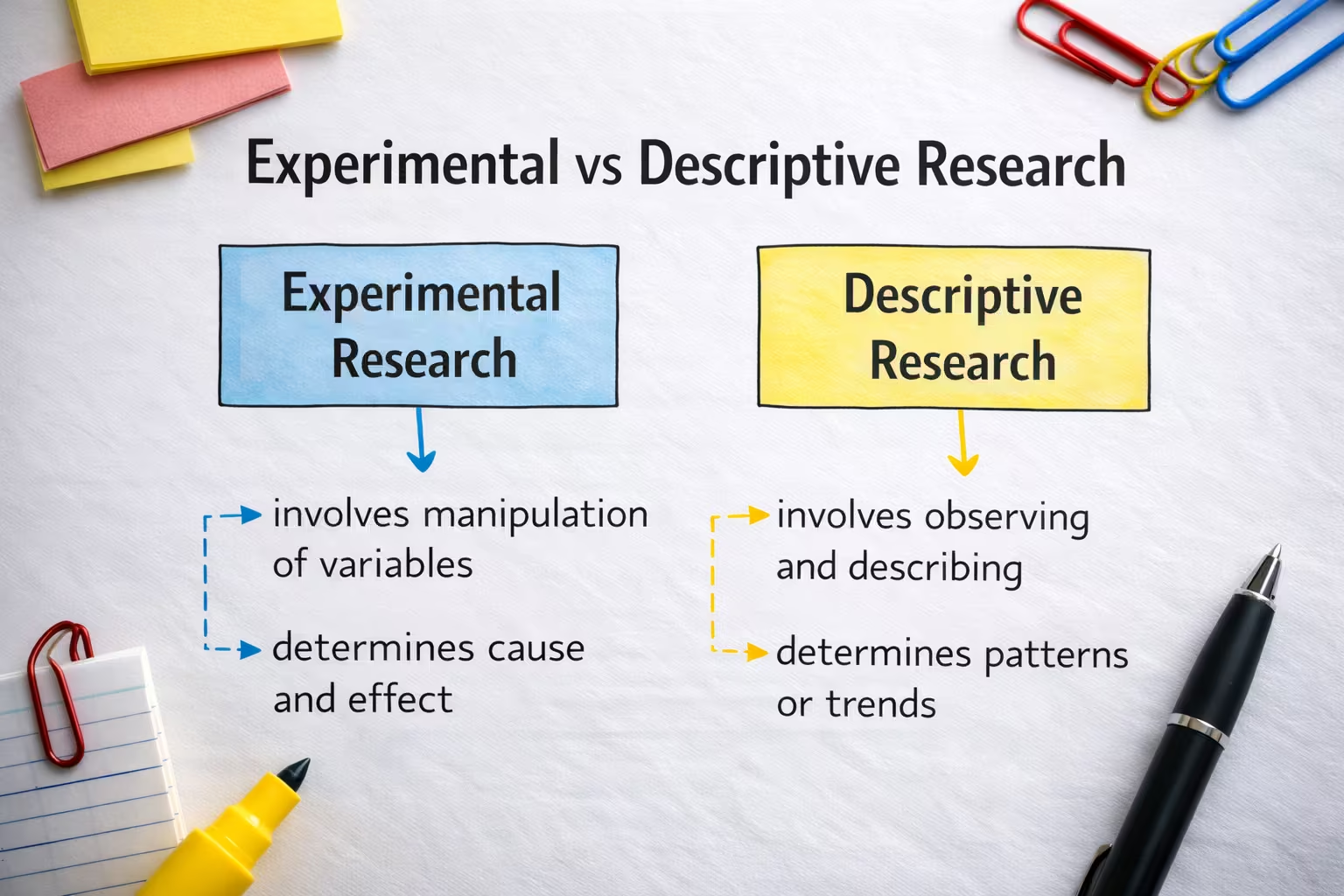
The conclusive way to find out the cause-and-effect relationships is through experimental research. Active control is its main principle. The researcher controls one variable (the independent variable) purposely to measure its impact on another (the dependent variable), and all other possible influences are constant.
- Features: Hypothesis testing, controlled laboratory conditions, randomised control trials (RCTs) and strict protocols. Examples: a new drug versus a placebo (testing), cognitive testing in a laboratory in noisy conditions of various noise ratios.
- Strengths: Has a high internal validity. It makes good, justifiable evidence that is very sought after by journals within the sciences.
What is Descriptive Research?
Descriptive research follows a different direction. It does not manipulate, but instead it watches and records the phenomena as they occur in nature. It aims at creating a realistic, descriptive image of the existing state of affairs, group or trend.
- Typical Methods: Survey, case studies, observational studies, and cross-sectional analyses.
- Purpose: To respond to such questions as what is? Or how prevalent? It finds patterns, states characteristics and investigates relationships without stating causation.
- Strengths: Richest, real-life data; can be more practical and ethical in early inquiry, is best suited to search a complex social or behavioural situation.
The Critical Differences: A Side-by-Side View
To make the right choices, one must know this basic dichotomy. Also, it is a warning to any reviewer to confuse them.
- Primary Goal: Experimental research studies the cause-and-effect (X causes Y?). In descriptive research, characteristics and associations (what is Y like? How are X and Y related? are observed.
- Researcher Role: In an experimental design, you are an active intervener. In descriptive design, you are a witness and a note taker.
- Environment: Experiments are conducted in highly controlled (often artificial) environments to isolate variables. The descriptive studies are taken in the natural, real-world setting to be authentic.
- Data & Analysis: Experimental data results in inferential statistics (ANOVA, t-tests) testing predictions. Descriptive statistics (means, percentages, correlations) and thematic analysis are useful in summarising descriptive data.

When to Adopt Experimental Research?
Use an experimental design when your primary focus is to prove a given causal-and effect hypothesis. This is non‑negotiable in:
- Clinical and Biomedical Sciences: The assessment of the efficacy and safety of an intervention.
- Psychology and Neuroscience: Determining the effect of a stimulus or condition on behaviour or neural activity.
- Engineering and Physical Sciences: Testing under real conditions the performance of a new process, material, or algorithm.
In Which Cases to Select Descriptive Research?
Select a descriptive design when you have to discover, record, or know a phenomenon in its natural form. It is the ideal choice for:
- Social Sciences and Education: Knowing the people, their lives, their work, or their society.
- Public Health and Epidemiology: Determining disease prevalence, health behaviour, or the availability of services in the population.
- Market and Business Research: Understanding product, brand perception or industry standards of preferences.
Recording Your Design: The Secret of the Reviewer Trust
It is as important how you place your writing about your method as it really is. Every design has reporting imperatives.
- In Experimental Papers: Revere reproducibility. Report randomisation of the participants, blinding, specific intervention steps, corresponding measurement items, and the reason behind any statistical test. Such transparency develops trust.
- Justify representativeness and accuracy: for Descriptive Papers. Be clear about your sampling frame and recruitment, give proof of the reliability and validity of your survey tool, and explain your data gathering process step-by-step.
Typical Design Errors that Sabotage Submissions
Causal Overreach: The introduction of causal inferences on the basis of descriptive, correlational statistics.
- Methodological Mash-up: A mixture of the two designs with no strong justification or defined mixed-methods structure.
- The Underpowered Experiment: An experiment in which the sample size is too small to produce a significant effect.
- The Unrepresentative Survey: A survey that makes general conclusions about a sample, but uses an unrepresentative or convenient sample.
Assistant in Journal Submission
The difference between a good manuscript and a fast-track submission is strategic journal submission assistance. It works as a quality control and optimisation layer:
- Design validation Experts determine that you are asking your research question using a powerful and appropriate methodology.
- Specific Journal Matching: You submit your study design to journals that actively seek it and appreciate it, whether it is a strong RCT or a large-scale observational study.
- Formatting and Compliance Audit: Making sure that all details, both abstract structure and reference style, satisfy the audience of a particular journal.
Conclusion
The path to the published article is full of decisions, the most significant decision being the one that can be made based on the type of research the researcher intends to perform, be it an experimental or descriptive design. One is the controlled environment to demonstrate why something occurs, the other is the wide-angle lens to record what is occurring. You have no better option just the right one for your question. With this decision made, carefully and with reporting, you will have created a manuscript that will be respected on first reading. Also, with expert journaling submission, you can use this disciplined approach to replace doubt of publishing with a smooth operation. The result is straightforward: you create with intent, and you post with haste.